 O dino efe? Kwisi
 Ntwa ya didino
 Peiso ya didino
 Metshamekwana ya didino
 Alebamo ya disetikara
 Manane a TOP a didino
 Ngakgamatsa!
E tshetse leng?

E ne e le kgolo go le kae?
E ne e le telele go le kae?
E ne e le kwa godimo go le kae?
kakanyo
Serikornis e ne e le kgolo go le kae fa e bapisiwa le WENA?
Ke dipalo fela mo sebatling sa gago. Ga go sepe se se bolokwang kgotsa se se romelwang gope.
E ne e le bonako go le kae?


Dintlha tse di monate
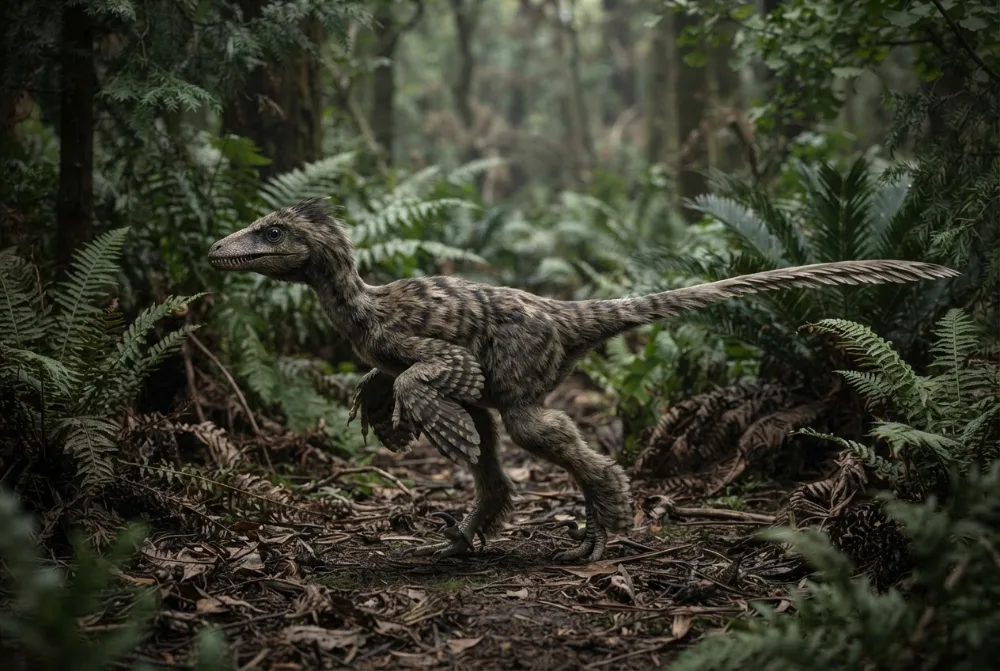
The name Serikornis means 'silken bird' because of its beautiful, feathery coat.1
It had long feathers on its hind legs all the way down to its toes, which is unusual for a ground-dwelling dinosaur.1
The feathers on its arms were symmetrical and didn't have tiny hooks called barbules, so they weren't good for flying.1
Serikornis lived during the Late Jurassic period, about 161 to 155 million years ago.2
Scientists think Serikornis was a ground-dwelling dinosaur that did not climb trees or fly.1
Dipotso tse di botswang thata ka ga Serikornis
?How big was Serikornis?
About 45 cm (1.5 feet) long, about the size of a pheasant.3
?Could Serikornis fly?
No, it could not fly. Its feathers lacked tiny hooks called barbules, so they couldn't hold air for flight.31
?What did Serikornis eat?
It was a meat-eating theropod dinosaur, so it likely ate small animals like insects or lizards.4
Mothubi wa ditlhamane
Tlhamane: Serikornis was a flying dinosaur with four wings.
Boammaaruri: Serikornis had long feathers on its legs and arms, but it could not fly and probably lived on the ground.1
Ya baitseanape ba didino
- Leina la saense
- Serikornis
- Leina le neilwe ke
- Lefèvre et al. 20175
- Setlhopha
- Didino tse di jang nama
- Lelapa / clade
- Paraves5
- Thulaganyo
- Theropoda5
- Bogolo jwa matlapa
- 162 go ya go 155 dimilione tsa dingwaga (Oxfordian)5
- Dibopego tsa matlapa
- Tiaojishan5
- Dinaga
- Tšhaena5
- Direkoto tsa difosili
- 1 mo The Paleobiology Database5
- Go fitlhelwa
- Serikornis was named in 2017 by a team of scientists including Ulysse Lefèvre and Andrea Cau. The only fossil was found in the Tiaojishan Formation of Liaoning, China.15
- Go sa ntse go ganetsanwa
- Scientists are still debating whether Serikornis is a very early bird relative or a more primitive dinosaur, and exactly how its feathers evolved.1
Kwa dintlha di tswang teng
- A new Jurassic theropod from China documents a transitional step in the macrostructure of feathers (pubmed.ncbi.nlm.nih.gov)
- PBDB Taxon (paleobiodb.org)
- New Feathered Dinosaur Had Four Wings but Couldn't Fly | National Geographic (nationalgeographic.com)
- Serikornis (en.wikipedia.org)
- Serikornis in The Paleobiology Database (CC BY 4.0): dingwaga, mafelo, dibopego tsa matlapa, thulaganyo.
Ntlha nngwe le nngwe mo tsebeng eno e na le nomoro e e supang motswedi wa yona. Fa re dirile phoso, maitshwarelo, re barati ba didino, ga re lokwalodikgang lwa saense. Re bolelele kwa [email protected] mme re tla e baakanya.
 Rex o tshwerwe ke tlala! Dino Wiki ke porojeke ya rre e a e diretseng morwawe yo o ratang didino, ke mahala, ga e na dipapatso e bile ga e na dilatedi. Batho ba bagolo ba ka fepa Rex senyamo go thusa gore e nne mo inthaneteng.Fepa Rex
 Allosaurus
 Carnotaurus
 Dilophosaurus
 Giganotosaurus
 Compsognathus
 Paronychodon
 Brachiosaurus
 Diplodocus
 Brontosaurus
 Camarasaurus
 Morosaurus
 Apatosaurus