 O dino efe? Kwisi
 Ntwa ya didino
 Peiso ya didino
 Metshamekwana ya didino
 Alebamo ya disetikara
 Manane a TOP a didino
 Ngakgamatsa!
E tshetse leng?

E ne e le kgolo go le kae?
E ne e le telele go le kae?
E ne e le kwa godimo go le kae?
E ne e le bokete go le kae?
 e ka nna bokete jaaka katse ya mo gae🍌bokete jaaka dibanana di le 29🪑nnye mo e ka tsamayang ka fa tlase ga setulo🏃e ne e ka taboga dimetara di le 100 mo metsotswaneng e le 12 (motho yo o bonako go gaisa o tlhoka 9,6)
Shuvuuia e ne e le kgolo go le kae fa e bapisiwa le WENA?
Ke dipalo fela mo sebatling sa gago. Ga go sepe se se bolokwang kgotsa se se romelwang gope.
E ne e le bonako go le kae?


Dintlha tse di monate
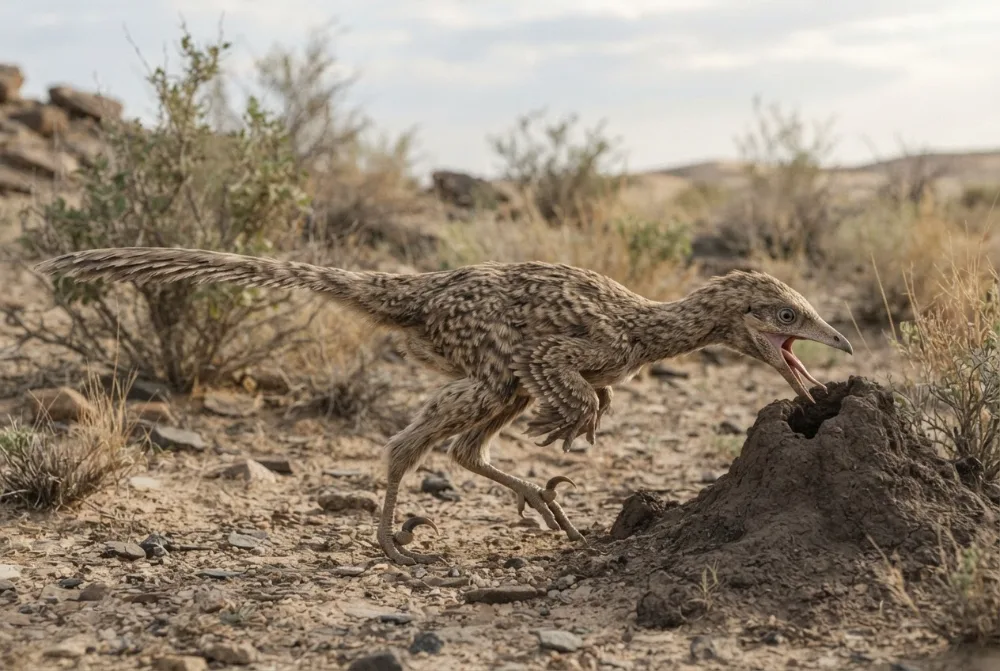
Shuvuuia is known from two beautifully preserved skulls, which are the first skulls ever found for its group, the Alvarezsauridae.2
Its lower jaw was not locked to the skull, so its mouth could open very wide to catch larger prey.1
Shuvuuia lived in the Late Cretaceous period, about 75 to 81 million years ago, in what is now the Gobi Desert of Mongolia.1
Scientists think Shuvuuia may have eaten termites, because its skull and jaw look like those of modern animals that eat insects.1
The name Shuvuuia means 'bird' in Mongolian, because its skull shows features that link it to birds.1
Dipotso tse di botswang thata ka ga Shuvuuia
?How big was Shuvuuia?
Shuvuuia was very small, about 1 metre (3.3 feet) long and weighed around 3.5 kilograms (7.7 pounds). It is one of the smallest known non-avian dinosaurs.4
?Did Shuvuuia have feathers?
Yes, scientists think Shuvuuia had a coat of feathers. Fossils show tiny tube-like structures that contain the same proteins found in modern bird feathers.4
?What did Shuvuuia eat?
Shuvuuia probably ate insects and small animals. It may have used its strong arms to dig into insect nests and its flexible jaw to catch prey like termites or small mammals.41
?Could Shuvuuia see in the dark?
Some scientists think Shuvuuia had excellent night vision and hearing, like an owl, and could hunt in complete darkness. However, a 2025 study disagreed and said its hearing was more like a chicken's.4
Ya baitseanape ba didino
- Leina la saense
- Shuvuuia
- Leina le neilwe ke
- Chiappe et al. 19985
- Setlhopha
- Didino tse di sa tlwaelegang tsa dintsiba
- Lelapa / clade
- Alvarezsauridae5
- Thulaganyo
- Theropoda > Alvarezsauridae5
- Bogolo jwa matlapa
- 84 go ya go 72 dimilione tsa dingwaga (Campanian)5
- Dibopego tsa matlapa
- Djadokhta5
- Dinaga
- Mongolia5
- Direkoto tsa difosili
- 3 mo The Paleobiology Database5
- Go fitlhelwa
- Shuvuuia was named by Luis Chiappe, Mark Norell, and James Clark in 1998. The first fossils were found at Ukhaa Tolgod in Mongolia.25
- Go sa ntse go ganetsanwa
- Scientists are still debating whether Shuvuuia was more closely related to birds or to other dinosaurs like therizinosaurs and oviraptorosaurs.2
Kwa dintlha di tswang teng
- Shuvuuia | Natural History Museum (nhm.ac.uk)
- The skull of a relative of the stem-group bird Mononykus | Nature (nature.com)
- Shuvuuia Fact Sheet - Enchanted Learning (enchantedlearning.com)
- Shuvuuia (en.wikipedia.org)
- Shuvuuia in The Paleobiology Database (CC BY 4.0): dingwaga, mafelo, dibopego tsa matlapa, thulaganyo.
Ntlha nngwe le nngwe mo tsebeng eno e na le nomoro e e supang motswedi wa yona. Fa re dirile phoso, maitshwarelo, re barati ba didino, ga re lokwalodikgang lwa saense. Re bolelele kwa [email protected] mme re tla e baakanya.
 Rex o tshwerwe ke tlala! Dino Wiki ke porojeke ya rre e a e diretseng morwawe yo o ratang didino, ke mahala, ga e na dipapatso e bile ga e na dilatedi. Batho ba bagolo ba ka fepa Rex senyamo go thusa gore e nne mo inthaneteng.Fepa Rex
Tse dingwe tsa setlhopha se le sengwe: Didino tse di sa tlwaelegang tsa dintsiba
 TherizinosaurusDidino tse di sa tlwaelegang tsa dintsiba
 OviraptorDidino tse di sa tlwaelegang tsa dintsiba
 ChirostenotesDidino tse di sa tlwaelegang tsa dintsiba
 CitipesDidino tse di sa tlwaelegang tsa dintsiba
 LeptorhynchosDidino tse di sa tlwaelegang tsa dintsiba
 AvimimusDidino tse di sa tlwaelegang tsa dintsiba
 Tyrannosaurus
 Triceratops
 Velociraptor
 Spinosaurus
 Ankylosaurus
 Parasaurolophus