 O dino efe? Kwisi
 Ntwa ya didino
 Peiso ya didino
 Metshamekwana ya didino
 Alebamo ya disetikara
 Manane a TOP a didino
 Ngakgamatsa!
Tupandactylus
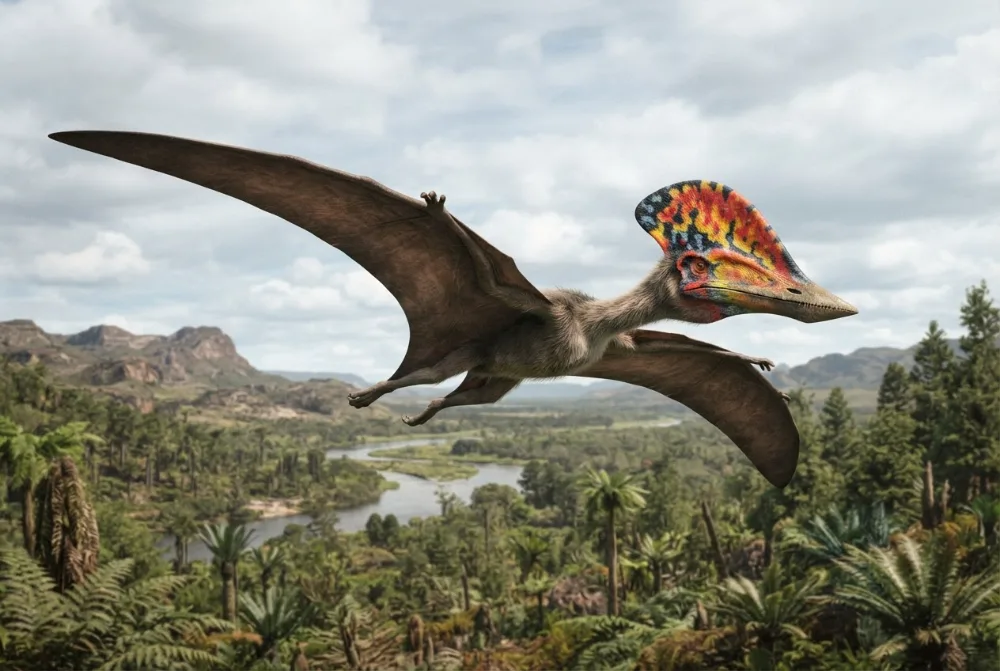
Tupandactylus was a flying reptile with a huge, colorful crest on its head. It lived in what is now Brazil about 115 million years ago and probably ate plants like a flying fruit-lover.12
E tshetse leng?
E ne e le kgolo go le kae?
Diphuka tsa yona di ne di namegile go le kae?
E ne e le kwa godimo go le kae?
 diphuka di le bophara jaaka dibaesekele di le 2 di latelana⚽e ne e ka fofa go kgabaganya lebala lotlhe la kgwele ya dinao mo metsotswaneng e le 6
Tupandactylus e ne e le kgolo go le kae fa e bapisiwa le WENA?
Ke dipalo fela mo sebatling sa gago. Ga go sepe se se bolokwang kgotsa se se romelwang gope.
E ne e le bonako go le kae?


Dintlha tse di monate
Tupandactylus had a giant head crest made of soft tissue and supported by bone spines. In T. imperator the crest was round, while in T. navigans it was tall and vertical.1
Its name comes from Tupã, the Tupi thunder god, and daktylos, the Greek word for finger.1
Tupandactylus probably spent a lot of time on the ground and only flew short distances, because its big crest made flying harder.1
The first fossil of Tupandactylus was a skull and partial lower jaw found in the Crato Formation of Brazil.1
Scientists think Tupandactylus may have been a terrestrial forager, walking around on the ground to find food.1
Tupandactylus had a fifth toe on its foot with a single bone, a feature seen in some other azhdarchoid pterosaurs.3
Dipotso tse di botswang thata ka ga Tupandactylus
?How big was Tupandactylus?
Tupandactylus imperator had a wingspan of about 3 to 4 metres (9.8 to 13.1 feet) and stood about 1.5 metres (4.9 feet) tall to the tip of its crest. The smaller species, T. navigans, had a wingspan of about 2.7 metres (8.9 feet).14
?Why did Tupandactylus have a crest?
Scientists think the crest was used for social or sexual display, like a peacock's tail. It was made of soft tissue and bone, and it was so big it may have made flying harder.14
?What did Tupandactylus eat?
Tupandactylus probably ate plants, like fruit, and may have used its long neck to reach food from higher bushes. Some fossils show plant material near its skull, hinting it was a herbivore.14
?Was Tupandactylus a dinosaur?
No, Tupandactylus was a pterosaur, a flying reptile that is not a dinosaur. It is closely related to dinosaurs but belongs to a separate group.1
?When did Tupandactylus live?
Tupandactylus lived about 112 million years ago, during the Early Cretaceous period, in what is now Brazil.1
Mothubi wa ditlhamane
Tlhamane: Some people think Tupandactylus was a dinosaur.
Boammaaruri: Tupandactylus was a pterosaur, a flying reptile that is not a dinosaur.1
Ya baitseanape ba didino
- Leina la saense
- Tupandactylus
- Leina le neilwe ke
- Kellner and Campos 20075
- Setlhopha
- Digagabi tse di fofang
- Lelapa / clade
- Tapejaridae5
- Thulaganyo
- Pterosauria > Pterodactyloidea5
- Bogolo jwa matlapa
- 120 go ya go 113 dimilione tsa dingwaga (Aptian)5
- Dibopego tsa matlapa
- Crato5
- Dinaga
- Borasele5
- Direkoto tsa difosili
- 3 mo The Paleobiology Database5
- Go fitlhelwa
- Tupandactylus was first described in 1997 as a species of Tapejara by D. A. Campos and Alexander W. A. Kellner. In 2007, Campos and Kellner gave it its own genus name Tupandactylus.1
- Go sa ntse go ganetsanwa
- Scientists are not sure if Tupandactylus imperator and Tupandactylus navigans are two different species or just males and females of the same species.1
Kwa dintlha di tswang teng
- Tupandactylus (en.wikipedia.org)
- PBDB Taxon (paleobiodb.org)
- Redescription of Tupandactylus imperator Campos & Keller, 1997 (Pterosauria, Tapejaridae) based on a new complete specimen from the Crato Formation (Aptian-Albian) of the Araripe Basin, Ceará, Brazil (doi.org)
- Pterosaur had a head crest so tall it may have made it hard to fly | New Scientist (newscientist.com)
- Tupandactylus in The Paleobiology Database (CC BY 4.0): dingwaga, mafelo, dibopego tsa matlapa, thulaganyo.
Ntlha nngwe le nngwe mo tsebeng eno e na le nomoro e e supang motswedi wa yona. Fa re dirile phoso, maitshwarelo, re barati ba didino, ga re lokwalodikgang lwa saense. Re bolelele kwa [email protected] mme re tla e baakanya.
 Rex o tshwerwe ke tlala! Dino Wiki ke porojeke ya rre e a e diretseng morwawe yo o ratang didino, ke mahala, ga e na dipapatso e bile ga e na dilatedi. Batho ba bagolo ba ka fepa Rex senyamo go thusa gore e nne mo inthaneteng.Fepa Rex
 Pteranodon
 Quetzalcoatlus
 Dorygnathus
 Rhamphorhynchus
 Anhanguera
 Pterodactylus
 Stegosaurus
 Iguanodon
 Archaeopteryx
 Giganotosaurus
 Microraptor
 Deinonychus