 O dino efe? Kwisi
 Ntwa ya didino
 Peiso ya didino
 Metshamekwana ya didino
 Alebamo ya disetikara
 Manane a TOP a didino
 Ngakgamatsa!
Ugrunaaluk
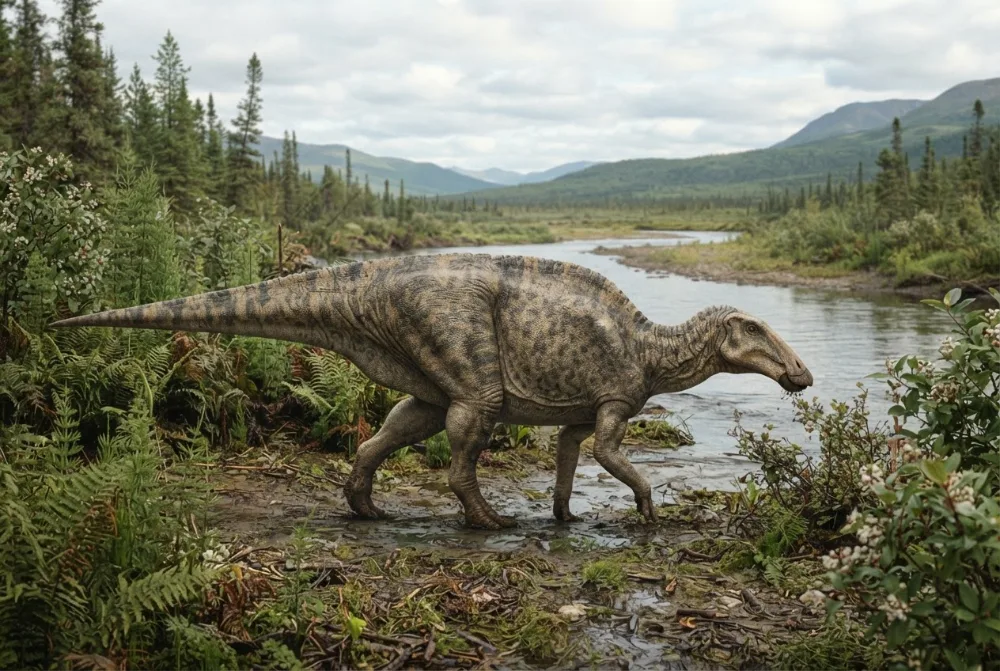
Ugrunaaluk was a duck-billed dinosaur that lived in the ancient Arctic, where it was cold and dark for part of the year. It had a long, flat beak and hundreds of teeth for chewing tough plants. This dinosaur is special because it shows that some dinosaurs could survive in polar regions.51
E tshetse leng?
E ne e le kgolo go le kae?
E ne e le telele go le kae?
E ne e le kwa godimo go le kae?
kakanyo
E ne e le bokete go le kae?
 telele jaaka dikoloi di le 2.5 di emisitswe mo moleng🍌telele jaaka dibanana di le 67 di latelana
 e ka nna bokete jaaka tlou🍉bokete jaaka magapu a le 1100🎒bokete jaaka diphaposiborutelo tse di tletseng bana di le 7🐻❄️bokete jaaka dibere tse ditshweu di le 12🏃e ne e ka taboga dimetara di le 100 mo metsotswaneng e le 17 (motho yo o bonako go gaisa o tlhoka 9,6)
Ugrunaaluk e ne e le kgolo go le kae fa e bapisiwa le WENA?
Ke dipalo fela mo sebatling sa gago. Ga go sepe se se bolokwang kgotsa se se romelwang gope.
E ne e le bonako go le kae?


Dintlha tse di monate
Ugrunaaluk lived in the Arctic about 69 million years ago, when the climate was much cooler than today, with average temperatures around 5 to 6°C.1
Most of the Ugrunaaluk fossils found are from young animals, not fully grown adults. Scientists think a whole herd of juveniles may have died together in a flood.1
Its name comes from the Iñupiaq language of Alaska. Ugruŋnaq means a grazing animal with grinding teeth, and -aluk means old, so Ugrunaaluk is 'ancient grazer'.1
Ugrunaaluk was a close relative of Edmontosaurus, but scientists found enough differences in its skull bones to give it its own name.1
The Liscomb bonebed where Ugrunaaluk was found has thousands of bones, mostly from this dinosaur, along with a few teeth from tyrannosaurs and other small dinosaurs.1
During the time of Ugrunaaluk, the Arctic had polar woodlands with flowering plants in the understory, and the days were dark for months in winter.1
Dipotso tse di botswang thata ka ga Ugrunaaluk
?How big was Ugrunaaluk?
Ugrunaaluk was about 7.6 to 9.1 meters (25 to 30 feet) long and stood about 1.8 to 2.1 meters (6 to 7 feet) tall at the hip.4
?What did Ugrunaaluk eat?
It was a plant-eater, with a flat beak and hundreds of teeth for chewing tough plants. Its jaw had at least 1,000 teeth with coarse surfaces perfect for pulverizing plants.4
?Did Ugrunaaluk live in the Arctic?
Yes, Ugrunaaluk lived in the ancient Arctic, above the Arctic Circle, about 69 million years ago. It endured cold and dark winters, with average temperatures around 5 to 6°C.41
?Was Ugrunaaluk a duck-billed dinosaur?
Yes, Ugrunaaluk belonged to the hadrosaur group of duck-billed dinosaurs. It had a long, flat beak and hundreds of teeth for chewing plants.4
?Why is Ugrunaaluk special?
Ugrunaaluk is special because it shows that some dinosaurs could survive in polar regions. It lived above the Arctic Circle, enduring months of darkness and cold.4
?How many teeth did Ugrunaaluk have?
Ugrunaaluk had at least 1,000 teeth in its jaw, with coarse surfaces perfect for pulverizing plants.4
?When did Ugrunaaluk live?
Ugrunaaluk lived about 69 million years ago, during the Late Cretaceous period, in the ancient Arctic.4
?Is Ugrunaaluk related to Edmontosaurus?
Yes, Ugrunaaluk is closely related to Edmontosaurus, but scientists found enough differences in its skull bones to give it its own name.1
?Where was Ugrunaaluk found?
Ugrunaaluk fossils were found in the Liscomb bonebed in the Prince Creek Formation of northern Alaska, along the Colville River.1
Mothubi wa ditlhamane
Tlhamane: Ugrunaaluk is just a young Edmontosaurus and not a real separate dinosaur.
Boammaaruri: Scientists showed that Ugrunaaluk has unique skull features that make it a distinct species, even when accounting for age differences.1
Ya baitseanape ba didino
- Leina la saense
- Ugrunaaluk
- Leina le neilwe ke
- Mori et al. 20165
- Setlhopha
- Melomo-pidipidi
- Lelapa / clade
- Hadrosauridae5
- Thulaganyo
- Ornithischia > Ornithopoda > Iguanodontia > Hadrosauridae5
- Bogolo jwa matlapa
- 72 go ya go 66 dimilione tsa dingwaga (Maastrichtian)5
- Dibopego tsa matlapa
- Prince Creek5
- Dinaga
- Amerika5
- Direkoto tsa difosili
- 1 mo The Paleobiology Database5
- Go fitlhelwa
- Ugrunaaluk was named in 2016 by Hirotsugu Mori, Patrick Druckenmiller, and Gregory Erickson. The fossils were found in the Liscomb bonebed along the Colville River in northern Alaska.51
- Go sa ntse go ganetsanwa
- Scientists are not sure exactly how big adult Ugrunaaluk grew, because almost all the fossils are from juveniles.1
Kwa dintlha di tswang teng
- Formation (lower Maastrichtian) of northern Alaska (app.pan.pl)
- Edmontosaurus (en.wikipedia.org)
- Edmontosaurus regalis (en.wikipedia.org)
- New Dinosaur Species Probably Endured Snow and Darkness for Months on End | NOVA | PBS (pbs.org)
- Ugrunaaluk in The Paleobiology Database (CC BY 4.0): dingwaga, mafelo, dibopego tsa matlapa, thulaganyo.
Ntlha nngwe le nngwe mo tsebeng eno e na le nomoro e e supang motswedi wa yona. Fa re dirile phoso, maitshwarelo, re barati ba didino, ga re lokwalodikgang lwa saense. Re bolelele kwa [email protected] mme re tla e baakanya.
 Rex o tshwerwe ke tlala! Dino Wiki ke porojeke ya rre e a e diretseng morwawe yo o ratang didino, ke mahala, ga e na dipapatso e bile ga e na dilatedi. Batho ba bagolo ba ka fepa Rex senyamo go thusa gore e nne mo inthaneteng.Fepa Rex
 Parasaurolophus
 Edmontosaurus
 Saurolophus
 Hypacrosaurus
 Corythosaurus
 Kritosaurus
 Tyrannosaurus
 Triceratops
 Velociraptor
 Spinosaurus
 Ankylosaurus
 Pteranodon