 O dino efe? Kwisi
 Ntwa ya didino
 Peiso ya didino
 Metshamekwana ya didino
 Alebamo ya disetikara
 Manane a TOP a didino
 Ngakgamatsa!
Xenoceratops
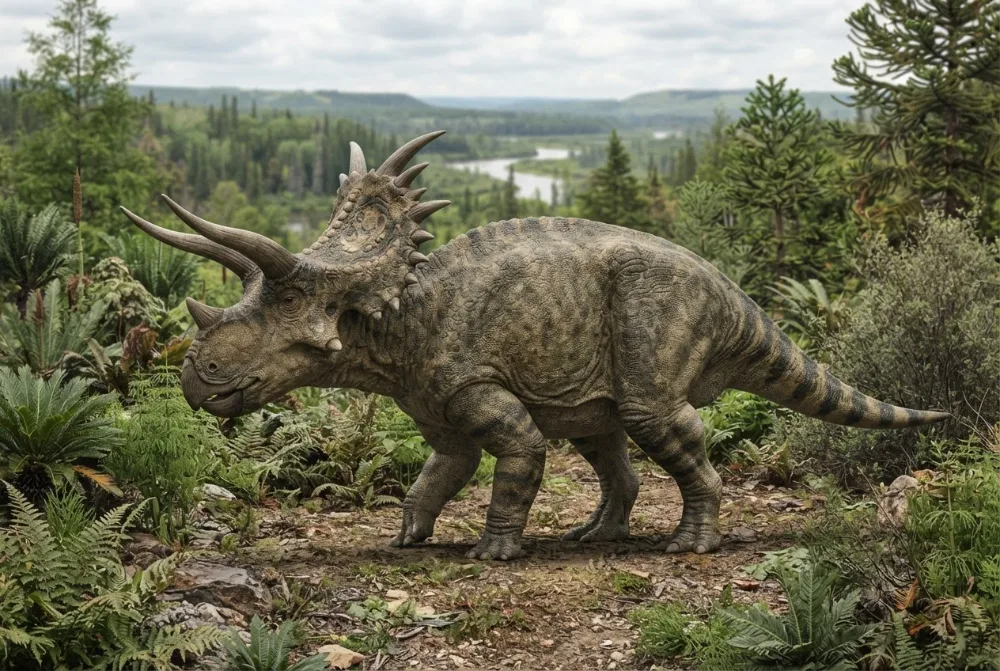
Xenoceratops was an early horned dinosaur that lived in Canada about 78 million years ago. It had a big frill on its head with spikes and two long horns above its eyes, making it look a bit like an alien. It was one of the oldest large horned dinosaurs ever found in North America.1
E tshetse leng?
E ne e le kgolo go le kae?
E ne e le telele go le kae?
E ne e le kwa godimo go le kae?
kakanyo
E ne e le bokete go le kae?

 telele jaaka dintšwa di le 6 go tswa kwa nkong go ya kwa mogatleng🍌telele jaaka dibanana di le 33 di latelanabokete jaaka dintšwa di le 90🍉bokete jaaka magapu a le 360🧸bokete jaaka bana ba kreše ba le 95🎒bokete jaaka bana ba sekolo ba le 56🐻❄️bokete jaaka dibere tse ditshweu di le 4🏃e ne e ka taboga dimetara di le 100 mo metsotswaneng e le 11 (motho yo o bonako go gaisa o tlhoka 9,6)
Xenoceratops e ne e le kgolo go le kae fa e bapisiwa le WENA?
Ke dipalo fela mo sebatling sa gago. Ga go sepe se se bolokwang kgotsa se se romelwang gope.
E ne e le bonako go le kae?


Dintlha tse di monate
Xenoceratops is the oldest known ceratopsid dinosaur from Canada, living about 78 million years ago.2
Its name means 'alien horned face' because it was found in rocks that had not yielded horned dinosaur fossils before.2
The fossils were collected in 1958 by paleontologist Wann Langston Jr., but they sat in a museum for decades before scientists realized they belonged to a new species.1
Unlike Triceratops, Xenoceratops had spikes on its frill in addition to the two long brow horns.1
Xenoceratops was about 6 metres long and weighed more than 2 tons, about as heavy as a large rhinoceros.1
It lived in a subtropical environment in Alberta, which at that time had no snow or frost.1
Scientists think Xenoceratops is the most primitive centrosaurine, meaning it branched off early in the evolution of this group of horned dinosaurs.2
Mothubi wa ditlhamane
Tlhamane: Xenoceratops is just a small, unimportant dinosaur.
Boammaaruri: Xenoceratops is important because it is the oldest known large horned dinosaur from Canada, and it shows that horned dinosaurs evolved their fancy frills and horns very early.1
Ya baitseanape ba didino
- Leina la saense
- Xenoceratops
- Leina le neilwe ke
- Ryan et al. 20123
- Setlhopha
- Didino tse di nang le dinaka
- Lelapa / clade
- Ceratopsidae3
- Thulaganyo
- Ornithischia > Ceratopsia > Ceratopsidae3
- Bogolo jwa matlapa
- 84 go ya go 72 dimilione tsa dingwaga (Campanian)3
- Dibopego tsa matlapa
- Foremost3
- Dinaga
- Khanata3
- Direkoto tsa difosili
- 1 mo The Paleobiology Database3
- Go fitlhelwa
- Xenoceratops was named in 2012 by Michael Ryan and colleagues. The fossils were originally collected in 1958 by Wann Langston Jr. from a bone bed in the Foremost Formation of Alberta, Canada, and later rediscovered in the Canadian Museum of Nature.2
- Go sa ntse go ganetsanwa
- Scientists are not sure exactly what the complete skull of Xenoceratops looked like, because only parts of the frill and horns have been found.2
Kwa dintlha di tswang teng
- Two-Ton "Alien" Horned Dinosaur Found, "Different From Every Other" | National Geographic (nationalgeographic.com)
- cdnsciencepub.com (cdnsciencepub.com)
- Xenoceratops in The Paleobiology Database (CC BY 4.0): dingwaga, mafelo, dibopego tsa matlapa, thulaganyo.
Ntlha nngwe le nngwe mo tsebeng eno e na le nomoro e e supang motswedi wa yona. Fa re dirile phoso, maitshwarelo, re barati ba didino, ga re lokwalodikgang lwa saense. Re bolelele kwa [email protected] mme re tla e baakanya.
 Rex o tshwerwe ke tlala! Dino Wiki ke porojeke ya rre e a e diretseng morwawe yo o ratang didino, ke mahala, ga e na dipapatso e bile ga e na dilatedi. Batho ba bagolo ba ka fepa Rex senyamo go thusa gore e nne mo inthaneteng.Fepa Rex
 Triceratops
 Protoceratops
 Ojoceratops
 Tatankaceratops
 Psittacosaurus
 Centrosaurus
 Tyrannosaurus
 Velociraptor
 Spinosaurus
 Ankylosaurus
 Parasaurolophus
 Pteranodon