 O dino efe? Kwisi
 Ntwa ya didino
 Peiso ya didino
 Metshamekwana ya didino
 Alebamo ya disetikara
 Manane a TOP a didino
 Ngakgamatsa!
Xericeps
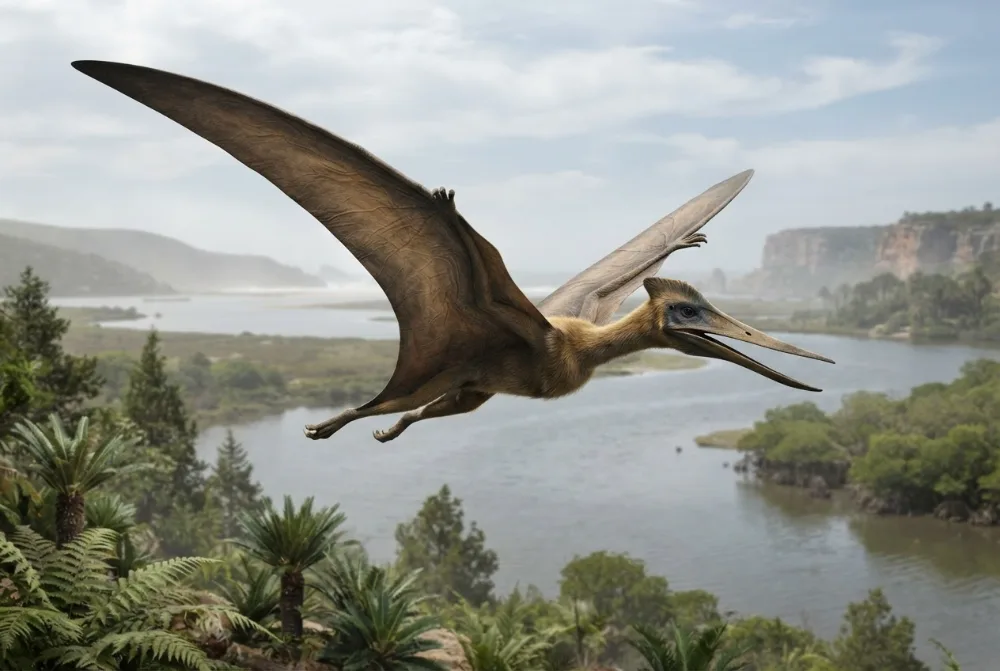
Xericeps was a flying reptile that lived in what is now the Sahara Desert in Morocco. It had a long, toothless beak that curved upward like a pair of tweezers. It probably used its beak to snatch fish from rivers and lakes.13
E tshetse leng?
E ne e le kgolo go le kae?
Diphuka tsa yona di ne di namegile go le kae?
 diphuka di le bophara jaaka dibaesekele di le 4 di latelana⚽e ne e ka fofa go kgabaganya lebala lotlhe la kgwele ya dinao mo metsotswaneng e le 4.6
Xericeps e ne e le kgolo go le kae fa e bapisiwa le WENA?
Ke dipalo fela mo sebatling sa gago. Ga go sepe se se bolokwang kgotsa se se romelwang gope.
E ne e le bonako go le kae?


Dintlha tse di monate
Xericeps is known only from a piece of its lower jaw. No other bones have been found yet.1
Its beak was curved upward, which is why its species name 'curvirostris' means 'curved snout'.1
Xericeps is one of only three named pterosaurs from the Kem Kem beds of Morocco. This area was once a river system full of dinosaurs and flying reptiles.2
Scientists think Xericeps was a medium-sized pterosaur, with a wingspan likely between 3 and 8 metres (10 to 26 feet).1
Dipotso tse di botswang thata ka ga Xericeps
?Is Xericeps a dinosaur?
No, Xericeps is a pterosaur, which is a flying reptile that lived alongside dinosaurs but is not a dinosaur itself.1
?How big was Xericeps?
It was medium sized for a pterosaur, with a wingspan estimated between 3 and 8 metres (10 to 26 feet). Scientists think it was likely closer to the lower end of that range.12
?What did Xericeps eat?
Xericeps probably used its long, curved, toothless beak to snatch fish from rivers and lakes.1
?Why did Xericeps have a curved beak?
Scientists think the upward curve helped it catch food, like fish, from water. The species name 'curvirostris' even means 'curved snout'.1
Ya baitseanape ba didino
- Leina la saense
- Xericeps
- Leina le neilwe ke
- Martill et al. 20183
- Setlhopha
- Digagabi tse di fofang
- Lelapa / clade
- Neoazhdarchia3
- Thulaganyo
- Pterosauria > Pterodactyloidea3
- Bogolo jwa matlapa
- 100 go ya go 94 dimilione tsa dingwaga (Cenomanian)3
- Dinaga
- Moroko3
- Direkoto tsa difosili
- 1 mo The Paleobiology Database3
- Go fitlhelwa
- The only known fossil of Xericeps was found by local mine workers at Aferdou N'Chaft in Morocco. British paleontologist David M. Martill bought it at the mine site in January 2017. He and his colleagues named it in 2018.12
- Go sa ntse go ganetsanwa
- Scientists are not sure exactly which group of pterosaurs Xericeps belongs to. Some studies place it with the alanqids, others with the chaoyangopterids.1
Kwa dintlha di tswang teng
- Xericeps (en.wikipedia.org)
- A new edentulous pterosaur from the Cretaceous Kem Kem beds of south eastern Morocco (sciencedirect.com)
- Xericeps in The Paleobiology Database (CC BY 4.0): dingwaga, mafelo, dibopego tsa matlapa, thulaganyo.
Ntlha nngwe le nngwe mo tsebeng eno e na le nomoro e e supang motswedi wa yona. Fa re dirile phoso, maitshwarelo, re barati ba didino, ga re lokwalodikgang lwa saense. Re bolelele kwa [email protected] mme re tla e baakanya.
 Rex o tshwerwe ke tlala! Dino Wiki ke porojeke ya rre e a e diretseng morwawe yo o ratang didino, ke mahala, ga e na dipapatso e bile ga e na dilatedi. Batho ba bagolo ba ka fepa Rex senyamo go thusa gore e nne mo inthaneteng.Fepa Rex
 Pteranodon
 Quetzalcoatlus
 Dorygnathus
 Rhamphorhynchus
 Anhanguera
 Pterodactylus
 Tyrannosaurus
 Triceratops
 Velociraptor
 Spinosaurus
 Ankylosaurus
 Parasaurolophus