 O dino efe? Kwisi
 Ntwa ya didino
 Peiso ya didino
 Metshamekwana ya didino
 Alebamo ya disetikara
 Manane a TOP a didino
 Ngakgamatsa!
Xiangyunloong
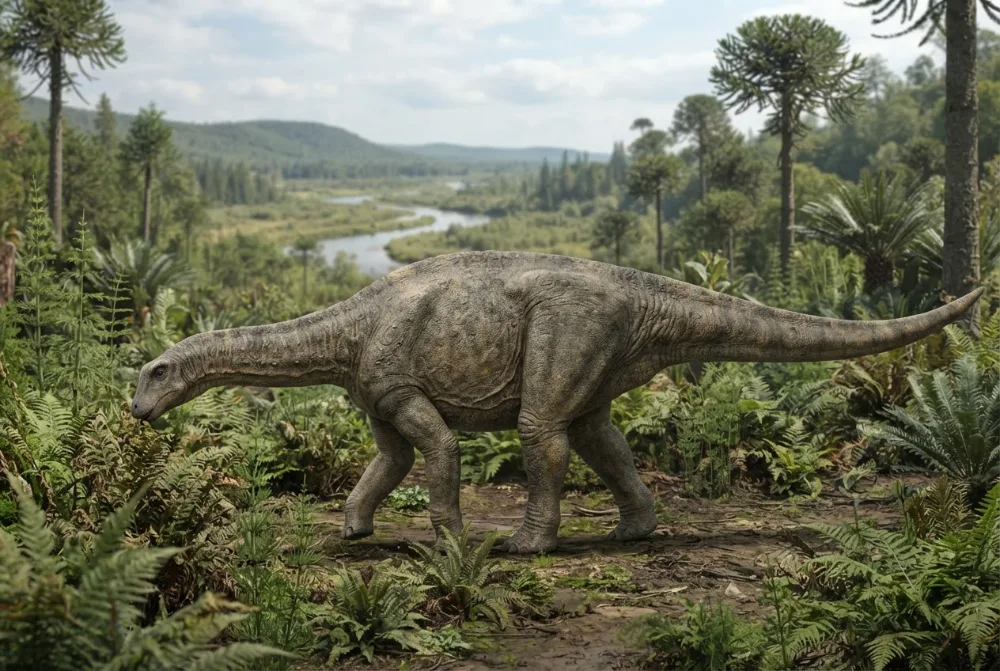
Xiangyunloong was a big, plant-eating dinosaur that lived in what is now China. It had a short neck but a very long and strong tail, which helped it balance its heavy body. This dinosaur shows that not all early long-necked dinosaurs had long necks!2
E tshetse leng?
E ne e le kgolo go le kae?
E ne e le telele go le kae?
E ne e le kwa godimo go le kae?
kakanyo
 telele jaaka dikoloi di le 2 di emisitswe mo moleng🍌telele jaaka dibanana di le 56 di latelana🏃e ne e ka taboga dimetara di le 100 mo metsotswaneng e le 16 (motho yo o bonako go gaisa o tlhoka 9,6)
Xiangyunloong e ne e le kgolo go le kae fa e bapisiwa le WENA?
Ke dipalo fela mo sebatling sa gago. Ga go sepe se se bolokwang kgotsa se se romelwang gope.
E ne e le bonako go le kae?


Dintlha tse di monate
Xiangyunloong had a short neck but a very long and powerful tail, which is unusual for early sauropodomorphs.2
Its tail was so strong that it could act as a counterbalance, helping the dinosaur stand on two legs to feed.2
Scientists think Xiangyunloong represents an early stage of gigantism, or getting very big, in sauropodomorphs.2
Xiangyunloong lived about 200 million years ago during the Early Jurassic period.4
The fossil of Xiangyunloong was found about 200 kilometers west of the famous Lufeng dinosaur fossil sites in China.2
Xiangyunloong is known from a partial skeleton that includes neck bones, back bones, tail bones, and hip bones.2
Dipotso tse di botswang thata ka ga Xiangyunloong
?How big was Xiangyunloong?
About 9 to 10 metres long, making it one of the largest early sauropodomorph dinosaurs from China.12
?Did Xiangyunloong have a long neck?
No, it had a short neck, which is unusual for early sauropodomorphs. Instead, it had a very long and strong tail.23
?What did Xiangyunloong eat?
It was a plant eating dinosaur, like other sauropodomorphs.1
Mothubi wa ditlhamane
Tlhamane: Many people think all early sauropodomorphs had long necks like later sauropods.
Boammaaruri: Xiangyunloong had a short neck and a long, strong tail, showing that early sauropodomorphs had different body shapes.2
Ya baitseanape ba didino
- Leina la saense
- Xiangyunloong
- Leina le neilwe ke
- Hu et al. 20264
- Setlhopha
- Melala-meleele
- Lelapa / clade
- Massopoda4
- Thulaganyo
- Sauropodomorpha4
- Bogolo jwa matlapa
- 201 go ya go 175 dimilione tsa dingwaga (Hettangian / Toarcian)4
- Dibopego tsa matlapa
- Fengjiahe4
- Dinaga
- Tšhaena4
- Direkoto tsa difosili
- 1 mo The Paleobiology Database4
- Go fitlhelwa
- Xiangyunloong was named in 2026 by Hu and colleagues based on a partial skeleton found in the Fengjiahe Formation in Yunnan, China.2
- Go sa ntse go ganetsanwa
- Scientists are still debating whether Xiangyunloong represents a new evolutionary path where the tail, not the neck, became long and strong.2
Kwa dintlha di tswang teng
- Xiangyunloong (en.wikipedia.org)
- A new sauropodomorph dinosaur from the Lower Jurassic Fengjiahe Formation of Dali of Yunnan Province, China | Royal Society Open Science | The Royal Society (royalsocietypublishing.org)
- Early Sauropodomorph Dinosaur Unearthed in China | Sci.News (sci.news)
- Xiangyunloong in The Paleobiology Database (CC BY 4.0): dingwaga, mafelo, dibopego tsa matlapa, thulaganyo.
Ntlha nngwe le nngwe mo tsebeng eno e na le nomoro e e supang motswedi wa yona. Fa re dirile phoso, maitshwarelo, re barati ba didino, ga re lokwalodikgang lwa saense. Re bolelele kwa [email protected] mme re tla e baakanya.
 Rex o tshwerwe ke tlala! Dino Wiki ke porojeke ya rre e a e diretseng morwawe yo o ratang didino, ke mahala, ga e na dipapatso e bile ga e na dilatedi. Batho ba bagolo ba ka fepa Rex senyamo go thusa gore e nne mo inthaneteng.Fepa Rex
 Brachiosaurus
 Diplodocus
 Brontosaurus
 Argentinosaurus
 Camarasaurus
 Morosaurus
 Dilophosaurus
 Stenopterygius
 Dorygnathus
 Scutellosaurus
 Sinosaurus
 Temnodontosaurus