 O dino efe? Kwisi
 Ntwa ya didino
 Peiso ya didino
 Metshamekwana ya didino
 Alebamo ya disetikara
 Manane a TOP a didino
 Ngakgamatsa!
E tshetse leng?

E ne e le kgolo go le kae?
E ne e le telele go le kae?
E ne e le kwa godimo go le kae?
kakanyo
E ne e le bokete go le kae?
 telele jaaka dikatse tsa mo gae di le 2 go tswa kwa nkong go ya kwa mogatleng🍌telele jaaka dibanana di le 6 di latelanae ka nna bokete jaaka katse ya mo gae🍌bokete jaaka dibanana di le 50🪑nnye mo e ka tsamayang ka fa tlase ga setulo🏃e ne e ka taboga dimetara di le 100 mo metsotswaneng e le 15 (motho yo o bonako go gaisa o tlhoka 9,6)
Xuanhuaceratops e ne e le kgolo go le kae fa e bapisiwa le WENA?
Ke dipalo fela mo sebatling sa gago. Ga go sepe se se bolokwang kgotsa se se romelwang gope.
E ne e le bonako go le kae?


Dintlha tse di monate
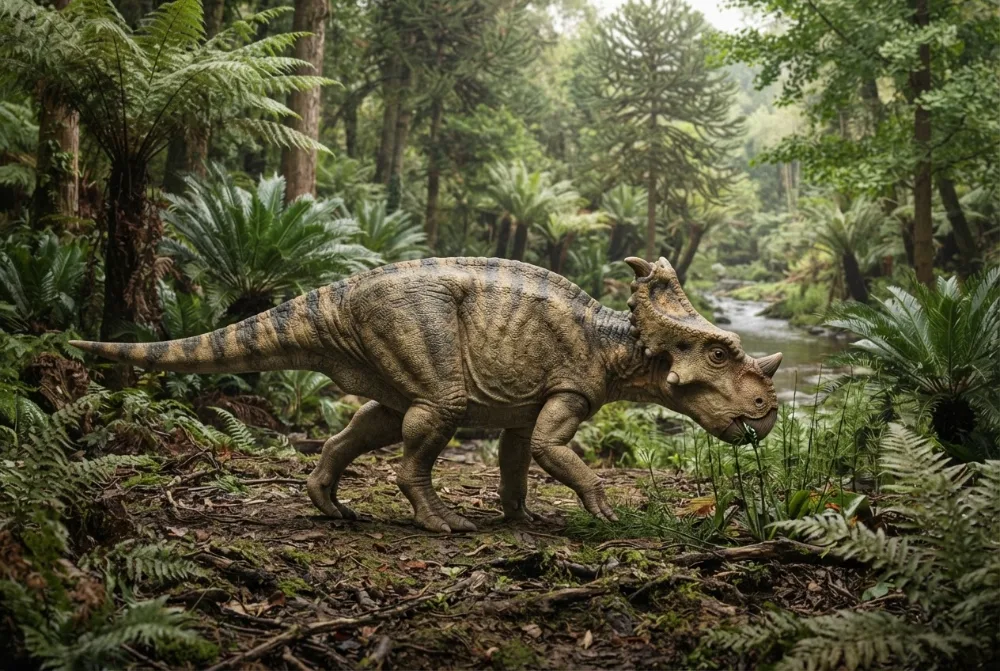
Xuanhuaceratops is one of the earliest known horned dinosaurs, living about 150 million years ago in the Late Jurassic.1
It was very small, only about 1 metre (3.3 feet) long and weighed as much as a large cat, around 6 kilograms (13 pounds).1
The first fossil was discovered in the 1970s by a man named Nie Rongzhen near Yanjiagou, China.1
Xuanhuaceratops had a unique feature: a single tooth in the premaxilla (the front part of the upper jaw).1
Its upper arm bones were very slender, only 4 centimetres (1.6 inches) long, suggesting it could walk on two legs when needed.1
Dipotso tse di botswang thata ka ga Xuanhuaceratops
?What did Xuanhuaceratops eat?
It was an herbivore, meaning it ate plants. It used its beak to nibble on plants.13
?How big was Xuanhuaceratops?
About 1 metre (3.3 feet) long and weighed around 6 kilograms (13 pounds), about the size of a large dog.1
?When did Xuanhuaceratops live?
It lived during the Late Jurassic Period, about 150 to 145 million years ago.1
Ya baitseanape ba didino
- Leina la saense
- Xuanhuaceratops
- Leina le neilwe ke
- Zhao et al. 20063
- Setlhopha
- Didino tse di nang le dinaka
- Lelapa / clade
- Chaoyangsauridae3
- Thulaganyo
- Ornithischia > Ceratopsia3
- Bogolo jwa matlapa
- 152 go ya go 133 dimilione tsa dingwaga (Kimmeridgian / Valanginian)3
- Dibopego tsa matlapa
- Tuchengzi3
- Dinaga
- Tšhaena3
- Direkoto tsa difosili
- 1 mo The Paleobiology Database3
- Go fitlhelwa
- The first fragmentary skeleton was found in the 1970s by Nie Rongzhen near Yanjiagou, China. It was named Xuanhuaceratops niei in 2006 by Zhao Xijin, Cheng Zhengwu, Xu Xing, and Peter J. Makovicky.1
- Go sa ntse go ganetsanwa
- Scientists are not sure exactly how Xuanhuaceratops is related to other early ceratopsians because its fossils are incomplete.2
Kwa dintlha di tswang teng
- Xuanhuaceratops (en.wikipedia.org)
- A New Taxon of Basal Ceratopsian from China and the Early Evolution of Ceratopsia | PLOS One (journals.plos.org)
- Xuanhuaceratops in The Paleobiology Database (CC BY 4.0): dingwaga, mafelo, dibopego tsa matlapa, thulaganyo.
Ntlha nngwe le nngwe mo tsebeng eno e na le nomoro e e supang motswedi wa yona. Fa re dirile phoso, maitshwarelo, re barati ba didino, ga re lokwalodikgang lwa saense. Re bolelele kwa [email protected] mme re tla e baakanya.
 Rex o tshwerwe ke tlala! Dino Wiki ke porojeke ya rre e a e diretseng morwawe yo o ratang didino, ke mahala, ga e na dipapatso e bile ga e na dilatedi. Batho ba bagolo ba ka fepa Rex senyamo go thusa gore e nne mo inthaneteng.Fepa Rex
 Triceratops
 Protoceratops
 Ojoceratops
 Tatankaceratops
 Psittacosaurus
 Centrosaurus
 Stegosaurus
 Iguanodon
 Archaeopteryx
 Giganotosaurus
 Microraptor
 Deinonychus