 Ban dino nga? Kiis
 Xeexu dino
 Rawante dino
 Fo yu ndaw yu dino
 Albomu sitikeer
 Limu TOP yu dino
 Bett ma!
Ajnabia
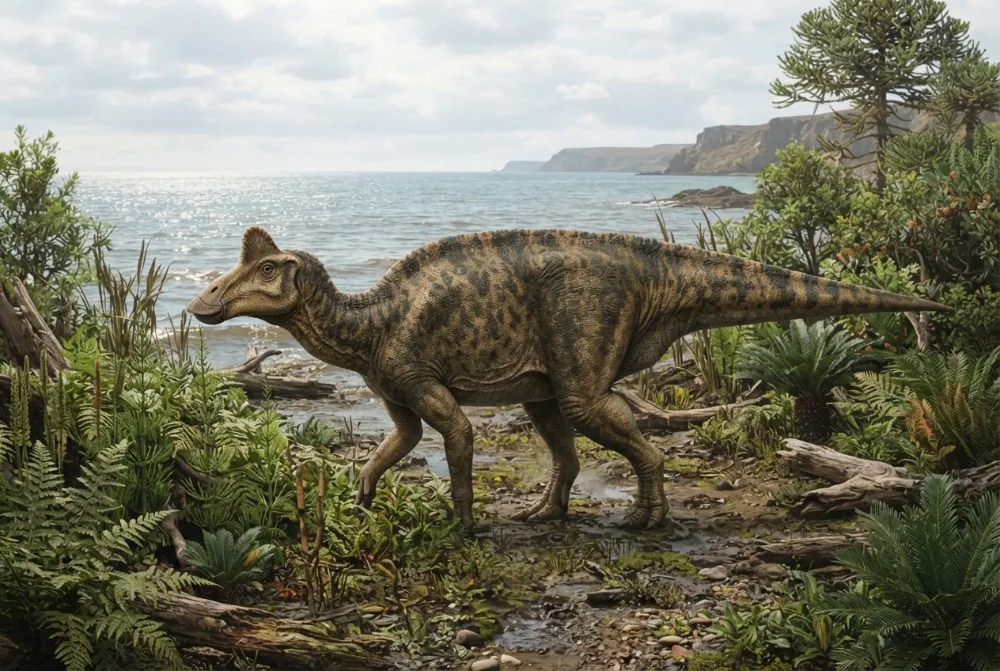
Ajnabia was a small duck-billed dinosaur that lived in Africa at the very end of the Cretaceous. It was a surprise to scientists because duck-billed dinosaurs were not known from Africa before. Ajnabia probably swam or rafted across the sea from Europe to reach its home.2
Kañ la dundoon?
Naka la réyoon?
Naka la guddoon?
Naka la kawewoon?
jortu
Naka la diisoon?
 gudd ni 4 xaj, bakkan ba geen🍌gudd ni 19 banaana yu ñu topp-toppale🍉diis ni 50 xaal🧸diis ni 13 xale yu maternel🎒diis ni 8 xale yu lekkool🏃mënoon na daw 100 meetar ci 8,4 segond (nit ki gën a gaaw dafay soxla 9,6)
Naka la Ajnabia réyoon, bu ñu ko méngalee ak YAW?
Ay kalkil rekk ci sa navigatëer. Dara du ñu denc, dara du ñu yónne fenn.
Naka la gaawoon?


Xibaar yu neex
Ajnabia is a lambeosaurine hadrosaur, a group of duck-billed dinosaurs that often had fancy head crests.2
It was one of the smallest duck-billed dinosaurs, only about 3.5 metres (11 feet) long.2
Ajnabia lived around 68 to 66 million years ago, just before the mass extinction that ended the age of dinosaurs.1
Its fossils were found in phosphate mines, which were once a shallow sea. The bones probably washed in from land.2
Ajnabia is related to European duck-billed dinosaurs, suggesting its ancestors crossed the sea from Europe to Africa.2
Only a few bones of Ajnabia have been found: part of the upper jaw, a piece of the lower jaw, and some teeth.1
Laaj yi ñu gën a laaj ci Ajnabia
?What did Ajnabia eat?
It was a herbivore, eating plants. As a duck-billed dinosaur, it had many teeth for chewing tough vegetation.1
?Did Ajnabia have a crest?
It probably did. Ajnabia was a lambeosaurine hadrosaur, a group known for having fancy head crests, though its fossils don't include the skull top.1
?How did Ajnabia get to Africa?
Scientists think it swam or rafted across the sea from Europe, because Africa was isolated by water at the time.12
?When did Ajnabia live?
About 68 to 66 million years ago, in the very latest Cretaceous, just before the asteroid impact that ended the dinosaurs.1
?Is Ajnabia a dinosaur?
Yes, it is a dinosaur. Specifically, it is a duck-billed dinosaur (hadrosaur) from the group Lambeosaurinae.1
Ngir ñi xam dino lool
- Turu xam-xam
- Ajnabia
- Ku ko tudde
- Longrich et al. 20214
- Kurél
- Gémmiñu kanaar
- Njaboot / klad
- Hadrosauridae4
- Klasifikasiyoŋ
- Ornithischia > Ornithopoda > Iguanodontia > Hadrosauridae4
- Màggaayu doj yi
- 72 ba 66 milyoŋ at (Maastrichtian)4
- Formasiyoŋi doj
- Couche III4
- Réew yi
- Marog4
- Fosil yu ñu gis
- 1 ci The Paleobiology Database4
- Gisees
- Ajnabia was named in 2021 by Longrich and colleagues. The fossils came from phosphate mines in Morocco and were described as a new species of duck-billed dinosaur.3
- Ñu ngi koy werante ba tey
- Scientists are not sure exactly how Ajnabia got to Africa. It may have swum or rafted across the sea from Europe, but the details of this journey are still debated.2
Fa xibaar yi jóge
- Ajnabia (en.wikipedia.org)
- A new small duckbilled dinosaur (Hadrosauridae: Lambeosaurinae) from Morocco and dinosaur diversity in the late Maastrichtian of North Africa | Scientific Reports (nature.com)
- PBDB Taxon (paleobiodb.org)
- Ajnabia in The Paleobiology Database (CC BY 4.0): at, béréb yi, formasiyoŋi doj, klasifikasiyoŋ.
Bépp xibaar ci xët wii am na lim bu wone fa mu jóge. Su nu juumee, baal nu, nun ñu bëgg dino lanu, du ab sërnaalu xam-xam. Wax nu ko ci [email protected] nu defar ko.
 Rex xiif na! Dino Wiki, mbiru ab baay la ngir doomam ju góor ju bëgg dinosoor, ci neen te amul kaamuñaate, amul tracker. Mag ñi mën nañu jox Rex tuuti ñam ngir dimbali ko mu des ci internet.Dundal Rex
 Parasaurolophus
 Edmontosaurus
 Saurolophus
 Hypacrosaurus
 Corythosaurus
 Kritosaurus
 Tyrannosaurus
 Triceratops
 Velociraptor
 Spinosaurus
 Ankylosaurus
 Pteranodon