 Ban dino nga? Kiis
 Xeexu dino
 Rawante dino
 Fo yu ndaw yu dino
 Albomu sitikeer
 Limu TOP yu dino
 Bett ma!
Alexandronectes
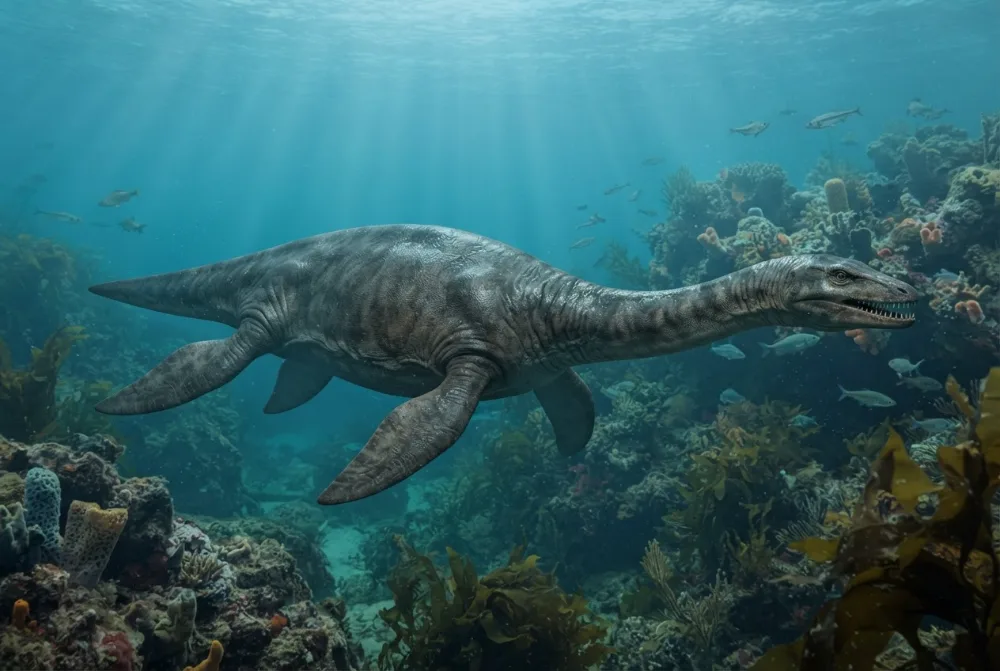
Alexandronectes was a long-necked marine reptile that swam in the seas around New Zealand near the end of the Age of Dinosaurs. It was a type of plesiosaur called an elasmosaurid, with a big head and a short neck compared to other elasmosaurids. It used its strong flippers to paddle through the water and hunt for fish and squid.12
Kañ la dundoon?
Naka la gaawoon?


Xibaar yu neex
Alexandronectes was a type of plesiosaur called an aristonectine, a group known for having unusually large skulls compared to other elasmosaurids.1
Its skull was smaller than those of other aristonectines like Kaiwhekea and Aristonectes, showing that not all members of this group were giants.1
The fossils of Alexandronectes were collected in 1872 by Alexander McKay, a famous New Zealand fossil hunter, but scientists did not name the animal until 2016.13
Its name means 'Alexander's swimmer from Zealandia', referring to the ancient continent that New Zealand is part of.1
Alexandronectes lived about 70 million years ago, during the early Maastrichtian stage of the Late Cretaceous.13
The only known fossils are two pieces of the back of the skull, which were originally thought to belong to two different animals.1
Laaj yi ñu gën a laaj ci Alexandronectes
?Was Alexandronectes a dinosaur?
No, it was a plesiosaur, a type of long-necked marine reptile that lived in the oceans, not a dinosaur.3
?How big was Alexandronectes?
Scientists do not know its exact size because only parts of its skull have been found. Its skull was smaller than those of other aristonectines like Kaiwhekea and Aristonectes.31
?What did Alexandronectes eat?
It likely ate fish and squid, using its strong flippers to paddle through the water and hunt.3
Ngir ñi xam dino lool
- Turu xam-xam
- Alexandronectes
- Ku ko tudde
- Otero et al. 20164
- Kurél
- Plesiyosoor yi
- Njaboot / klad
- Elasmosauridae4
- Klasifikasiyoŋ
- Plesiosauria > Elasmosauridae > Sauropterygia4
- Màggaayu doj yi
- 84 ba 66 milyoŋ at (Campanian / Maastrichtian)4
- Formasiyoŋi doj
- Conway4
- Réew yi
- Nuwel Selaand4
- Fosil yu ñu gis
- 1 ci The Paleobiology Database4
- Gisees
- The fossils were found in 1872 by Alexander McKay near the Waipara River in New Zealand. They were stored at the Canterbury Museum for over 140 years before being studied and named Alexandronectes zealandiensis in 2016.13
- Ñu ngi koy werante ba tey
- Scientists are not sure exactly how big Alexandronectes was, because only a partial skull has been found.1
Fa xibaar yi jóge
- UJVP_A_1054494_O (sedici.unlp.edu.ar)
- PBDB Taxon (paleobiodb.org)
- Alexandronectes (en.wikipedia.org)
- Alexandronectes in The Paleobiology Database (CC BY 4.0): at, béréb yi, formasiyoŋi doj, klasifikasiyoŋ.
Bépp xibaar ci xët wii am na lim bu wone fa mu jóge. Su nu juumee, baal nu, nun ñu bëgg dino lanu, du ab sërnaalu xam-xam. Wax nu ko ci [email protected] nu defar ko.
 Rex xiif na! Dino Wiki, mbiru ab baay la ngir doomam ju góor ju bëgg dinosoor, ci neen te amul kaamuñaate, amul tracker. Mag ñi mën nañu jox Rex tuuti ñam ngir dimbali ko mu des ci internet.Dundal Rex
 Elasmosaurus
 Pliosaurus
 Plesiosaurus
 Cimoliasaurus
 Colymbosaurus
 Trinacromerum
 Tyrannosaurus
 Triceratops
 Velociraptor
 Spinosaurus
 Ankylosaurus
 Parasaurolophus