 Ban dino nga? Kiis
 Xeexu dino
 Rawante dino
 Fo yu ndaw yu dino
 Albomu sitikeer
 Limu TOP yu dino
 Bett ma!
Amargatitanis
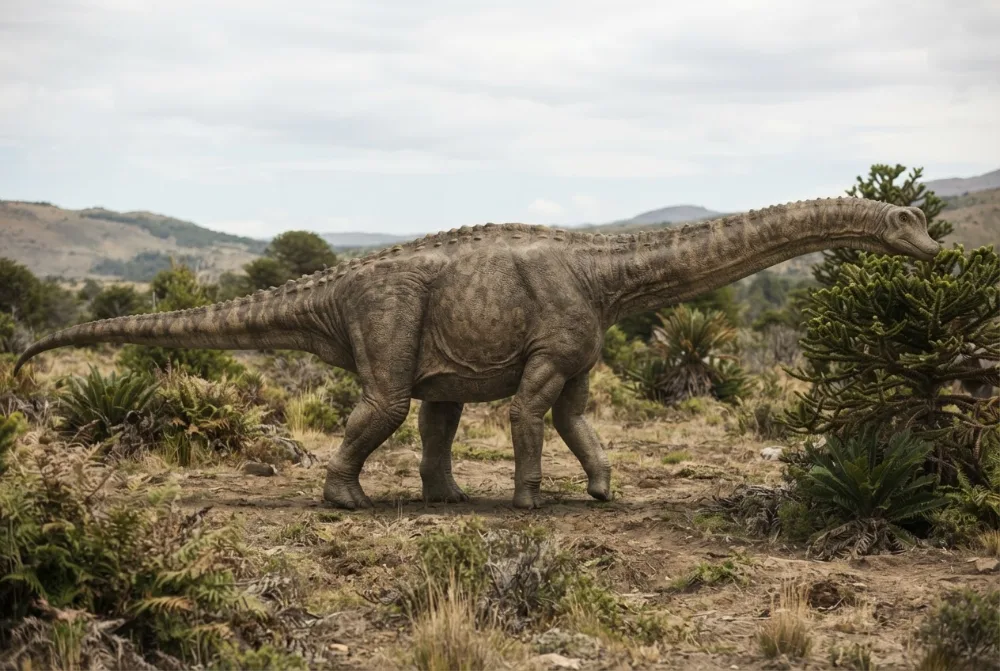
Amargatitanis was a long-necked plant-eater that lived in what is now Argentina. It was a sauropod, but not one of the biggest, it was about as long as a school bus. Its fossils were found near a place called La Amarga, which means 'the bitter one' in Spanish.1
Kañ la dundoon?
Naka la réyoon?
Naka la guddoon?
Naka la kawewoon?
jortu
Naka la diisoon?
 gudd ni 2,5 oto yu ñu taxawal ci benn rëdd🍌gudd ni 67 banaana yu ñu topp-toppale
 diis ni 180 xaj🍉diis ni 700 xaal🎒diis ni 4 klaas yu mat yu xale yu lekkool🐻❄️diis ni 8 uurs yu weex🏃mënoon na daw 100 meetar ci 17 segond (nit ki gën a gaaw dafay soxla 9,6)
Naka la Amargatitanis réyoon, bu ñu ko méngalee ak YAW?
Ay kalkil rekk ci sa navigatëer. Dara du ñu denc, dara du ñu yónne fenn.
Naka la gaawoon?


Xibaar yu neex
Amargatitanis was first thought to be a titanosaur, but later scientists realized it was a dicraeosaurid, a group of sauropods with short necks and tall spines on their vertebrae.1
The only known skeleton of Amargatitanis is incomplete: just a partial hind leg, a hip bone, and two vertebrae. That makes it hard for scientists to know exactly what it looked like.1
Amargatitanis lived about 129 to 123 million years ago, during the Early Cretaceous period.1
The fossils were collected by famous paleontologist José Bonaparte in 1983, but the dinosaur wasn't named until 2007 by Sebastián Apesteguía.1
Amargatitanis shared its home with other sauropods like Amargasaurus and Zapalasaurus. They probably ate different plants to avoid competing for food.1
Like other dicraeosaurids, Amargatitanis had a long tail and strong legs. Its neck was shorter than many other sauropods, so it probably fed at heights up to about 2.7 metres (8.9 feet).1
Laaj yi ñu gën a laaj ci Amargatitanis
?How big was Amargatitanis?
About 12 metres (39.7 feet) long and weighed around 3.5 metric tons (3.9 short tons), according to one estimate. Another study gave a higher weight of about 11.4 metric tons (12.6 short tons).1
?What did Amargatitanis eat?
It was a plant-eater, or herbivore. It probably ate low-growing plants because its neck was shorter than many other sauropods.13
?When did Amargatitanis live?
It lived about 129 to 123 million years ago, during the Early Cretaceous period.1
Ngir ñi xam dino lool
- Turu xam-xam
- Amargatitanis
- Ku ko tudde
- Apesteguía 20073
- Kurél
- Baat yu gudd
- Njaboot / klad
- Dicraeosauridae3
- Klasifikasiyoŋ
- Sauropodomorpha > Sauropoda > Diplodocoidea3
- Màggaayu doj yi
- 126 ba 121 milyoŋ at (Barremian)3
- Formasiyoŋi doj
- La Amarga3
- Réew yi
- Arsantin3
- Fosil yu ñu gis
- 1 ci The Paleobiology Database3
- Gisees
- Amargatitanis was named by Argentine paleontologist Sebastián Apesteguía in 2007. The fossils were found in 1983 by a team led by José Bonaparte in the La Amarga Formation of Argentina.1
- Ñu ngi koy werante ba tey
- Scientists are not sure whether Amargatitanis is a valid genus or a nomen dubium (doubtful name), because the fossils are so few and fragmentary.2
Fa xibaar yi jóge
- Amargatitanis (en.wikipedia.org)
- PBDB Taxon (paleobiodb.org)
- Amargatitanis in The Paleobiology Database (CC BY 4.0): at, béréb yi, formasiyoŋi doj, klasifikasiyoŋ.
Bépp xibaar ci xët wii am na lim bu wone fa mu jóge. Su nu juumee, baal nu, nun ñu bëgg dino lanu, du ab sërnaalu xam-xam. Wax nu ko ci [email protected] nu defar ko.
 Rex xiif na! Dino Wiki, mbiru ab baay la ngir doomam ju góor ju bëgg dinosoor, ci neen te amul kaamuñaate, amul tracker. Mag ñi mën nañu jox Rex tuuti ñam ngir dimbali ko mu des ci internet.Dundal Rex
 Brachiosaurus
 Diplodocus
 Brontosaurus
 Argentinosaurus
 Camarasaurus
 Morosaurus
 Stegosaurus
 Iguanodon
 Archaeopteryx
 Giganotosaurus
 Microraptor
 Deinonychus