 Ban dino nga? Kiis
 Xeexu dino
 Rawante dino
 Fo yu ndaw yu dino
 Albomu sitikeer
 Limu TOP yu dino
 Bett ma!
Kañ la dundoon?

Naka la réyoon?
Naka la guddoon?
Naka la kawewoon?
Naka la diisoon?
 gudd ni 2,5 oto yu ñu taxawal ci benn rëdd🍌gudd ni 61 banaana yu ñu topp-toppale
 lu tollu ci diisaayu ñey🍉diis ni 1000 xaal🎒diis ni 6 klaas yu mat yu xale yu lekkool🐻❄️diis ni 11 uurs yu weex🏃mënoon na daw 100 meetar ci 15 segond (nit ki gën a gaaw dafay soxla 9,6)
Naka la Iguanodon réyoon, bu ñu ko méngalee ak YAW?
Ay kalkil rekk ci sa navigatëer. Dara du ñu denc, dara du ñu yónne fenn.
Naka la gaawoon?


Xibaar yu neex
Iguanodon was named in 1825 by Gideon Mantell after he found teeth that looked like iguana teeth.1
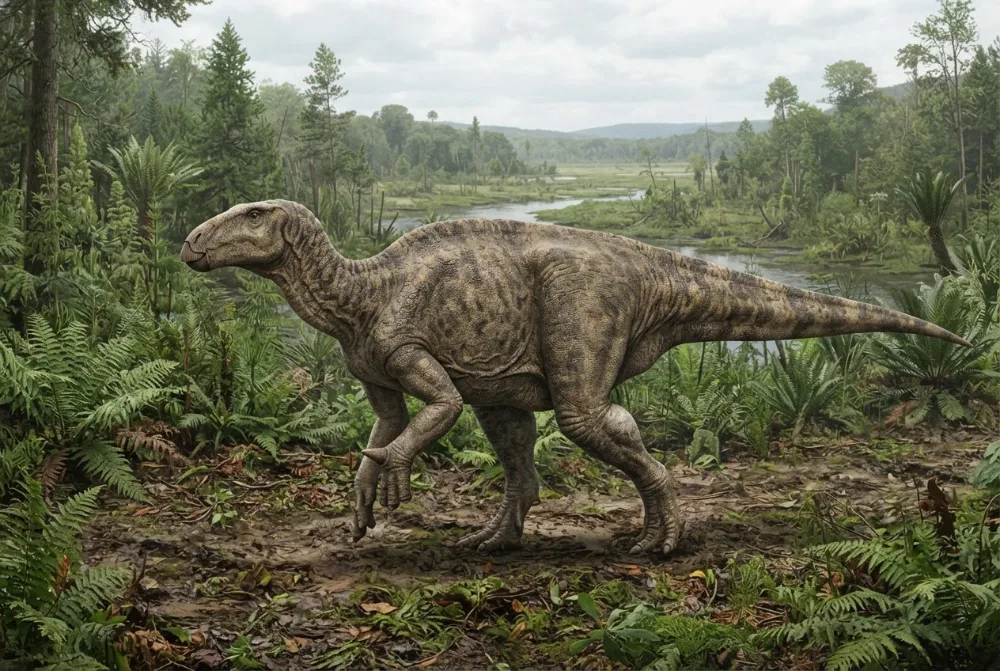
Its thumb had a big, sharp spike that scientists think was used for defense against predators.1
Iguanodon had a flexible little finger that could grasp objects, unlike its other fingers which were more like hooves.1
When Iguanodon closed its mouth, the bones in its upper jaw would bow out, making the teeth grind against each other like a chewing motion.1
The front of Iguanodon's mouth had no teeth, just a bony beak covered with a hard material for cropping plants.1
Iguanodon could reach food from ground level up to 4 to 5 metres (13 to 16 feet) high, so it ate both low plants and tree leaves.1
In 1878, many complete Iguanodon skeletons were found in a coal mine in Bernissart, Belgium, which helped scientists understand the dinosaur much better.1
Laaj yi ñu gën a laaj ci Iguanodon
?How big was Iguanodon?
Iguanodon was about 9 to 11 metres (30 to 36 feet) long and weighed around 4.5 metric tons (5 short tons).1
?What did Iguanodon eat?
Iguanodon was a plant-eater. It used its beak to snip leaves and its cheek teeth to grind tough plants like cycads.34
?Did Iguanodon have a thumb spike?
Yes, Iguanodon had a large, sharp spike on each thumb. It may have been used for defense or for breaking into fruits and seeds.35
?Could Iguanodon walk on two legs?
Yes, Iguanodon could walk on two legs or on all fours. It was one of the few dinosaurs that could do both.34
?When did Iguanodon live?
Iguanodon lived during the Early Cretaceous period, about 126 to 122 million years ago.1
?Who discovered Iguanodon?
Iguanodon was named by Gideon Mantell in 1825 after teeth were found in Sussex, England. His wife Mary Ann Mantell is often credited with finding the first teeth.51
?Was Iguanodon a dinosaur?
Yes, Iguanodon was a dinosaur. It was one of the first dinosaurs ever named, after Megalosaurus.1
?How fast could Iguanodon run?
Up to about 24 km/h (15 mph) on two legs, about as fast as a grown-up riding a bike. Most of the time it walked much slower.4
Ku tas léeb yu dul dëgg
Léeb: Iguanodon was a slow, clumsy dinosaur that always walked on four legs.
Dëgg: Iguanodon could walk on two legs or all fours, and it was probably quite agile for its size.2
Ngir ñi xam dino lool
- Turu xam-xam
- Iguanodon
- Ku ko tudde
- Mantell 18256
- Kurél
- Dino yu lekk gàncax te am gémmiñu picc
- Njaboot / klad
- Ankylopollexia6
- Klasifikasiyoŋ
- Ornithischia > Ornithopoda > Iguanodontia6
- Màggaayu doj yi
- 155 ba 66 milyoŋ at (Kimmeridgian / Maastrichtian)6
- Formasiyoŋi doj
- Arcillas de Morella, Weald Clay, Wessex6
- Réew yi
- Angalteer, Españ, Almaañ, Faraas, Portigaal, Belsik6
- Fosil yu ñu gis
- 133 ci The Paleobiology Database6
- Ñu ngi koy wooye itam
- Heterosaurus, Iguanosaurus, Struthopus, Therosaurus (tur yu njëkk yi, léegi ñu ngi leen jàppe ni benn rab rekk)6
- Gisees
- Iguanodon was first named by Gideon Mantell in 1825 based on fossil teeth found in Sussex, England. Later, in 1878, many complete skeletons were discovered in a Belgian coal mine and studied by Louis Dollo.1
- Ñu ngi koy werante ba tey
- Scientists still debate exactly what plants Iguanodon ate. Some think it ate horsetails, cycads, and conifers, while others link it to the spread of flowering plants.1
Fa xibaar yi jóge
- Iguanodon (en.wikipedia.org)
- Iguanodon | Diet, Habitat & Extinction (britannica.com)
- Iguanodon | National Geographic Kids (kids.nationalgeographic.com)
- enchantedlearning.com (enchantedlearning.com)
- Iguanodon: the teeth that led to a dinosaur discovery | Natural History Museum (nhm.ac.uk)
- Iguanodon in The Paleobiology Database (CC BY 4.0): at, béréb yi, formasiyoŋi doj, klasifikasiyoŋ.
Bépp xibaar ci xët wii am na lim bu wone fa mu jóge. Su nu juumee, baal nu, nun ñu bëgg dino lanu, du ab sërnaalu xam-xam. Wax nu ko ci [email protected] nu defar ko.
 Rex xiif na! Dino Wiki, mbiru ab baay la ngir doomam ju góor ju bëgg dinosoor, ci neen te amul kaamuñaate, amul tracker. Mag ñi mën nañu jox Rex tuuti ñam ngir dimbali ko mu des ci internet.Dundal Rex
 Tenontosaurus
 Thescelosaurus
 Zalmoxes
 Camptosaurus
 Rhabdodon
 Nanosaurus
 Stegosaurus
 Archaeopteryx
 Giganotosaurus
 Microraptor
 Deinonychus
 Baryonyx