 Ban dino nga? Kiis
 Xeexu dino
 Rawante dino
 Fo yu ndaw yu dino
 Albomu sitikeer
 Limu TOP yu dino
 Bett ma!
Kañ la dundoon?

Naka la réyoon?
Naka la guddoon?
Naka la kawewoon?
jortu
Naka la diisoon?
Naka la Ambopteryx réyoon, bu ñu ko méngalee ak YAW?
Ay kalkil rekk ci sa navigatëer. Dara du ñu denc, dara du ñu yónne fenn.
Naka la gaawoon?


Xibaar yu neex
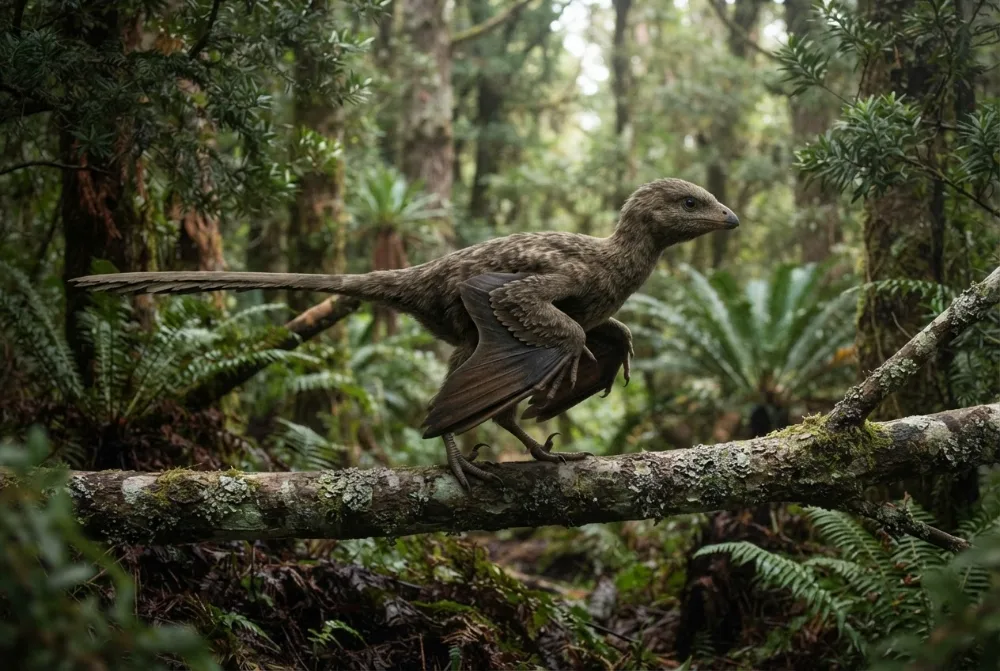
Ambopteryx had a long, rod-like bone sticking out from its wrist that helped support a wing membrane, just like in pterosaurs and bats.2
Its forelimbs were 1.3 times longer than its hindlimbs, which is unusual for a dinosaur.1
Ambopteryx had a short tail that ended in a fused pygostyle, a feature also seen in modern birds.1
This dinosaur was about the size of a modern pigeon, measuring only 32 cm (about 1 foot) long.1
The name Ambopteryx means 'both wing' because its wing was like a pterosaur's but it was a dinosaur.1
Fossilized feathers were found around its head, neck, and shoulders, showing it had a fluffy coat.1
Laaj yi ñu gën a laaj ci Ambopteryx
?How big was Ambopteryx?
About 32 centimetres (13 inches) long and weighed around 306 grams (10.8 ounces), roughly the size of a modern pigeon.4
?What did Ambopteryx eat?
It was probably omnivorous. Its stomach contained gastroliths (gizzard stones) and bone fragments, suggesting it ate both plants and meat.45
?Could Ambopteryx fly?
It could probably glide between trees, like a flying squirrel. Scientists are still studying how well it could truly fly.5
?Did Ambopteryx have feathers?
Yes, it had dense layers of feathers on its head, neck, and shoulders, along with bat-like membranous wings.42
Ku tas léeb yu dul dëgg
Léeb: Some people think Ambopteryx could fly like a bird.
Dëgg: It probably could not flap its wings to fly. Instead, it likely glided from tree to tree using its skin wings.2
Ngir ñi xam dino lool
- Turu xam-xam
- Ambopteryx
- Ku ko tudde
- Wang et al. 20196
- Kurél
- Dino yuy lekk yàpp
- Njaboot / klad
- Scansoriopterygidae6
- Klasifikasiyoŋ
- Theropoda6
- Màggaayu doj yi
- 162 ba 143 milyoŋ at (Oxfordian / Tithonian)6
- Réew yi
- Siin6
- Fosil yu ñu gis
- 1 ci The Paleobiology Database6
- Gisees
- Ambopteryx was named in 2019 by Wang and colleagues. The only known fossil was found near Wubaiding Village in Liaoning, China, in rocks about 163 million years old.1
- Ñu ngi koy werante ba tey
- Scientists are not sure exactly how Ambopteryx moved through the air. It may have glided, but some think it could also climb trees.2
Fa xibaar yi jóge
- Ambopteryx longibrachium Wang & O'Connor & Xu & Zhou 2019, gen. et sp. nov. (zenodo.org)
- A new Jurassic scansoriopterygid and the loss of membranous wings in theropod dinosaurs | Nature (nature.com)
- PBDB Taxon (paleobiodb.org)
- Ambopteryx (en.wikipedia.org)
- Ambopteryx, new species of bat-wing dinosaur, discovered in China | National Geographic (nationalgeographic.com)
- Ambopteryx in The Paleobiology Database (CC BY 4.0): at, béréb yi, formasiyoŋi doj, klasifikasiyoŋ.
Bépp xibaar ci xët wii am na lim bu wone fa mu jóge. Su nu juumee, baal nu, nun ñu bëgg dino lanu, du ab sërnaalu xam-xam. Wax nu ko ci [email protected] nu defar ko.
 Rex xiif na! Dino Wiki, mbiru ab baay la ngir doomam ju góor ju bëgg dinosoor, ci neen te amul kaamuñaate, amul tracker. Mag ñi mën nañu jox Rex tuuti ñam ngir dimbali ko mu des ci internet.Dundal Rex
 Allosaurus
 Carnotaurus
 Dilophosaurus
 Giganotosaurus
 Compsognathus
 Paronychodon
 Brachiosaurus
 Diplodocus
 Brontosaurus
 Camarasaurus
 Morosaurus
 Apatosaurus