 Ban dino nga? Kiis
 Xeexu dino
 Rawante dino
 Fo yu ndaw yu dino
 Albomu sitikeer
 Limu TOP yu dino
 Bett ma!
Kañ la dundoon?

Naka la réyoon?
Naka la guddoon?
Naka la kawewoon?
Naka la diisoon?
 gudd ni 2 oto yu ñu taxawal ci benn rëdd🍌gudd ni 56 banaana yu ñu topp-toppale
 lu tollu ci diisaayu ñey🍉diis ni 1100 xaal🎒diis ni 7 klaas yu mat yu xale yu lekkool🐻❄️diis ni 12 uurs yu weex🏃mënoon na daw 100 meetar ci 20 segond (nit ki gën a gaaw dafay soxla 9,6)
Naka la Antetonitrus réyoon, bu ñu ko méngalee ak YAW?
Ay kalkil rekk ci sa navigatëer. Dara du ñu denc, dara du ñu yónne fenn.
Naka la gaawoon?


Xibaar yu neex
Antetonitrus lived about 201 to 193 million years ago, during the Early Jurassic.2
Its name means 'before thunder' because it lived before the famous sauropod Brontosaurus, whose name means 'thunder lizard'.1
Unlike later sauropods, Antetonitrus had a flexible thumb that could grasp, not just support weight.1
Its fossils were first found in 1981 and were originally thought to belong to another dinosaur called Euskelosaurus.1
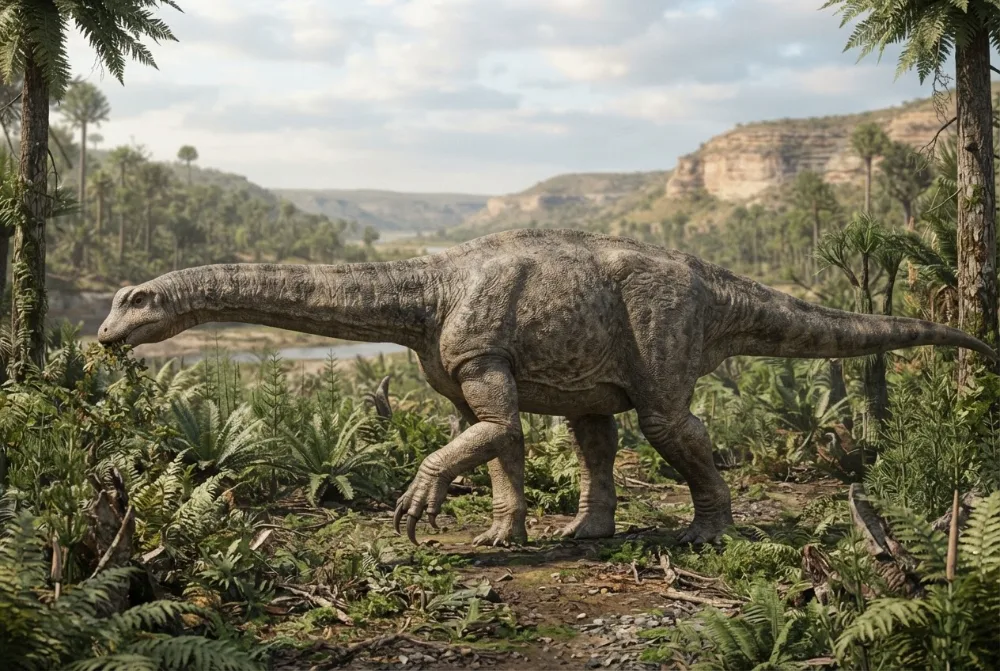
Antetonitrus was about 8 to 10 metres long and weighed as much as a large elephant.1
Its thigh bone was slightly S-shaped when viewed from the side, unlike the straight thigh bones of later sauropods.1
Antetonitrus is one of the oldest known sauropods, tied with other early sauropods from the same formation in South Africa.1
Laaj yi ñu gën a laaj ci Antetonitrus
?How big was Antetonitrus?
Antetonitrus was about 8 to 10 metres (26 to 33 feet) long, stood 1.5 to 2 metres (5 to 6.5 feet) tall at the hip, and weighed around 5.6 metric tons (6.2 short tons). It may not have been fully grown yet.34
?Could Antetonitrus grab things with its hands?
Yes. Unlike later sauropods, Antetonitrus had a flexible thumb that could grasp, not just support weight. Its wrist bones were not locked into a permanent weight-supporting position.35
Ngir ñi xam dino lool
- Turu xam-xam
- Antetonitrus
- Ku ko tudde
- Yates and Kitching 20036
- Kurél
- Baat yu gudd
- Njaboot / klad
- Lessemsauridae6
- Klasifikasiyoŋ
- Sauropodomorpha > Sauropoda6
- Màggaayu doj yi
- 201 ba 193 milyoŋ at (Hettangian / Sinemurian)6
- Formasiyoŋi doj
- Elliot6
- Réew yi
- Afrig di Sid6
- Fosil yu ñu gis
- 2 ci The Paleobiology Database6
- Gisees
- Antetonitrus was named in 2003 by Adam Yates and James Kitching. The fossils were discovered by Kitching in 1981 in the Free State of South Africa and were stored as Euskelosaurus until Yates recognized them as a new dinosaur.1
- Ñu ngi koy werante ba tey
- Scientists are not sure if Antetonitrus was a true sauropod or a very close relative, because it had both primitive and advanced features.1
Fa xibaar yi jóge
- Antetonitrus (en.wikipedia.org)
- PBDB Taxon (paleobiodb.org)
- Antetonitrus (en.wikipedia.org)
- A Giant Dinosaur from the Earliest Jurassic of South Africa and the Transition to Quadrupedality in Early Sauropodomorphs: Current Biology (cell.com)
- The earliest known sauropod dinosaur and the first steps towards sauropod locomotion (royalsocietypublishing.org)
- Antetonitrus in The Paleobiology Database (CC BY 4.0): at, béréb yi, formasiyoŋi doj, klasifikasiyoŋ.
Bépp xibaar ci xët wii am na lim bu wone fa mu jóge. Su nu juumee, baal nu, nun ñu bëgg dino lanu, du ab sërnaalu xam-xam. Wax nu ko ci [email protected] nu defar ko.
 Rex xiif na! Dino Wiki, mbiru ab baay la ngir doomam ju góor ju bëgg dinosoor, ci neen te amul kaamuñaate, amul tracker. Mag ñi mën nañu jox Rex tuuti ñam ngir dimbali ko mu des ci internet.Dundal Rex
 Brachiosaurus
 Diplodocus
 Brontosaurus
 Argentinosaurus
 Camarasaurus
 Morosaurus
 Dilophosaurus
 Stenopterygius
 Dorygnathus
 Scutellosaurus
 Sinosaurus
 Temnodontosaurus