 Ban dino nga? Kiis
 Xeexu dino
 Rawante dino
 Fo yu ndaw yu dino
 Albomu sitikeer
 Limu TOP yu dino
 Bett ma!
Stenopterygius
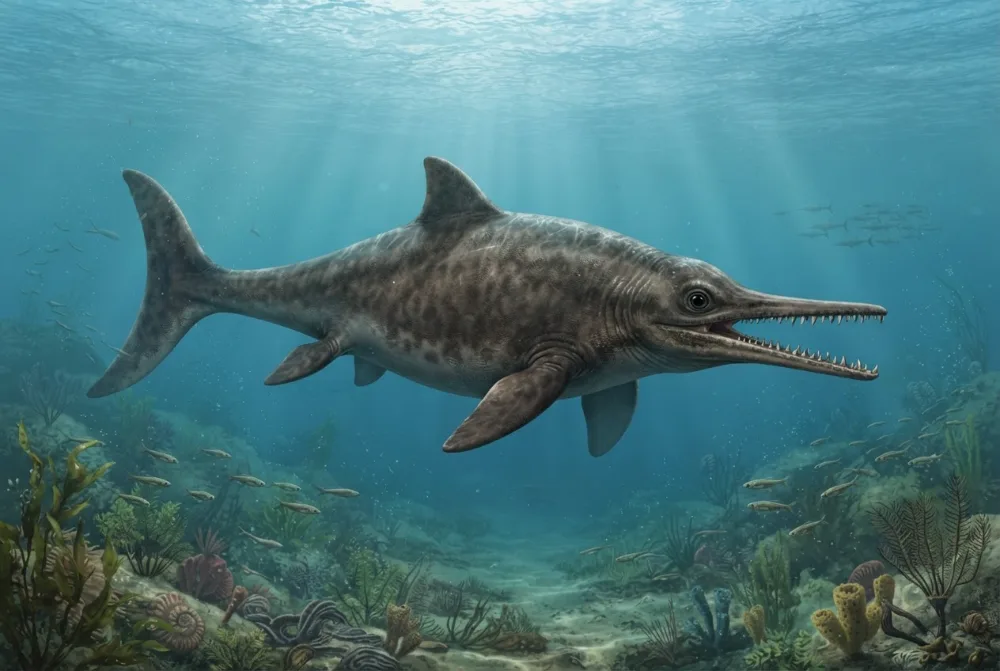
Stenopterygius was a fast-swimming marine reptile that lived in the Jurassic seas. It looked a bit like a dolphin but was actually an ichthyosaur, not a dinosaur. It had a long beak full of teeth and chased after fish and squid.1
Kañ la dundoon?
Naka la réyoon?
Naka la guddoon?
 gudd ni 4 xaj, bakkan ba geen🍌gudd ni 22 banaana yu ñu topp-toppale🏊mënoon na féey guddaayu pisin bu mag (50 m) ci 3,8 segond
Naka la Stenopterygius réyoon, bu ñu ko méngalee ak YAW?
Ay kalkil rekk ci sa navigatëer. Dara du ñu denc, dara du ñu yónne fenn.
Naka la gaawoon?


Xibaar yu neex
Stenopterygius had a small skull and narrow flippers compared to its relative Ichthyosaurus.1
One well-preserved fossil shows traces of skin, revealing that Stenopterygius was countershaded: darker on the back and lighter on the belly.1
Fossils of Stenopterygius often contain the remains of its last meal in the stomach area.1
The tail ended in a large, semicircular, leathery vertical fin, and it also had a triangular dorsal fin on its back.1
Stenopterygius lived during the Early and Middle Jurassic, about 183 to 173 million years ago.1
The type specimen of Stenopterygius quadriscissus is a complete skeleton that even preserved a very large embryo inside.1
Laaj yi ñu gën a laaj ci Stenopterygius
?How big was Stenopterygius?
Stenopterygius was a medium sized ichthyosaur, with most species reaching about 3.5 metres long, while the largest, S. uniter, could exceed 4 metres.1
?What did Stenopterygius eat?
Stenopterygius hunted fish, cephalopods, and other animals in the open sea. Fossils often contain the remains of its last meal in the stomach area.1
?Was Stenopterygius a dinosaur?
No, Stenopterygius was an ichthyosaur, a marine reptile, not a dinosaur. It looked a bit like a dolphin but was actually a different group of reptiles.1
?Did Stenopterygius give birth to live young?
Yes, Stenopterygius gave birth to live young, and one famous fossil shows a mother that died in childbirth. It preferred tail-first births, like modern dolphins and whales.1
Ngir ñi xam dino lool
- Turu xam-xam
- Stenopterygius
- Ku ko tudde
- Jaekel 19043
- Kurél
- Iktiyosoor yi
- Njaboot / klad
- Thunnosauria3
- Klasifikasiyoŋ
- Ichthyosauria > Ichthyosauromorpha3
- Màggaayu doj yi
- 184 ba 171 milyoŋ at (Toarcian / Aalenian)3
- Formasiyoŋi doj
- Posidonia Shale, Opalinuston, Beacon Limstone3
- Réew yi
- Almaañ, Angalteer, Liksàmbuur, Faraas3
- Fosil yu ñu gis
- 47 ci The Paleobiology Database3
- Gisees
- The species was first named as Ichthyosaurus quadriscissus by Quenstedt in 1856. Otto Jaekel gave it its own genus, Stenopterygius, in 1904.1
- Ñu ngi koy werante ba tey
- Scientists are still debating exactly how many species of Stenopterygius existed, because the fossils are often incomplete.2
Fa xibaar yi jóge
- Stenopterygius (en.wikipedia.org)
- First Diagnostic Marine Reptile Remains from the Aalenian (Middle Jurassic): A New Ichthyosaur from Southwestern Germany | PLOS One (journals.plos.org)
- Stenopterygius in The Paleobiology Database (CC BY 4.0): at, béréb yi, formasiyoŋi doj, klasifikasiyoŋ.
Bépp xibaar ci xët wii am na lim bu wone fa mu jóge. Su nu juumee, baal nu, nun ñu bëgg dino lanu, du ab sërnaalu xam-xam. Wax nu ko ci [email protected] nu defar ko.
 Rex xiif na! Dino Wiki, mbiru ab baay la ngir doomam ju góor ju bëgg dinosoor, ci neen te amul kaamuñaate, amul tracker. Mag ñi mën nañu jox Rex tuuti ñam ngir dimbali ko mu des ci internet.Dundal Rex
 Ichthyosaurus
 Platypterygius
 Khudiakovia
 Ophthalmosaurus
 Chonespondylus
 Cymbospondylus
 Dilophosaurus
 Dorygnathus
 Lufengosaurus
 Scutellosaurus
 Yunnanosaurus
 Sinosaurus