 Ban dino nga? Kiis
 Xeexu dino
 Rawante dino
 Fo yu ndaw yu dino
 Albomu sitikeer
 Limu TOP yu dino
 Bett ma!
Argentinonectes
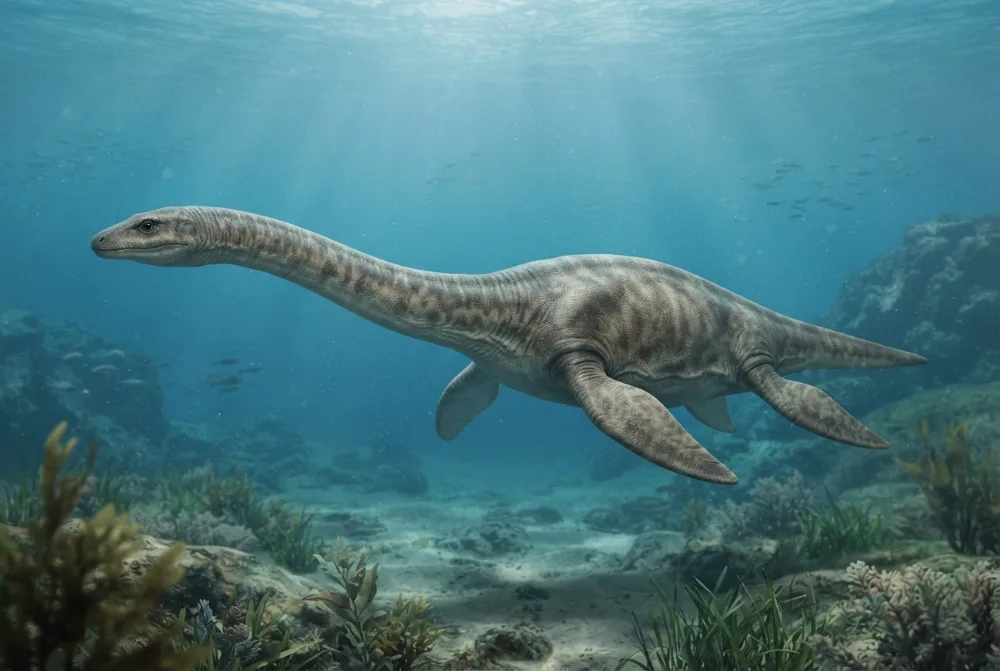
Argentinonectes was a huge, long-necked marine reptile that swam in the seas near Antarctica 66 million years ago. It had four flipper-like legs and a stiff tail that may have had a fin on the end. This plesiosaur is the most complete one ever found in Argentina!1
Kañ la dundoon?
Naka la réyoon?
Naka la guddoon?
 gudd ni 2 oto yu ñu taxawal ci benn rëdd🍌gudd ni 50 banaana yu ñu topp-toppale🏊mënoon na féey guddaayu pisin bu mag (50 m) ci 7,8 segond
Naka la Argentinonectes réyoon, bu ñu ko méngalee ak YAW?
Ay kalkil rekk ci sa navigatëer. Dara du ñu denc, dara du ñu yónne fenn.
Naka la gaawoon?


Xibaar yu neex
The fossil was found under 50 cm (20 inches) of water in Lake Argentino, making it tricky to dig out.1
Its rib cage and belly bones were very stiff, which helped it dive without its lungs collapsing.1
Shark teeth and scratches on its bones show that sharks ate the dead plesiosaur's body.1
The tail had eight tightly locked vertebrae at the tip, probably supporting a small tail fin.1
Its forelimbs were about 1.8 metres (5.9 feet) long, and the hindlimbs were a bit shorter at 1.3 metres (4.3 feet).1
The skeleton is missing the skull and most of the neck, possibly because they floated away after death.1
Laaj yi ñu gën a laaj ci Argentinonectes
?How big was Argentinonectes?
It was about 7 to 9 metres (23 to 30 feet) long. That is roughly as long as a school bus.1
?What did Argentinonectes eat?
Scientists do not know for sure because the skull is missing. But like other plesiosaurs, it probably ate fish and squid.1
?When did Argentinonectes live?
It lived at the very end of the Cretaceous Period, about 66 million years ago.1
?Is Argentinonectes a dinosaur?
No, it is a plesiosaur, a marine reptile that swam in the ocean. It is not a dinosaur.1
Ku tas léeb yu dul dëgg
Léeb: Some people think all plesiosaurs were slow and clumsy on land.
Dëgg: Argentinonectes and other plesiosaurs were fully aquatic and never came onto land. They were fast swimmers in the ocean.1
Ngir ñi xam dino lool
- Turu xam-xam
- Argentinonectes
- Ku ko tudde
- Novas et al. 20263
- Kurél
- Plesiyosoor yi
- Njaboot / klad
- Elasmosauridae3
- Klasifikasiyoŋ
- Plesiosauria > Elasmosauridae > Sauropterygia3
- Màggaayu doj yi
- 72 ba 66 milyoŋ at (Maastrichtian)3
- Formasiyoŋi doj
- Calafate3
- Réew yi
- Arsantin3
- Fosil yu ñu gis
- 1 ci The Paleobiology Database3
- Gisees
- The fossil was found in 2009 in Lake Argentino, Argentina, and was named Argentinonectes calafatensis by Fernando Novas and colleagues in 2026.1
- Ñu ngi koy werante ba tey
- Scientists are not sure why the skull and neck are missing. They may have been eroded by waves or detached when the body bloated and floated.1
Fa xibaar yi jóge
- Argentinonectes (en.wikipedia.org)
- PBDB Taxon (paleobiodb.org)
- Argentinonectes in The Paleobiology Database (CC BY 4.0): at, béréb yi, formasiyoŋi doj, klasifikasiyoŋ.
Bépp xibaar ci xët wii am na lim bu wone fa mu jóge. Su nu juumee, baal nu, nun ñu bëgg dino lanu, du ab sërnaalu xam-xam. Wax nu ko ci [email protected] nu defar ko.
 Rex xiif na! Dino Wiki, mbiru ab baay la ngir doomam ju góor ju bëgg dinosoor, ci neen te amul kaamuñaate, amul tracker. Mag ñi mën nañu jox Rex tuuti ñam ngir dimbali ko mu des ci internet.Dundal Rex
 Elasmosaurus
 Pliosaurus
 Plesiosaurus
 Cimoliasaurus
 Colymbosaurus
 Trinacromerum
 Tyrannosaurus
 Triceratops
 Velociraptor
 Spinosaurus
 Ankylosaurus
 Parasaurolophus