 Ban dino nga? Kiis
 Xeexu dino
 Rawante dino
 Fo yu ndaw yu dino
 Albomu sitikeer
 Limu TOP yu dino
 Bett ma!
Bagualia
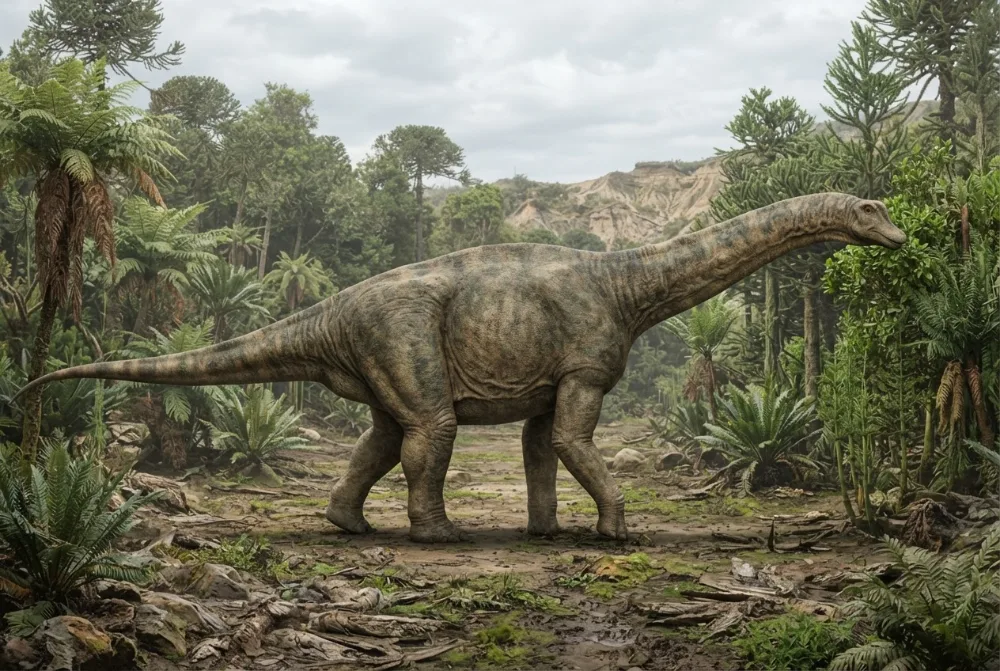
Bagualia was an early long-necked dinosaur that lived about 180 million years ago. It is one of the oldest known true sauropods, the group that later included giants like Brachiosaurus. Bagualia had a deep skull and big spoon-shaped teeth for eating tough plants.21
Kañ la dundoon?
Naka la réyoon?
Naka la guddoon?
Naka la kawewoon?
jortu
Naka la diisoon?
 gudd ni 2,5 oto yu ñu taxawal ci benn rëdd🍌gudd ni 67 banaana yu ñu topp-toppale
 diis ni 1,5 ñey🍉diis ni 2000 xaal🎒diis ni 12 klaas yu mat yu xale yu lekkool🐻❄️diis ni 22 uurs yu weex🏃mënoon na daw 100 meetar ci 24 segond (nit ki gën a gaaw dafay soxla 9,6)
Naka la Bagualia réyoon, bu ñu ko méngalee ak YAW?
Ay kalkil rekk ci sa navigatëer. Dara du ñu denc, dara du ñu yónne fenn.
Naka la gaawoon?


Xibaar yu neex
Bagualia lived during a time of major climate change, when a huge volcanic event warmed the Earth and many other plant-eating dinosaurs died out.2
The holotype specimen includes the back half of a skull and the first seven neck bones, all still connected together.2
Scientists found remains of at least three Bagualia individuals at the same site, all about the same size.2
Bagualia had a short, deep snout and large nostrils that were set far back on its skull, like later sauropods.2
Laaj yi ñu gën a laaj ci Bagualia
?How big was Bagualia?
Scientists estimate Bagualia weighed over 10 tonnes, making it one of the first truly giant sauropods. Its exact length is not known, but it had a long neck and a large body.5
?What did Bagualia eat?
Bagualia ate tough plants like conifers. Its spoon-shaped teeth had very thick enamel, about seven times thicker than other plant-eaters, to help shear leaves.1
?When did Bagualia live?
Bagualia lived about 179 million years ago, during the Early Jurassic period. That makes it one of the oldest known true sauropods.15
?Where was Bagualia found?
Bagualia fossils were found in Bagual Canyon in Chubut, Argentina. The remains were discovered in 2007 and 2009 by scientists from the Museo Paleontológico Egidio Feruglio.1
Ngir ñi xam dino lool
- Turu xam-xam
- Bagualia
- Ku ko tudde
- Pol et al. 20206
- Kurél
- Baat yu gudd
- Njaboot / klad
- Eusauropoda6
- Klasifikasiyoŋ
- Sauropodomorpha > Sauropoda6
- Màggaayu doj yi
- 183 ba 180 milyoŋ at (Toarcian)6
- Formasiyoŋi doj
- Cañadón Asfalto6
- Réew yi
- Arsantin6
- Fosil yu ñu gis
- 1 ci The Paleobiology Database6
- Gisees
- Bagualia was named in 2020 by Diego Pol and colleagues. The fossils were found in the Cañadón Asfalto Formation in Chubut, Argentina, at a site called Bagual Canyon.12
- Ñu ngi koy werante ba tey
- Scientists are still debating exactly how Bagualia is related to other early sauropods and how quickly the group evolved after the Toarcian warming event.2
Fa xibaar yi jóge
- Bagualia (en.wikipedia.org)
- Extinction of herbivorous dinosaurs linked to Early Jurassic global warming event (royalsocietypublishing.org)
- PBDB Taxon (paleobiodb.org)
- Nuevos hallazgos sobre Bagualia alba, un dinosaurio saurópodo qu (iipg.conicet.gov.ar)
- Axial skeleton of Bagualia (palaeo-electronica.org)
- Bagualia in The Paleobiology Database (CC BY 4.0): at, béréb yi, formasiyoŋi doj, klasifikasiyoŋ.
Bépp xibaar ci xët wii am na lim bu wone fa mu jóge. Su nu juumee, baal nu, nun ñu bëgg dino lanu, du ab sërnaalu xam-xam. Wax nu ko ci [email protected] nu defar ko.
 Rex xiif na! Dino Wiki, mbiru ab baay la ngir doomam ju góor ju bëgg dinosoor, ci neen te amul kaamuñaate, amul tracker. Mag ñi mën nañu jox Rex tuuti ñam ngir dimbali ko mu des ci internet.Dundal Rex
 Brachiosaurus
 Diplodocus
 Brontosaurus
 Argentinosaurus
 Camarasaurus
 Morosaurus
 Dilophosaurus
 Stenopterygius
 Dorygnathus
 Scutellosaurus
 Sinosaurus
 Temnodontosaurus