 Ban dino nga? Kiis
 Xeexu dino
 Rawante dino
 Fo yu ndaw yu dino
 Albomu sitikeer
 Limu TOP yu dino
 Bett ma!
Kañ la dundoon?

Naka la réyoon?
Naka la diisoon?

Naka la Bustingorrytitan réyoon, bu ñu ko méngalee ak YAW?
Ay kalkil rekk ci sa navigatëer. Dara du ñu denc, dara du ñu yónne fenn.
Naka la gaawoon?


Xibaar yu neex
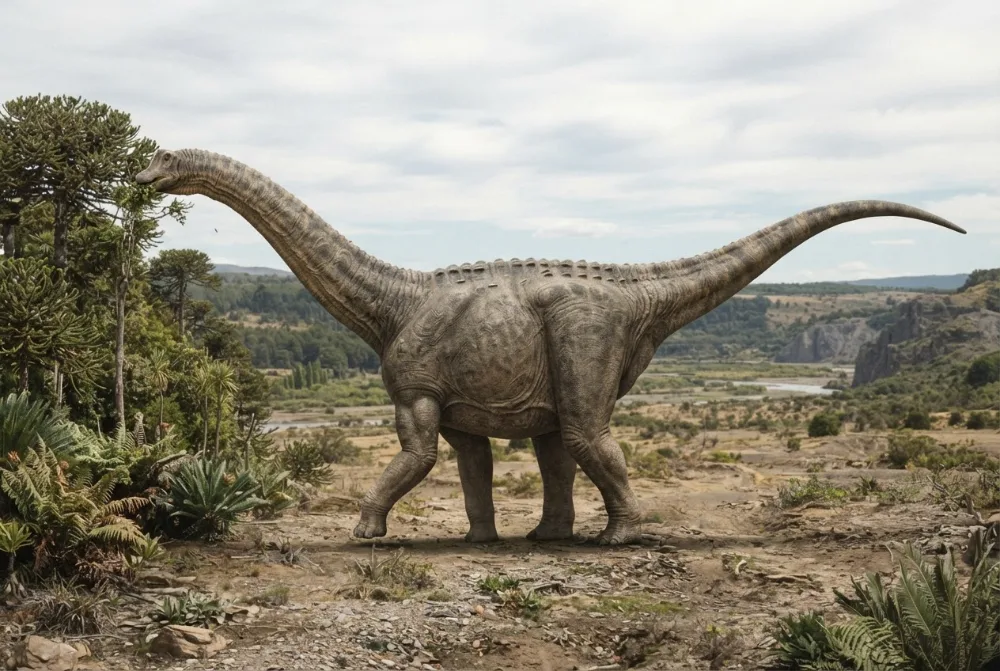
Bustingorrytitan lived about 100 million years ago during the early Late Cretaceous.1
Its fossils were found at the 'Bustingorry II' site, which is in the Huincul Formation.1
Bustingorrytitan is known from four specimens, including a relatively complete skeleton.1
This dinosaur had unique bones in its back, with a deep socket-like fossa on the vertebrae.1
Bustingorrytitan is a lithostrotian, a group of titanosaurs that includes the saltasaurids.1
It shared its home with other giant sauropods like Argentinosaurus and Chucarosaurus.1
The name Bustingorrytitan honors the Bustingorry family, who owned the land where the fossils were found.1
Laaj yi ñu gën a laaj ci Bustingorrytitan
?How big was Bustingorrytitan?
It weighed about 67.3 tonnes, which is as heavy as about 10 African elephants. It was one of the largest titanosaurs ever found.21
?When did Bustingorrytitan live?
It lived about 100 million years ago, during the early Late Cretaceous (Albian to Cenomanian).23
?Where was Bustingorrytitan found?
Its fossils were discovered at the 'Bustingorry II' site in Neuquén Province, Argentina, in the Huincul Formation.23
?What did Bustingorrytitan eat?
It was a plant-eater, like all sauropods. It used its long neck to reach leaves high in the trees.2
Ngir ñi xam dino lool
- Turu xam-xam
- Bustingorrytitan
- Ku ko tudde
- Simón and Salgado 20234
- Kurél
- Baat yu gudd
- Njaboot / klad
- Lithostrotia4
- Klasifikasiyoŋ
- Sauropodomorpha > Sauropoda > Titanosauria > Macronaria4
- Màggaayu doj yi
- 110 ba 106 milyoŋ at (Albian)4
- Formasiyoŋi doj
- Huincul4
- Réew yi
- Arsantin4
- Fosil yu ñu gis
- 1 ci The Paleobiology Database4
- Gisees
- Bustingorrytitan was named by M. E. Simón and L. Salgado in 2023 based on fossils from the Huincul Formation in Neuquén Province, Argentina.4
- Ñu ngi koy werante ba tey
- Scientists are still debating exactly how many times giant body size evolved in titanosaurs, and Bustingorrytitan helps show that gigantism happened multiple times.1
Fa xibaar yi jóge
- A new gigantic titanosaurian sauropod from the early Late Cretaceous of Patagonia (Neuquén Province, Argentina) (app.pan.pl)
- Bustingorrytitan (en.wikipedia.org)
- app010862023 (app.pan.pl)
- Bustingorrytitan in The Paleobiology Database (CC BY 4.0): at, béréb yi, formasiyoŋi doj, klasifikasiyoŋ.
Bépp xibaar ci xët wii am na lim bu wone fa mu jóge. Su nu juumee, baal nu, nun ñu bëgg dino lanu, du ab sërnaalu xam-xam. Wax nu ko ci [email protected] nu defar ko.
 Rex xiif na! Dino Wiki, mbiru ab baay la ngir doomam ju góor ju bëgg dinosoor, ci neen te amul kaamuñaate, amul tracker. Mag ñi mën nañu jox Rex tuuti ñam ngir dimbali ko mu des ci internet.Dundal Rex
 Brachiosaurus
 Diplodocus
 Brontosaurus
 Argentinosaurus
 Camarasaurus
 Morosaurus
 Stegosaurus
 Iguanodon
 Archaeopteryx
 Giganotosaurus
 Microraptor
 Deinonychus