 Ban dino nga? Kiis
 Xeexu dino
 Rawante dino
 Fo yu ndaw yu dino
 Albomu sitikeer
 Limu TOP yu dino
 Bett ma!
Kañ la dundoon?

Naka la réyoon?
Naka la guddoon?
Naka la kawewoon?
Naka la diisoon?
 gudd ni 4 muusu kër, bakkan ba geen🍌gudd ni 11 banaana yu ñu topp-toppale🍉diis ni 4 xaal🏃mënoon na daw 100 meetar ci 10 segond (nit ki gën a gaaw dafay soxla 9,6)
Naka la Byronosaurus réyoon, bu ñu ko méngalee ak YAW?
Ay kalkil rekk ci sa navigatëer. Dara du ñu denc, dara du ñu yónne fenn.
Naka la gaawoon?


Xibaar yu neex
Byronosaurus had a large brain for its size, making it one of the smartest non-bird dinosaurs.1
Its eyes faced forward, so it could judge distances well, which helped it hunt.2
Two baby Byronosaurus skulls were found inside a nest of oviraptorid eggs, probably as leftovers from a predator.1
Unlike other troodontids, Byronosaurus had smooth teeth without serrations, like its close relative Xixiasaurus.1
The first Byronosaurus fossils were discovered in 1993 by an American Museum of Natural History expedition to the Gobi Desert.1
Byronosaurus lived during the Late Cretaceous, about 80 to 71 million years ago.1
Its bones were mixed with bones of other animals when found, and scientists had to carefully sort them out.2
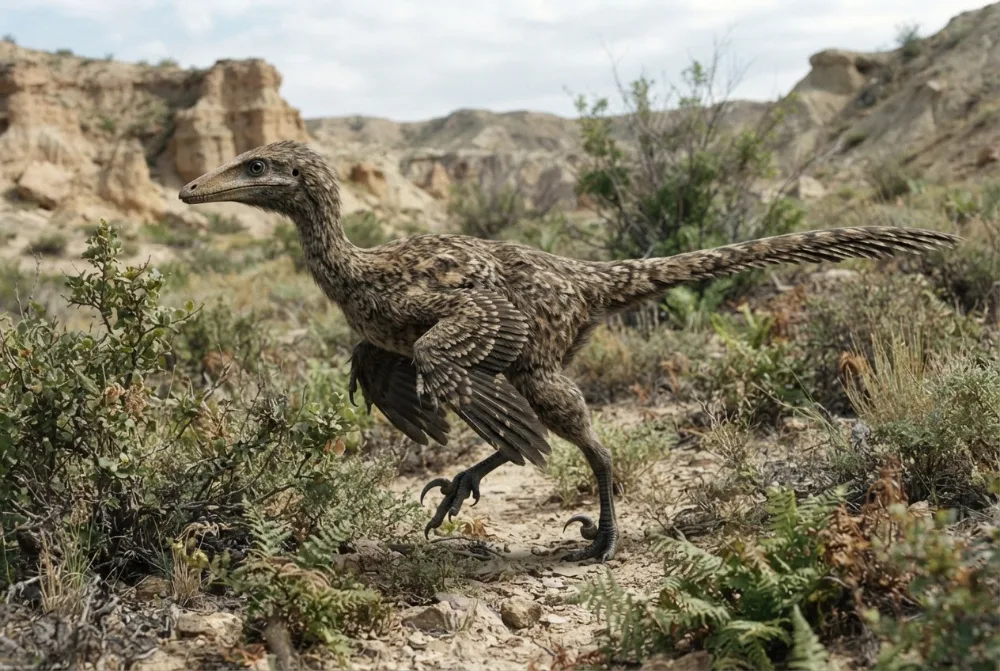
Laaj yi ñu gën a laaj ci Byronosaurus
?How big was Byronosaurus?
Byronosaurus was a small dinosaur, about 1.5 to 2 metres (5 to 6.6 feet) long and 50 cm (20 inches) tall. It weighed only about 4 to 20 kg (9 to 44 pounds), about the size of a large bird.12
?What did Byronosaurus eat?
Scientists are not sure. Some think it ate meat, others think it may have eaten plants or both. Its smooth teeth without serrations suggest it may have had a different diet from other troodontids.1
?When did Byronosaurus live?
Byronosaurus lived during the Late Cretaceous Period, about 80 to 71 million years ago. Its fossils were found in Mongolia.12
?Was Byronosaurus a dinosaur?
Yes, Byronosaurus was a small theropod dinosaur, specifically a troodontid. It was not a bird, but it was closely related to birds.1
Ku tas léeb yu dul dëgg
Léeb: Some people think all troodontids were meat-eaters with serrated teeth.
Dëgg: Byronosaurus had smooth teeth without serrations, so it may have been an omnivore or herbivore, not a pure carnivore.1
Ngir ñi xam dino lool
- Turu xam-xam
- Byronosaurus
- Ku ko tudde
- Norell et al. 20003
- Kurél
- Raptor yi
- Njaboot / klad
- Troodontidae3
- Klasifikasiyoŋ
- Theropoda > Troodontidae3
- Màggaayu doj yi
- 84 ba 72 milyoŋ at (Campanian)3
- Formasiyoŋi doj
- Djadokhta3
- Réew yi
- Mongoli3
- Fosil yu ñu gis
- 3 ci The Paleobiology Database3
- Gisees
- Byronosaurus was named in 2000 by Mark Norell, Peter Makovicky, and James Clark. The first skeleton was found in 1993 at Ukhaa Tolgod, Mongolia, and a second skull was found in 1996 at Bolor's Hill.1
- Ñu ngi koy werante ba tey
- Scientists are not sure what Byronosaurus ate. Its smooth teeth suggest it might have been an omnivore or herbivore, but some experts think it was still a carnivore.1
Fa xibaar yi jóge
- Byronosaurus (en.wikipedia.org)
- Byronosaurus jaffei | AMNH (amnh.org)
- Byronosaurus in The Paleobiology Database (CC BY 4.0): at, béréb yi, formasiyoŋi doj, klasifikasiyoŋ.
Bépp xibaar ci xët wii am na lim bu wone fa mu jóge. Su nu juumee, baal nu, nun ñu bëgg dino lanu, du ab sërnaalu xam-xam. Wax nu ko ci [email protected] nu defar ko.
 Rex xiif na! Dino Wiki, mbiru ab baay la ngir doomam ju góor ju bëgg dinosoor, ci neen te amul kaamuñaate, amul tracker. Mag ñi mën nañu jox Rex tuuti ñam ngir dimbali ko mu des ci internet.Dundal Rex
 Velociraptor
 Microraptor
 Deinonychus
 Asiamericana
 Richardoestesia
 Saurornitholestes
 Tyrannosaurus
 Triceratops
 Spinosaurus
 Ankylosaurus
 Parasaurolophus
 Pteranodon