 Ban dino nga? Kiis
 Xeexu dino
 Rawante dino
 Fo yu ndaw yu dino
 Albomu sitikeer
 Limu TOP yu dino
 Bett ma!
Kañ la dundoon?

Naka la réyoon?
Naka la guddoon?
Naka la kawewoon?
jortu
Naka la diisoon?
 gudd ni 3 xaj, bakkan ba geen🍌gudd ni 16 banaana yu ñu topp-toppale🍉diis ni 22 xaal🧸diis ni 6 xale yu maternel🎒diis ni 3 xale yu lekkool🏃mënoon na daw 100 meetar ci 7,5 segond (nit ki gën a gaaw dafay soxla 9,6)
Naka la Citipati réyoon, bu ñu ko méngalee ak YAW?
Ay kalkil rekk ci sa navigatëer. Dara du ñu denc, dara du ñu yónne fenn.
Naka la gaawoon?


Xibaar yu neex
Citipati means 'funeral pyre lord' in Sanskrit, named after a skeleton-like spirit in Tibetan folklore.1
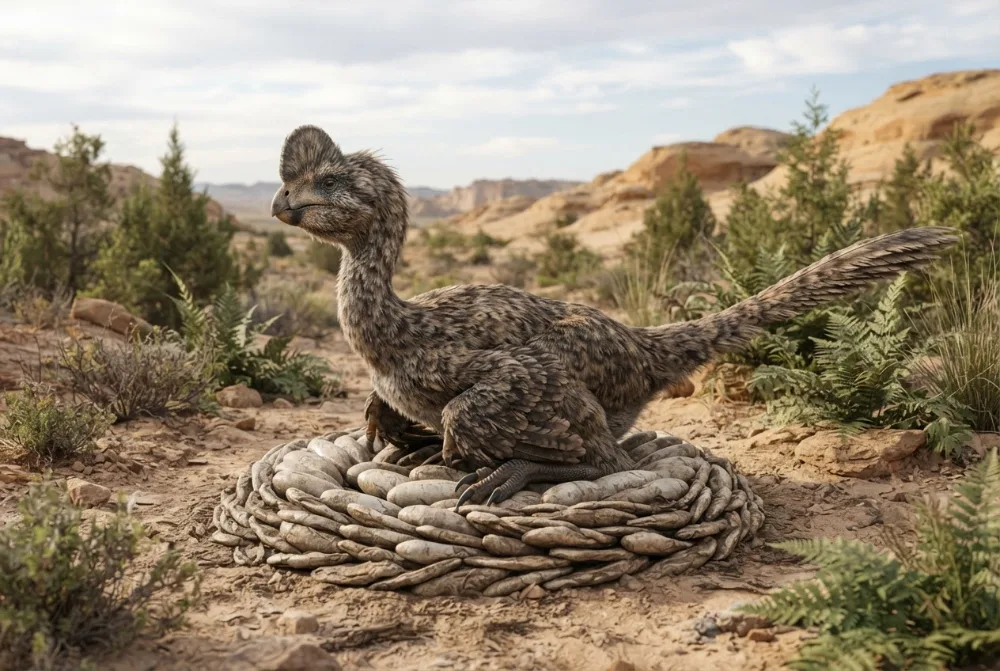
One famous Citipati fossil is nicknamed 'Big Mama' because it was found sitting on a nest of eggs.1
Citipati had a pygostyle, a fused tailbone that supported a fan of feathers, just like modern birds.1
Its arms and tail were covered in long feathers that probably helped shade and protect its eggs and babies.1
Citipati was one of the largest oviraptorids, about the size of an emu, and weighed as much as a large dog.1
Scientists think Citipati may have brought small dinosaurs to its nest to feed its hatchlings.1
Laaj yi ñu gën a laaj ci Citipati
?How big was Citipati?
Citipati was about 2.5 to 2.9 metres long and weighed 75 to 110 kilograms. That is much larger than an emu.1
?What did Citipati eat?
Citipati was probably omnivorous, meaning it ate both plants and meat. Scientists think it may have brought small dinosaurs to its nest to feed its babies.12
?Did Citipati have feathers?
Yes, Citipati had long feathers on its arms and tail. These feathers probably helped protect its eggs and babies from sun, wind, and rain.1
?Why did Citipati sit on its eggs?
Citipati sat on its eggs to keep them warm and safe, just like birds do today. Its arms spread over the nest helped shade and protect the eggs.13
Ku tas léeb yu dul dëgg
Léeb: Oviraptorids like Citipati were egg thieves.
Dëgg: The name Oviraptor means 'egg thief', but fossils show Citipati was a caring parent that brooded its own eggs, not a robber.1
Ngir ñi xam dino lool
- Turu xam-xam
- Citipati
- Ku ko tudde
- Clark et al. 20014
- Kurél
- Dino yu am dun yu doy waar
- Njaboot / klad
- Oviraptoridae4
- Klasifikasiyoŋ
- Theropoda > Oviraptorosauria4
- Màggaayu doj yi
- 84 ba 72 milyoŋ at (Campanian)4
- Formasiyoŋi doj
- Djadokhta4
- Réew yi
- Mongoli4
- Fosil yu ñu gis
- 2 ci The Paleobiology Database4
- Gisees
- Citipati was named in 2001 by paleontologists James Clark, Mark Norell, and Rinchen Barsbold. The first fossils were found in the 1990s at Ukhaa Tolgod in Mongolia.12
- Ñu ngi koy werante ba tey
- Scientists are not sure if Citipati was mostly a plant-eater or an omnivore that also ate meat.1
Fa xibaar yi jóge
- Citipati (en.wikipedia.org)
- Citipati | Natural History Museum (nhm.ac.uk)
- Citipati Osmolskae: Get to Know a Dino | AMNH (amnh.org)
- Citipati in The Paleobiology Database (CC BY 4.0): at, béréb yi, formasiyoŋi doj, klasifikasiyoŋ.
Bépp xibaar ci xët wii am na lim bu wone fa mu jóge. Su nu juumee, baal nu, nun ñu bëgg dino lanu, du ab sërnaalu xam-xam. Wax nu ko ci [email protected] nu defar ko.
 Rex xiif na! Dino Wiki, mbiru ab baay la ngir doomam ju góor ju bëgg dinosoor, ci neen te amul kaamuñaate, amul tracker. Mag ñi mën nañu jox Rex tuuti ñam ngir dimbali ko mu des ci internet.Dundal Rex
 Therizinosaurus
 Oviraptor
 Chirostenotes
 Citipes
 Leptorhynchos
 Avimimus
 Tyrannosaurus
 Triceratops
 Velociraptor
 Spinosaurus
 Ankylosaurus
 Parasaurolophus