 Ban dino nga? Kiis
 Xeexu dino
 Rawante dino
 Fo yu ndaw yu dino
 Albomu sitikeer
 Limu TOP yu dino
 Bett ma!
Datai
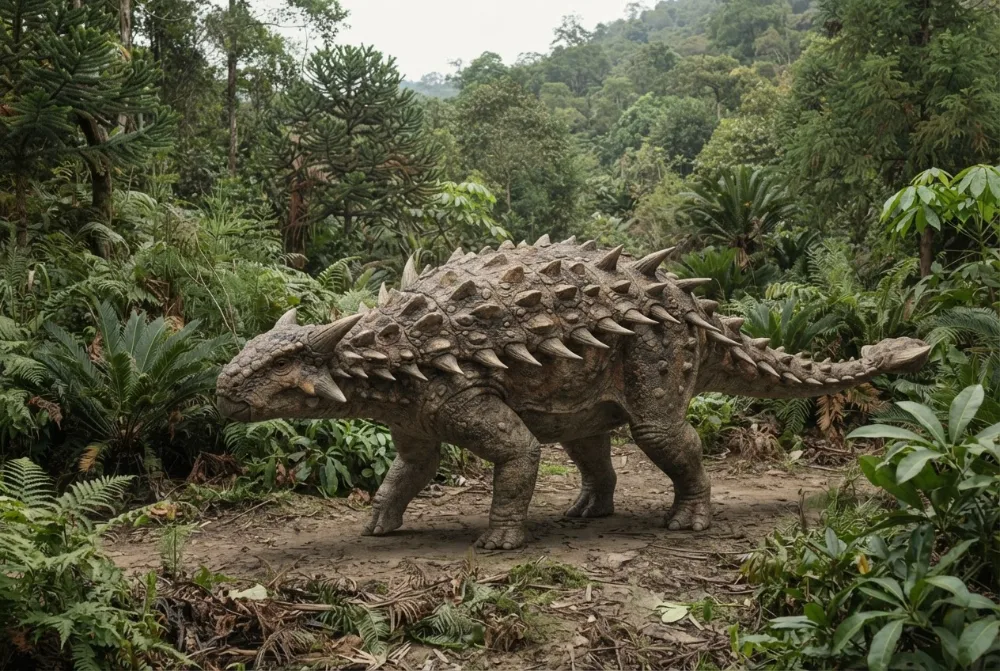
Datai was an armored dinosaur that walked on four legs and had bony plates and spikes on its body. It had a pair of horns on its cheeks, which made it look extra tough. It lived in what is now China, about 90 million years ago.12
Kañ la dundoon?
Naka la réyoon?
Naka la guddoon?
Naka la kawewoon?
jortu
 gudd ni 4 xaj, bakkan ba geen🍌gudd ni 22 banaana yu ñu topp-toppale🏃mënoon na daw 100 meetar ci 18 segond (nit ki gën a gaaw dafay soxla 9,6)
Naka la Datai réyoon, bu ñu ko méngalee ak YAW?
Ay kalkil rekk ci sa navigatëer. Dara du ñu denc, dara du ñu yónne fenn.
Naka la gaawoon?


Xibaar yu neex
Datai had a pair of horns on its cheeks, which is unusual and helped scientists identify it as a new species.2
The two Datai fossils were found lying on top of each other, likely because they were buried quickly by wind-blown sand.2
The neck bones of one Datai had curved holes about 2 cm wide, probably made by small creatures like mollusks burrowing in the sediment after the dinosaur died.2
Datai's tail had ossified tendons, which suggests it may have had a tail club for defense.1
Scientists used Datai's features to help make the family tree of ankylosaurs more stable, because before, many relationships were uncertain.1
Datai lived during the Late Cretaceous, about 96 to 90 million years ago, which is a time when many armored dinosaurs roamed.1
Laaj yi ñu gën a laaj ci Datai
?What did Datai eat?
Datai was a plant-eating dinosaur. It was a ground-dwelling herbivore, so it likely ate low-growing plants.3
?Did Datai have a tail club?
It likely did. Its tail bones were surrounded by ossified tendons, which suggests it may have had a tail club for defense.1
?How big was Datai?
Scientists don't know exactly, because the fossils are from young, not fully grown individuals. The known specimens were immature, so their adult size is uncertain.1
?When did Datai live?
Datai lived during the Late Cretaceous, about 96 to 90 million years ago, in what is now China.1
Ku tas léeb yu dul dëgg
Léeb: Some people think all armored dinosaurs had tail clubs, but not all did.
Dëgg: Datai likely had a tail club because of ossified tendons near its tail, but many other ankylosaurs did not have one.1
Ngir ñi xam dino lool
- Turu xam-xam
- Datai
- Ku ko tudde
- Xing et al. 20243
- Kurél
- Dino yu am kiiraay
- Njaboot / klad
- Ankylosauridae3
- Klasifikasiyoŋ
- Ornithischia > Ankylosauria > Ankylosauridae > Thyreophora3
- Màggaayu doj yi
- 94 ba 86 milyoŋ at (Turonian / Coniacian)3
- Formasiyoŋi doj
- Zhoutian3
- Réew yi
- Siin3
- Fosil yu ñu gis
- 1 ci The Paleobiology Database3
- Gisees
- The fossils were found in 2016 in Jiangxi Province, China, and later acquired by the Yingliang Stone Natural History Museum. In 2024, a team led by Xing Lida named the new species Datai yingliangis.12
- Ñu ngi koy werante ba tey
- Scientists are still debating exactly where Datai fits in the ankylosaur family tree. Depending on the analysis, it appears either as a basal ankylosaurine or as a close relative of Pinacosaurus.1
Fa xibaar yi jóge
- Datai (en.wikipedia.org)
- Fossils of new armored dinosaur species found in east China-Xinhua (english.news.cn)
- Datai in The Paleobiology Database (CC BY 4.0): at, béréb yi, formasiyoŋi doj, klasifikasiyoŋ.
Bépp xibaar ci xët wii am na lim bu wone fa mu jóge. Su nu juumee, baal nu, nun ñu bëgg dino lanu, du ab sërnaalu xam-xam. Wax nu ko ci [email protected] nu defar ko.
 Rex xiif na! Dino Wiki, mbiru ab baay la ngir doomam ju góor ju bëgg dinosoor, ci neen te amul kaamuñaate, amul tracker. Mag ñi mën nañu jox Rex tuuti ñam ngir dimbali ko mu des ci internet.Dundal Rex
 Ankylosaurus
 Sauropelta
 Pinacosaurus
 Scutellosaurus
 Struthiosaurus
 Euoplocephalus
 Tyrannosaurus
 Triceratops
 Velociraptor
 Spinosaurus
 Parasaurolophus
 Pteranodon