 Ban dino nga? Kiis
 Xeexu dino
 Rawante dino
 Fo yu ndaw yu dino
 Albomu sitikeer
 Limu TOP yu dino
 Bett ma!
Kañ la dundoon?

Naka la réyoon?
Naka la guddoon?
Naka la kawewoon?
Naka la diisoon?
 gudd ni 4 oto yu ñu taxawal ci benn rëdd🍌gudd ni 110 banaana yu ñu topp-toppale
 lu tollu ci diisaayu ñey🍉diis ni 1200 xaal🎒diis ni 8 klaas yu mat yu xale yu lekkool🐻❄️diis ni 13 uurs yu weex🏃mënoon na daw 100 meetar ci 20 segond (nit ki gën a gaaw dafay soxla 9,6)
Naka la Dicraeosaurus réyoon, bu ñu ko méngalee ak YAW?
Ay kalkil rekk ci sa navigatëer. Dara du ñu denc, dara du ñu yónne fenn.
Naka la gaawoon?


Xibaar yu neex
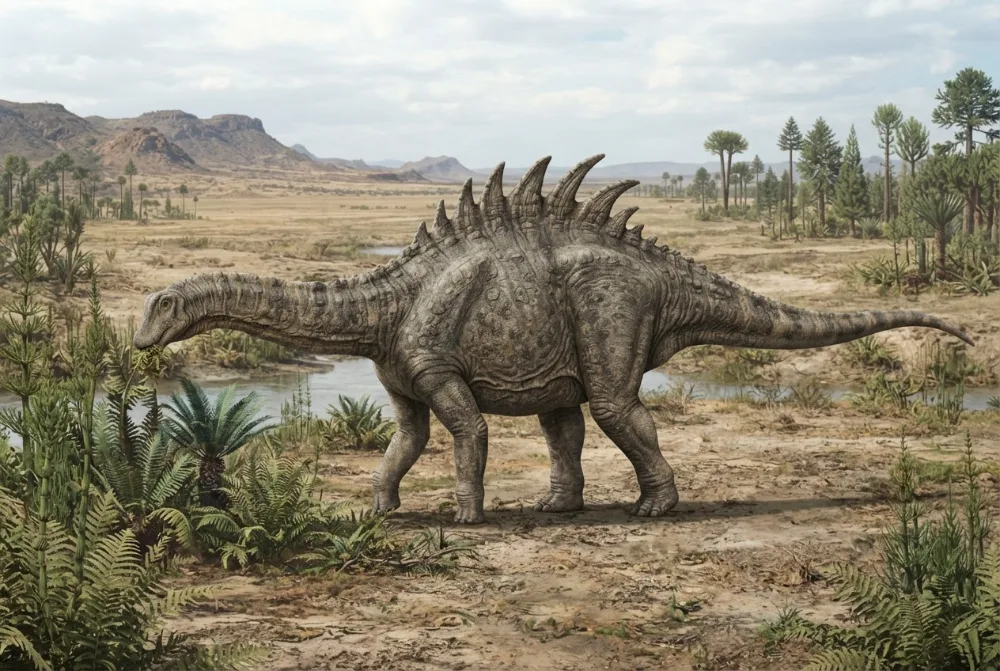
Dicraeosaurus had forked spines on its backbone, which is why its name means 'forked lizard'.1
It lived between 161 and 143 million years ago, during the Late Jurassic period.5
This dinosaur was a sauropod, a group of huge, long-necked plant-eaters.1
Fossils of Dicraeosaurus have been found in the Tendaguru Formation in Tanzania.5
Dicraeosaurus was about 20 metres long, as long as two school buses.1
It was named by German paleontologist Werner Janensch in 1914.5
Laaj yi ñu gën a laaj ci Dicraeosaurus
?How big was Dicraeosaurus?
Dicraeosaurus was about 14 to 15 metres (46 to 49 feet) long and weighed around 5 to 6 metric tons (5.5 to 6.6 short tons). That is roughly as long as two school buses.34
?What did Dicraeosaurus eat?
Dicraeosaurus was a herbivore, meaning it ate plants. It likely browsed on low-level vegetation no more than 3 metres (about 10 feet) off the ground, using its peg-like teeth.34
?Why did Dicraeosaurus have forked spines?
The forked spines on its backbone likely provided attachment points for muscles, which helped support its neck. They might have also supported a small sail or fatty ridge, but scientists aren't sure.34
?When did Dicraeosaurus live?
Dicraeosaurus lived during the Late Jurassic period, about 155 to 151 million years ago.34
?Where was Dicraeosaurus found?
Fossils of Dicraeosaurus were found in the Tendaguru Formation in Tanzania, Africa. The first fossils were discovered by Werner Janensch and Edwin Hennig between 1909 and 1912.34
?Was Dicraeosaurus bigger than T. rex?
Dicraeosaurus was about 14 to 15 metres long, which is longer than a T. rex, but it was lighter, weighing around 5 to 6 metric tons. T. rex was heavier and more robust.3
Ngir ñi xam dino lool
- Turu xam-xam
- Dicraeosaurus
- Ku ko tudde
- Janensch 19145
- Kurél
- Baat yu gudd
- Njaboot / klad
- Dicraeosauridae5
- Klasifikasiyoŋ
- Sauropodomorpha > Sauropoda > Diplodocoidea5
- Màggaayu doj yi
- 162 ba 143 milyoŋ at (Oxfordian / Tithonian)5
- Formasiyoŋi doj
- Tendaguru, Kadzi5
- Réew yi
- Tansani, Simbabwe5
- Fosil yu ñu gis
- 19 ci The Paleobiology Database5
- Gisees
- Dicraeosaurus was named by Werner Janensch in 1914 based on fossils found in Tanzania.5
Fa xibaar yi jóge
- Dicraeosaurus | Natural History Museum (nhm.ac.uk)
- Dicraeosaurus hansemanni skeletal reconstruction (deviantart.com)
- Dicraeosaurus (en.wikipedia.org)
- DICRAEOSAURUS - DinoChecker dinosaur archive (dinochecker.com)
- Dicraeosaurus in The Paleobiology Database (CC BY 4.0): at, béréb yi, formasiyoŋi doj, klasifikasiyoŋ.
Bépp xibaar ci xët wii am na lim bu wone fa mu jóge. Su nu juumee, baal nu, nun ñu bëgg dino lanu, du ab sërnaalu xam-xam. Wax nu ko ci [email protected] nu defar ko.
 Rex xiif na! Dino Wiki, mbiru ab baay la ngir doomam ju góor ju bëgg dinosoor, ci neen te amul kaamuñaate, amul tracker. Mag ñi mën nañu jox Rex tuuti ñam ngir dimbali ko mu des ci internet.Dundal Rex
 Brachiosaurus
 Diplodocus
 Brontosaurus
 Argentinosaurus
 Camarasaurus
 Morosaurus
 Allosaurus
 Compsognathus
 Camptosaurus
 Nanosaurus
 Rhamphorhynchus
 Ceratosaurus