 Ban dino nga? Kiis
 Xeexu dino
 Rawante dino
 Fo yu ndaw yu dino
 Albomu sitikeer
 Limu TOP yu dino
 Bett ma!
Dunkleosteus
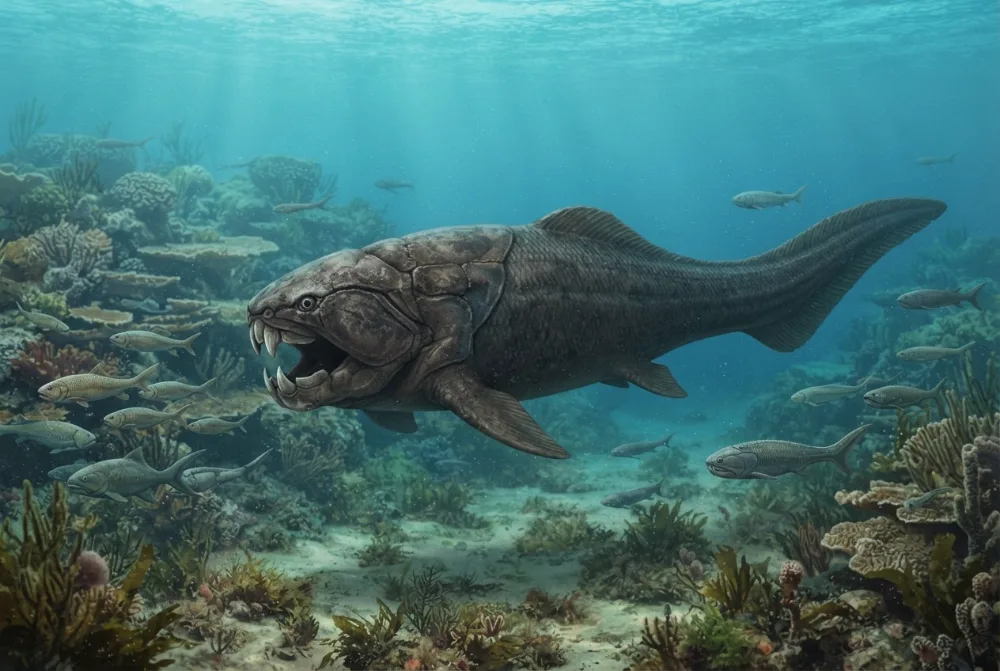
Dunkleosteus was a giant armoured fish that swam in the oceans about 382 to 358 million years ago. It had thick bone plates on its head and front body, and it was one of the first big predators in the sea. It wasn't a dinosaur, but it was super scary!1
Kañ la dundoon?
Naka la réyoon?
Naka la guddoon?
Naka la diisoon?
 gudd ni 2 oto yu ñu taxawal ci benn rëdd🍌gudd ni 56 banaana yu ñu topp-toppale
 diis ni 200 xaj🍉diis ni 800 xaal🎒diis ni 5 klaas yu mat yu xale yu lekkool🐻❄️diis ni 9 uurs yu weex🏊mënoon na féey guddaayu pisin bu mag (50 m) ci 7,2 segond
Naka la Dunkleosteus réyoon, bu ñu ko méngalee ak YAW?
Ay kalkil rekk ci sa navigatëer. Dara du ñu denc, dara du ñu yónne fenn.
Naka la gaawoon?


Xibaar yu neex
Dunkleosteus had a four-bar linkage in its skull that let it open its jaws in just 20 milliseconds, as fast as a blink!1
Its bite force was estimated at up to 7,495 newtons (about 1,685 pounds), which is among the highest of any fish ever.1
Instead of teeth, Dunkleosteus had sharp, blade-like bony plates in its jaws that could cut through armoured prey.1
Fossils of Dunkleosteus are often found with boluses of fish bones, which are the undigested remains of its last meals.1
The armour plates on its head and front body were up to 7.6 cm (3 inches) thick in some places, but thinner elsewhere.1
Dunkleosteus might have been a fast swimmer, not slow as once thought, because it could catch fast fish like Orodus.1
Laaj yi ñu gën a laaj ci Dunkleosteus
?How big was Dunkleosteus?
The largest known species, Dunkleosteus terrelli, was probably about 3.4 metres (11 feet) long for typical adults, and up to 4.1 metres (13 feet) for exceptionally large individuals. Some older estimates were much bigger, but recent studies suggest these smaller sizes.1
?Did Dunkleosteus have teeth?
No, instead of teeth it had sharp, blade-like bony plates in its jaws that could cut through armoured prey. These blades even sharpened themselves as the fish opened and closed its mouth.13
?What did Dunkleosteus eat?
It ate armoured prey like ammonites and other placoderms, and could even catch fast-swimming fish like Orodus. Fossils show it sometimes regurgitated bones from its last meal.1
?How fast could Dunkleosteus open its mouth?
It could open its jaws in just 20 milliseconds and complete a feeding snap in 50 to 60 milliseconds, which is as fast as a blink. This helped it catch fast prey.4
?Was Dunkleosteus a dinosaur?
No, it was a giant armoured fish that lived in the oceans during the Devonian Period, long before dinosaurs existed. It belonged to a group called placoderms.1
?How strong was Dunkleosteus' bite?
Its bite force was estimated at up to 7,495 newtons, which is among the highest of any fish ever. That is strong enough to puncture armour.14
?Where have Dunkleosteus fossils been found?
Fossils have been found in the United States, Canada, Poland, Belgium, Morocco, and Russia. The largest collection is at the Cleveland Museum of Natural History in Ohio.1
?When did Dunkleosteus live?
It lived during the Late Devonian Period, about 382 to 358 million years ago. That is before the first dinosaurs appeared.1
?Could Dunkleosteus swim fast?
Yes, it might have been a fast swimmer, not slow as once thought. It could catch fast-swimming fish like Orodus, which suggests it was quick.1
?Why did Dunkleosteus have armour?
Its thick bone plates on the head and front body protected it from other predators and helped it hunt armoured prey. The plates were up to 7.6 cm (3 inches) thick in some places.1
Ku tas léeb yu dul dëgg
Léeb: Dunkleosteus was a dinosaur.
Dëgg: Dunkleosteus was not a dinosaur. It was a fish, specifically an arthrodire placoderm, and it lived long before the first dinosaurs.1
Ngir ñi xam dino lool
- Turu xam-xam
- Dunkleosteus
- Ku ko tudde
- Newberry 18745
- Kurél
- Rab yu siiw lool yu jamono ju yàgg
- Njaboot / klad
- Dunkleosteidae5
- Klasifikasiyoŋ
- Placodermi > Phlyctaeniiformes > Dunkleosteidae5
- Màggaayu doj yi
- 388 ba 359 milyoŋ at (Givetian / Famennian)5
- Formasiyoŋi doj
- Ohio Shale, Lost Burro, Tērvete5
- Réew yi
- Amerig, Letoni, Kanadaa5
- Fosil yu ñu gis
- 7 ci The Paleobiology Database5
- Gisees
- The first fossils were found in 1867 by Jay Terrell, an amateur paleontologist, near Lake Erie in Ohio, USA. The species was named Dunkleosteus terrelli in 1956, honouring both David Dunkle and Jay Terrell.1
- Ñu ngi koy werante ba tey
- Scientists still debate how Dunkleosteus fed. Some think it used suction to gulp prey, but a 2025 study suggests it actively bit and tore prey, and its bite force estimates might need to be revised.1
Fa xibaar yi jóge
- Dunkleosteus (en.wikipedia.org)
- PBDB Taxon (paleobiodb.org)
- Meet Dunk: Ohio’s Ancient Apex Predator (cmnh.org)
- Feeding mechanics and bite force modelling of the skull of Dunkleosteus terrelli , an ancient apex predator (pmc.ncbi.nlm.nih.gov)
- Dunkleosteus in The Paleobiology Database (CC BY 4.0): at, béréb yi, formasiyoŋi doj, klasifikasiyoŋ.
Bépp xibaar ci xët wii am na lim bu wone fa mu jóge. Su nu juumee, baal nu, nun ñu bëgg dino lanu, du ab sërnaalu xam-xam. Wax nu ko ci [email protected] nu defar ko.
 Rex xiif na! Dino Wiki, mbiru ab baay la ngir doomam ju góor ju bëgg dinosoor, ci neen te amul kaamuñaate, amul tracker. Mag ñi mën nañu jox Rex tuuti ñam ngir dimbali ko mu des ci internet.Dundal Rex
 Megalodon
 Sabre-toothed cat
 Dimetrodon
 Woolly mammoth
 Arthropleura
 Helicoprion