 Ban dino nga? Kiis
 Xeexu dino
 Rawante dino
 Fo yu ndaw yu dino
 Albomu sitikeer
 Limu TOP yu dino
 Bett ma!
Europasaurus
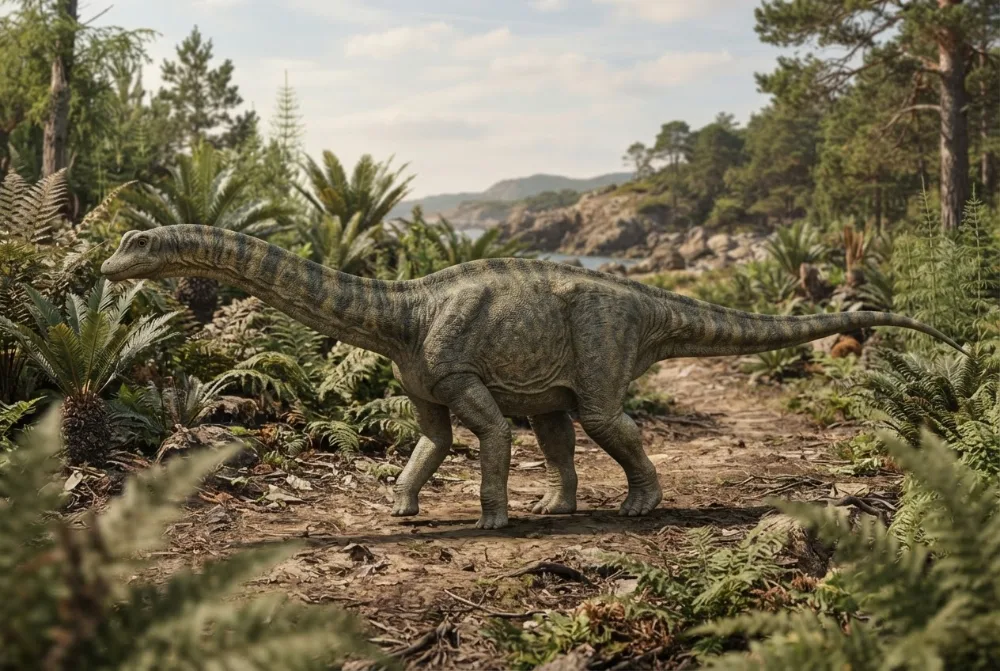
Europasaurus was a tiny sauropod dinosaur that lived on an island in what is now Germany. It was a dwarf, much smaller than its giant relatives like Brachiosaurus. Scientists think it shrank because food was limited on its island home.21
Kañ la dundoon?
Naka la réyoon?
Naka la guddoon?
Naka la kawewoon?
jortu
Naka la diisoon?

 gudd ni 6 xaj, bakkan ba geen🍌gudd ni 34 banaana yu ñu topp-toppalediis ni 100 xaj🍉diis ni 420 xaal🎒diis ni 2,5 klaas yu mat yu xale yu lekkool🐻❄️diis ni 5 uurs yu weex🏃mënoon na daw 100 meetar ci 13 segond (nit ki gën a gaaw dafay soxla 9,6)
Naka la Europasaurus réyoon, bu ñu ko méngalee ak YAW?
Ay kalkil rekk ci sa navigatëer. Dara du ñu denc, dara du ñu yónne fenn.
Naka la gaawoon?


Xibaar yu neex
Europasaurus is one of the smallest known sauropods, only about as long as a car.1
It lived during the Late Jurassic, about 154 to 151 million years ago.1
The first fossil was a single tooth found by a private collector named Holger Lüdtke in 1998.1
Bone studies show that Europasaurus grew more slowly than its giant relatives, a sign of island dwarfism.2
About one third of the Europasaurus bones found have tooth marks, probably from fish or crocodile-like scavengers.1
Young Europasaurus had well-developed inner ears, meaning they could probably hear well and may have stayed close to adults for protection.1
Laaj yi ñu gën a laaj ci Europasaurus
?How big was Europasaurus?
About 5.7 to 6.2 metres long, weighing 750 to 2,100 kilograms as an adult. That is roughly as long as a car.13
?Why was Europasaurus so small?
It was a dwarf species due to insular dwarfism, meaning it shrank because it lived on an island with limited food. Bone studies show it grew more slowly than its giant relatives.21
?What did Europasaurus eat?
It was herbivorous, meaning it ate plants. Conifer cones and twigs from araucarian trees (like modern monkey puzzle trees) have been found at its fossil site.31
?Did Europasaurus live in herds?
Yes, fossils of at least 11 individuals were found together, suggesting they lived in groups. Scientists think a herd might have drowned while crossing a tidal zone.1
?When did Europasaurus live?
It lived during the Late Jurassic Period, about 154 to 151 million years ago.13
?Where was Europasaurus found?
Its fossils were found in a quarry at Langenberg Mountain in northern Germany. It lived on an island in the Lower Saxony basin.1
Ngir ñi xam dino lool
- Turu xam-xam
- Europasaurus
- Ku ko tudde
- Sander et al. 20064
- Kurél
- Baat yu gudd
- Njaboot / klad
- Camarasauromorpha4
- Klasifikasiyoŋ
- Sauropodomorpha > Sauropoda > Macronaria4
- Màggaayu doj yi
- 152 ba 149 milyoŋ at (Kimmeridgian)4
- Formasiyoŋi doj
- Süntel4
- Réew yi
- Almaañ4
- Fosil yu ñu gis
- 1 ci The Paleobiology Database4
- Gisees
- The first fossils were found in 1998 by Holger Lüdtke in a quarry in Germany. After more bones were found, the species was named Europasaurus holgeri in 2006 by Sander and colleagues.1
- Ñu ngi koy werante ba tey
- Scientists are not sure exactly why Europasaurus became so small, but they think it was because it lived on an island with limited food.2
Fa xibaar yi jóge
- Europasaurus (en.wikipedia.org)
- nature.com (nature.com)
- Europasaurus | Natural History Museum (nhm.ac.uk)
- Europasaurus in The Paleobiology Database (CC BY 4.0): at, béréb yi, formasiyoŋi doj, klasifikasiyoŋ.
Bépp xibaar ci xët wii am na lim bu wone fa mu jóge. Su nu juumee, baal nu, nun ñu bëgg dino lanu, du ab sërnaalu xam-xam. Wax nu ko ci [email protected] nu defar ko.
 Rex xiif na! Dino Wiki, mbiru ab baay la ngir doomam ju góor ju bëgg dinosoor, ci neen te amul kaamuñaate, amul tracker. Mag ñi mën nañu jox Rex tuuti ñam ngir dimbali ko mu des ci internet.Dundal Rex
 Brachiosaurus
 Diplodocus
 Brontosaurus
 Argentinosaurus
 Camarasaurus
 Morosaurus
 Allosaurus
 Compsognathus
 Camptosaurus
 Nanosaurus
 Rhamphorhynchus
 Ceratosaurus