 Ban dino nga? Kiis
 Xeexu dino
 Rawante dino
 Fo yu ndaw yu dino
 Albomu sitikeer
 Limu TOP yu dino
 Bett ma!
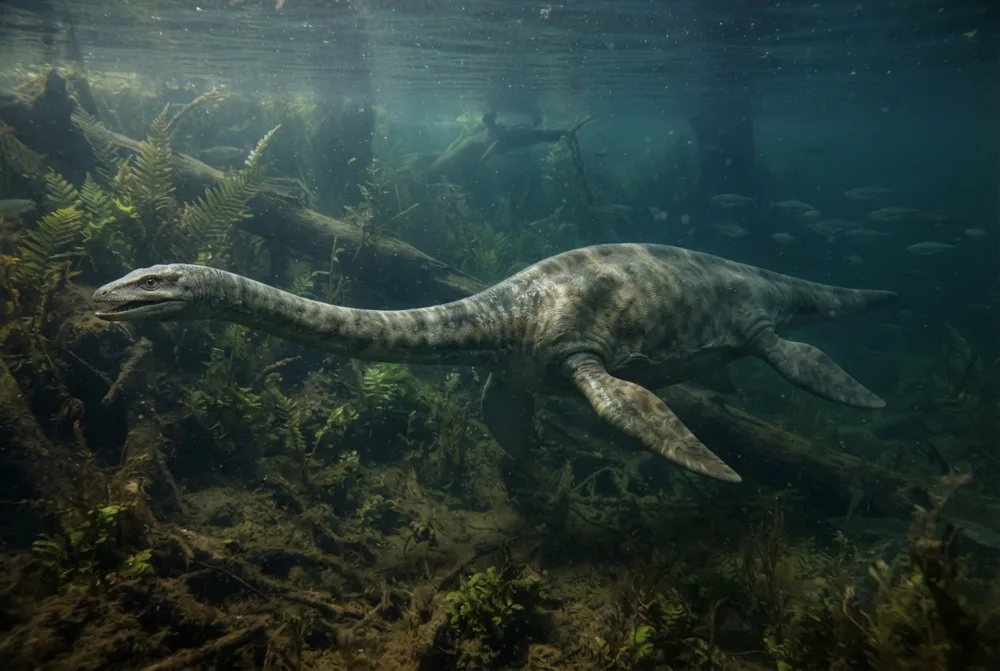
Fluvionectes
Fluvionectes was a long-necked marine reptile that swam in rivers and estuaries, not the open ocean. It was a type of plesiosaur called an elasmosaur, and it hunted fish and other prey in the water.1
Kañ la dundoon?
Naka la réyoon?
Naka la guddoon?
Naka la diisoon?
 gudd ni 7 xaj, bakkan ba geen🍌gudd ni 39 banaana yu ñu topp-toppale🍉diis ni 78 xaal🧸diis ni 21 xale yu maternel🎒diis ni 12 xale yu lekkool🏊mënoon na féey guddaayu pisin bu mag (50 m) ci 6,2 segond
Naka la Fluvionectes réyoon, bu ñu ko méngalee ak YAW?
Ay kalkil rekk ci sa navigatëer. Dara du ñu denc, dara du ñu yónne fenn.
Naka la gaawoon?


Xibaar yu neex
Fluvionectes is one of the few plesiosaurs found in non-marine rocks, meaning it lived in rivers and estuaries, not the open ocean.1
The holotype skeleton was found disarticulated, scattered over an area of about 2.5 square metres, with only two rib bones still connected.1
Fluvionectes had 22 dorsal vertebrae, which is a unique feature that helps scientists identify it as a new species.1
The name Fluvionectes comes from Latin and Greek words meaning 'river swimmer', because it lived in rivers.1
The species name sloanae honours Donna Sloan, who discovered the holotype and worked as a scientific illustrator at the Royal Tyrrell Museum.1
Fluvionectes was smaller than many other elasmosaurids that lived in the ocean, which might be because it lived in rivers.1
Laaj yi ñu gën a laaj ci Fluvionectes
?How big was Fluvionectes?
About 5 to 5.2 metres (16 to 17 ft) long for the holotype, and the largest known specimen may have reached 7 metres (23 ft).23
?What did Fluvionectes eat?
It hunted fish and other vertebrates in the water, using its slender tooth and powerful flippers to catch prey.4
?Where did Fluvionectes live?
It lived in rivers and estuaries (brackish water) in what is now Alberta, Canada, not in the open ocean like most other elasmosaurs.23
?Is Fluvionectes a dinosaur?
No, it is a plesiosaur, a type of marine reptile that lived in the water during the time of dinosaurs.2
Ku tas léeb yu dul dëgg
Léeb: Some people think all plesiosaurs lived only in the ocean.
Dëgg: Fluvionectes shows that some plesiosaurs lived in rivers and estuaries, not just the open sea.1
Ngir ñi xam dino lool
- Turu xam-xam
- Fluvionectes
- Ku ko tudde
- Campbell et al. 20215
- Kurél
- Plesiyosoor yi
- Njaboot / klad
- Elasmosauridae5
- Klasifikasiyoŋ
- Plesiosauria > Elasmosauridae > Sauropterygia5
- Màggaayu doj yi
- 84 ba 72 milyoŋ at (Campanian)5
- Formasiyoŋi doj
- Dinosaur Park5
- Réew yi
- Kanadaa5
- Fosil yu ñu gis
- 6 ci The Paleobiology Database5
- Gisees
- The holotype was discovered by Donna Sloan in the Dinosaur Park Formation in Alberta, Canada. It was named by Campbell and colleagues in 2021.1
- Ñu ngi koy werante ba tey
- Scientists are still debating why Fluvionectes was smaller than ocean-living elasmosaurids, and whether it spent its whole life in rivers or moved between fresh and salt water.1
Fa xibaar yi jóge
- PeerJ A new elasmosaurid (Sauropterygia: Plesiosauria) from the non-marine to paralic Dinosaur Park Formation of southern Alberta, Canada (peerj.com)
- Fluvionectes (en.wikipedia.org)
- A new elasmosaurid (Sauropterygia: Plesiosauria) from the non-marine to paralic Dinosaur Park Formation of southern Alberta, Canada (pmc.ncbi.nlm.nih.gov)
- New Late Cretaceous Marine Reptile publication by M. Ryan and J. Campbell | Department of Earth Sciences (earthsci.carleton.ca)
- Fluvionectes in The Paleobiology Database (CC BY 4.0): at, béréb yi, formasiyoŋi doj, klasifikasiyoŋ.
Bépp xibaar ci xët wii am na lim bu wone fa mu jóge. Su nu juumee, baal nu, nun ñu bëgg dino lanu, du ab sërnaalu xam-xam. Wax nu ko ci [email protected] nu defar ko.
 Rex xiif na! Dino Wiki, mbiru ab baay la ngir doomam ju góor ju bëgg dinosoor, ci neen te amul kaamuñaate, amul tracker. Mag ñi mën nañu jox Rex tuuti ñam ngir dimbali ko mu des ci internet.Dundal Rex
 Elasmosaurus
 Pliosaurus
 Plesiosaurus
 Cimoliasaurus
 Colymbosaurus
 Trinacromerum
 Tyrannosaurus
 Triceratops
 Velociraptor
 Spinosaurus
 Ankylosaurus
 Parasaurolophus