 Ban dino nga? Kiis
 Xeexu dino
 Rawante dino
 Fo yu ndaw yu dino
 Albomu sitikeer
 Limu TOP yu dino
 Bett ma!
Kañ la dundoon?

Naka la réyoon?
Naka la guddoon?
Naka la kawewoon?
jortu
Naka la diisoon?

 gudd ni 4 muusu kër, bakkan ba geen🍌gudd ni 11 banaana yu ñu topp-toppale🍉diis ni 29 xaal🧸diis ni 8 xale yu maternel🎒diis ni 5 xale yu lekkool🏃mënoon na daw 100 meetar ci 5,5 segond (nit ki gën a gaaw dafay soxla 9,6)
Naka la Harpymimus réyoon, bu ñu ko méngalee ak YAW?
Ay kalkil rekk ci sa navigatëer. Dara du ñu denc, dara du ñu yónne fenn.
Naka la gaawoon?


Xibaar yu neex
Harpymimus had about 11 small, blunt teeth only in its lower jaw, unlike later ostrich dinosaurs which had no teeth at all.2
Its name comes from the Harpies, scary bird monsters from Greek myths, and the Greek word for mimic.2
The only known skeleton is almost complete but was crushed flat, making some details hard to see.2
Harpymimus had a long neck, long arms with sharp claws, and long legs built for running.2
It lived alongside the horned dinosaur Psittacosaurus in the same region of Mongolia.2
Scientists think Harpymimus was an early member of the group that includes the giant-clawed Deinocheirus.2
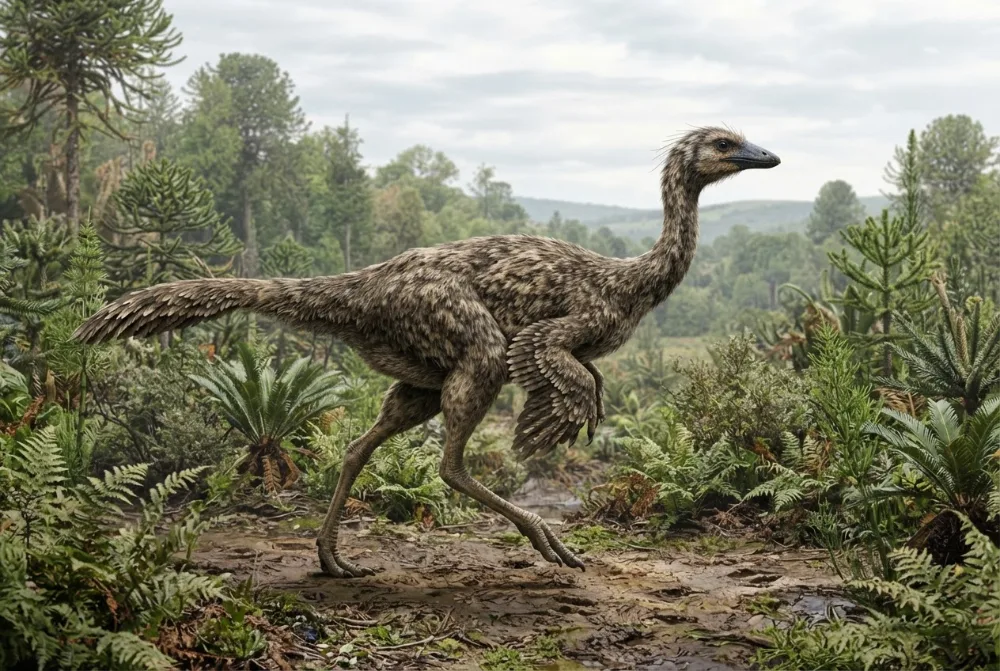
Laaj yi ñu gën a laaj ci Harpymimus
?How big was Harpymimus?
About 2 metres (6.6 feet) long and weighed over 146.5 kilograms (323 pounds).12
?What did Harpymimus eat?
It was omnivorous. Its small, blunt teeth and beak were used for grabbing and holding food, not cutting or piercing.12
?Did Harpymimus have feathers?
The sources do not mention feathers, but as a theropod dinosaur related to birds, it may have had simple feathers. No direct evidence has been found.2
?When did Harpymimus live?
It lived during the Early Cretaceous Period, about 121 to 99 million years ago.1
Ngir ñi xam dino lool
- Turu xam-xam
- Harpymimus
- Ku ko tudde
- Barsbold and Perle 19843
- Kurél
- Dino yu niru otris
- Njaboot / klad
- Deinocheiridae3
- Klasifikasiyoŋ
- Theropoda > Ornithomimosauria3
- Màggaayu doj yi
- 110 ba 100 milyoŋ at (Albian)3
- Formasiyoŋi doj
- Khuren Dukh3
- Réew yi
- Mongoli3
- Fosil yu ñu gis
- 1 ci The Paleobiology Database3
- Gisees
- A Soviet-Mongolian expedition found the skeleton in the Gobi Desert in 1981. In 1984, paleontologists Rinchen Barsbold and Altangerel Perle named it Harpymimus okladnikovi after the archaeologist Alexey Okladnikov.2
- Ñu ngi koy werante ba tey
- Scientists are not sure exactly how Harpymimus used its small teeth, since they were too blunt for cutting meat or plants.2
Fa xibaar yi jóge
- Harpymimus | Natural History Museum (nhm.ac.uk)
- Harpymimus (en.wikipedia.org)
- Harpymimus in The Paleobiology Database (CC BY 4.0): at, béréb yi, formasiyoŋi doj, klasifikasiyoŋ.
Bépp xibaar ci xët wii am na lim bu wone fa mu jóge. Su nu juumee, baal nu, nun ñu bëgg dino lanu, du ab sërnaalu xam-xam. Wax nu ko ci [email protected] nu defar ko.
 Rex xiif na! Dino Wiki, mbiru ab baay la ngir doomam ju góor ju bëgg dinosoor, ci neen te amul kaamuñaate, amul tracker. Mag ñi mën nañu jox Rex tuuti ñam ngir dimbali ko mu des ci internet.Dundal Rex
 Gallimimus
 Ornithomimus
 Struthiomimus
 Deinocheirus
 Dromiceiomimus
 Archaeornithomimus
 Stegosaurus
 Iguanodon
 Archaeopteryx
 Giganotosaurus
 Microraptor
 Deinonychus