 Ban dino nga? Kiis
 Xeexu dino
 Rawante dino
 Fo yu ndaw yu dino
 Albomu sitikeer
 Limu TOP yu dino
 Bett ma!
Kañ la dundoon?

Naka la réyoon?
Naka la guddoon?
Naka la kawewoon?
jortu
Naka la diisoon?
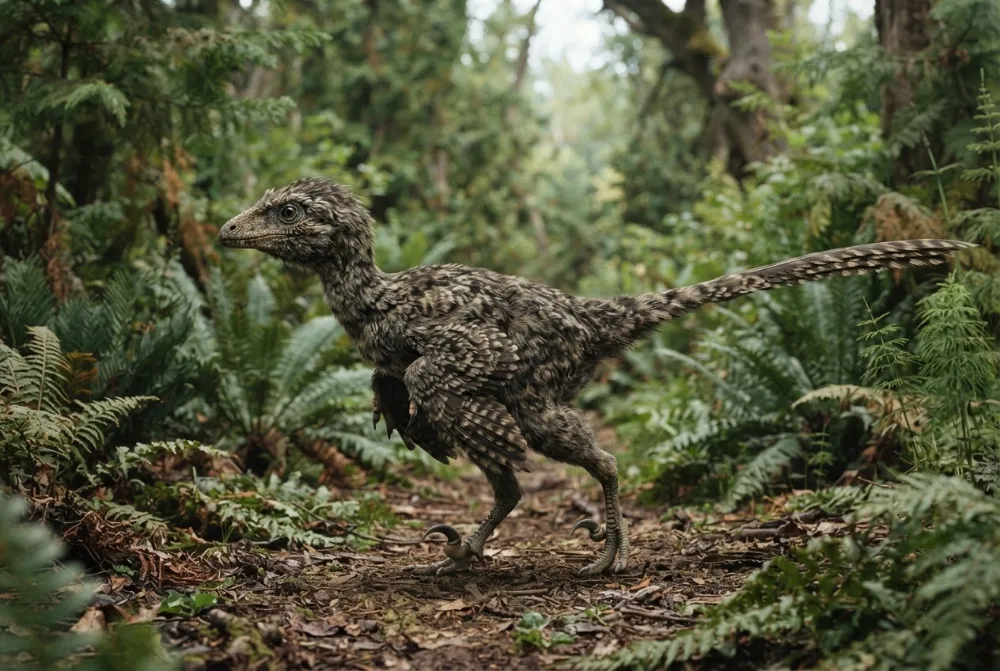
 gudd ni 2 muusu kër, bakkan ba geen🍌gudd ni 6 banaana yu ñu topp-toppale🪶gën a woyof muusu kër🍌diis ni 16 banaana🪑tuuti ba mën a dox ci suufu siis🏃mënoon na daw 100 meetar ci 15 segond (nit ki gën a gaaw dafay soxla 9,6)
Naka la Hesperonychus réyoon, bu ñu ko méngalee ak YAW?
Ay kalkil rekk ci sa navigatëer. Dara du ñu denc, dara du ñu yónne fenn.
Naka la gaawoon?


Xibaar yu neex
Hesperonychus weighed only about 1.9 kilograms, which is less than a house cat.1
It is the smallest carnivorous non-avian dinosaur known from North America.1
Hesperonychus belongs to a group called Microraptorinae, which includes the four-winged Microraptor from China.1
Its fossils were first collected in 1982 but were not studied until 25 years later.1
Hesperonychus lived about 75 million years ago during the Late Cretaceous.1
Even though it was fully grown, its hip bones were fused together, showing it was an adult.1
Laaj yi ñu gën a laaj ci Hesperonychus
?How big was Hesperonychus?
About 1 metre long and weighed between 1.5 and 2 kilograms, roughly the size of a large cat.31
?What did Hesperonychus eat?
It was a meat-eater. It ate small animals like lizards, mammals, and insects.31
?Did Hesperonychus have feathers?
Yes, it almost certainly had feathers. It belonged to a group of feathered dinosaurs called Microraptorinae, which includes the four-winged Microraptor.31
?Could Hesperonychus fly?
Probably not. Scientists think it was more like a ground-running predator, not a glider like its relative Microraptor.3
Ngir ñi xam dino lool
- Turu xam-xam
- Hesperonychus
- Ku ko tudde
- Longrich and Currie 20094
- Kurél
- Raptor yi
- Njaboot / klad
- Dromaeosauridae4
- Klasifikasiyoŋ
- Theropoda > Dromaeosauridae4
- Màggaayu doj yi
- 84 ba 72 milyoŋ at (Campanian)4
- Formasiyoŋi doj
- Dinosaur Park, Oldman4
- Réew yi
- Kanadaa4
- Fosil yu ñu gis
- 4 ci The Paleobiology Database4
- Gisees
- The holotype was collected in 1982 by Dr. Elizabeth Nicholls, but it was not described until 2009 by Nicholas Longrich and Philip Currie. The species name honors Elizabeth Nicholls.13
- Ñu ngi koy werante ba tey
- Scientists are not sure exactly how many small dromaeosaurids lived in North America, because only isolated bones have been found so far.1
Fa xibaar yi jóge
- A microraptorine (Dinosauria, Dromaeosauridae) from the Late Cretaceous of North America (pmc.ncbi.nlm.nih.gov)
- A microraptorine (Dinosauria, Dromaeosauridae) from the Late Cretaceous of North America (pnas.org)
- Hesperonychus (en.wikipedia.org)
- Hesperonychus in The Paleobiology Database (CC BY 4.0): at, béréb yi, formasiyoŋi doj, klasifikasiyoŋ.
Bépp xibaar ci xët wii am na lim bu wone fa mu jóge. Su nu juumee, baal nu, nun ñu bëgg dino lanu, du ab sërnaalu xam-xam. Wax nu ko ci [email protected] nu defar ko.
 Rex xiif na! Dino Wiki, mbiru ab baay la ngir doomam ju góor ju bëgg dinosoor, ci neen te amul kaamuñaate, amul tracker. Mag ñi mën nañu jox Rex tuuti ñam ngir dimbali ko mu des ci internet.Dundal Rex
 Velociraptor
 Microraptor
 Deinonychus
 Asiamericana
 Richardoestesia
 Saurornitholestes
 Tyrannosaurus
 Triceratops
 Spinosaurus
 Ankylosaurus
 Parasaurolophus
 Pteranodon