 Ban dino nga? Kiis
 Xeexu dino
 Rawante dino
 Fo yu ndaw yu dino
 Albomu sitikeer
 Limu TOP yu dino
 Bett ma!
Kañ la dundoon?

Naka la réyoon?
Naka la guddoon?
Naka la kawewoon?
jortu
Naka la diisoon?

 gudd ni 6 xaj, bakkan ba geen🍌gudd ni 36 banaana yu ñu topp-toppale
 lu tollu ci diisaayu ñey🍉diis ni 1000 xaal🎒diis ni 6 klaas yu mat yu xale yu lekkool🐻❄️diis ni 11 uurs yu weex🏃mënoon na daw 100 meetar ci 28 segond (nit ki gën a gaaw dafay soxla 9,6)
Naka la Hesperosaurus réyoon, bu ñu ko méngalee ak YAW?
Ay kalkil rekk ci sa navigatëer. Dara du ñu denc, dara du ñu yónne fenn.
Naka la gaawoon?


Xibaar yu neex
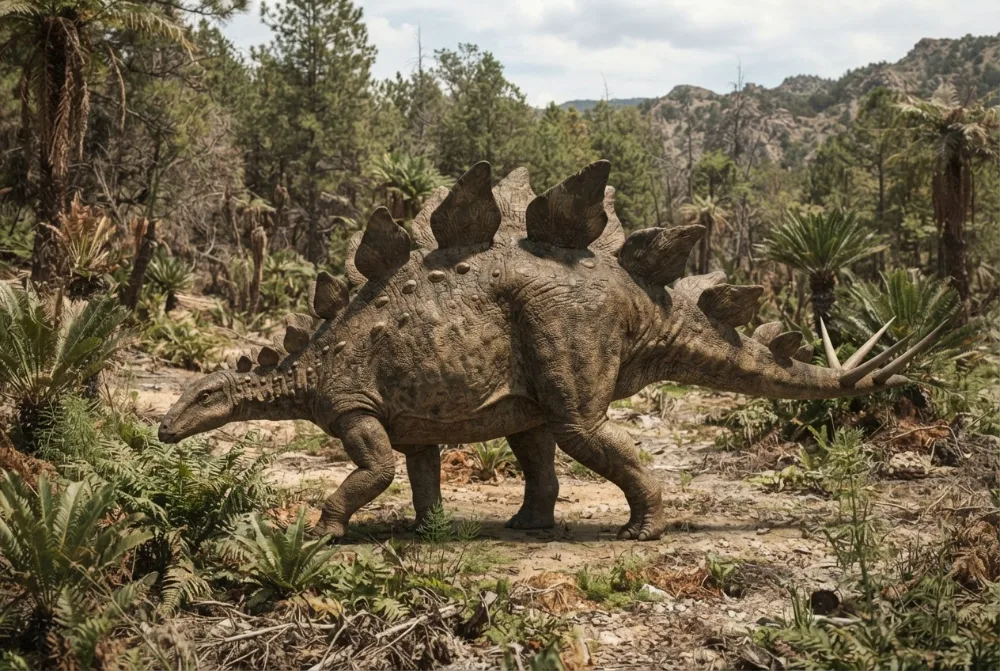
Hesperosaurus is known from a nearly complete skeleton and skull, which is rare for stegosaurs.3
One fossil preserves the first known impression of the horn sheath on a stegosaur back plate.1
Its back plates were longer and lower than those of its close relative Stegosaurus.1
Hesperosaurus lived a little earlier than other stegosaurs from the Morrison Formation.1
The tail spikes, called a thagomizer, had two pairs: the front pair thicker and the rear pair thinner and more horizontal.1
Scientists have debated whether Hesperosaurus should be its own genus or a species of Stegosaurus.1
Laaj yi ñu gën a laaj ci Hesperosaurus
?How big was Hesperosaurus?
Hesperosaurus was a large stegosaur, reaching about 6.5 metres (21 feet) in length and weighing around 3.5 metric tons (3.9 short tons). Some large individuals may have reached 5 metric tons (5.5 short tons).1
?What did Hesperosaurus eat?
Hesperosaurus was a herbivore, meaning it ate plants. It was a quadrupedal plant-eater, like other stegosaurs.13
?When did Hesperosaurus live?
Hesperosaurus lived during the Late Jurassic period, about 156 million years ago. It lived a little earlier than other stegosaurs from the Morrison Formation.13
?Where was Hesperosaurus found?
Fossils of Hesperosaurus have been found in the states of Wyoming and Montana in the United States of America. They were first discovered in 1985.1
?Did Hesperosaurus have plates or spikes?
Hesperosaurus had two rows of bony plates on its back and four spikes on its tail. The tail spikes, called a thagomizer, had two pairs: the front pair thicker and the rear pair thinner and more horizontal.1
Ngir ñi xam dino lool
- Turu xam-xam
- Hesperosaurus
- Ku ko tudde
- Carpenter et al. 20014
- Kurél
- Dino yu am ay plak
- Njaboot / klad
- Stegosauridae4
- Klasifikasiyoŋ
- Ornithischia > Stegosauria > Thyreophora4
- Màggaayu doj yi
- 158 ba 143 milyoŋ at ()4
- Formasiyoŋi doj
- Morrison4
- Réew yi
- Amerig4
- Fosil yu ñu gis
- 8 ci The Paleobiology Database4
- Gisees
- Hesperosaurus was named in 2001 by Kenneth Carpenter, Clifford Miles, and Karen Cloward. The first fossils were found in 1985 on a ranch in Johnson County, Wyoming, USA.1
- Ñu ngi koy werante ba tey
- Scientists still debate whether Hesperosaurus is a separate genus from Stegosaurus or just a species of Stegosaurus.1
Fa xibaar yi jóge
- Hesperosaurus (en.wikipedia.org)
- PBDB Taxon (paleobiodb.org)
- Hesperosaurus | Natural History Museum (nhm.ac.uk)
- Hesperosaurus in The Paleobiology Database (CC BY 4.0): at, béréb yi, formasiyoŋi doj, klasifikasiyoŋ.
Bépp xibaar ci xët wii am na lim bu wone fa mu jóge. Su nu juumee, baal nu, nun ñu bëgg dino lanu, du ab sërnaalu xam-xam. Wax nu ko ci [email protected] nu defar ko.
 Rex xiif na! Dino Wiki, mbiru ab baay la ngir doomam ju góor ju bëgg dinosoor, ci neen te amul kaamuñaate, amul tracker. Mag ñi mën nañu jox Rex tuuti ñam ngir dimbali ko mu des ci internet.Dundal Rex
 Stegosaurus
 Diracodon
 Hypsirophus
 Dacentrurus
 Miragaia
 Kentrosaurus
 Brachiosaurus
 Diplodocus
 Allosaurus
 Brontosaurus
 Compsognathus
 Camarasaurus