 Ban dino nga? Kiis
 Xeexu dino
 Rawante dino
 Fo yu ndaw yu dino
 Albomu sitikeer
 Limu TOP yu dino
 Bett ma!
Honghesaurus
Honghesaurus was a small, lizard-like marine reptile that swam in the warm Tethys Ocean about 244 million years ago. It had an incredibly long tail, longer than any other pachypleurosaur, which helped it wiggle through the water like a fish.1
Kañ la dundoon?
Naka la réyoon?
Naka la guddoon?
Naka la Honghesaurus réyoon, bu ñu ko méngalee ak YAW?
Ay kalkil rekk ci sa navigatëer. Dara du ñu denc, dara du ñu yónne fenn.
Naka la gaawoon?


Xibaar yu neex
Honghesaurus had 121 vertebrae in total, including 69 in its tail, making it the longest-tailed pachypleurosaur known.1
Its long trunk and tail gave it an advantage in maneuverability and energy efficiency for swimming with side-to-side movements.1
It had a unique feature: two fossae (small pits) in its retroarticular process, a part of the jaw, which is not seen in any other pachypleurosaur.1
Its tail was mostly laterally compressed because it had only five pairs of caudal ribs, helping it move through water efficiently.1
Honghesaurus had 29 dorsal (back) vertebrae, more than most other pachypleurosaurs, which usually have 25 or fewer.1
It lived in a semi-enclosed sea called the Yangtze Sea, part of the eastern Palaeotethys Ocean, during the Middle Triassic.1
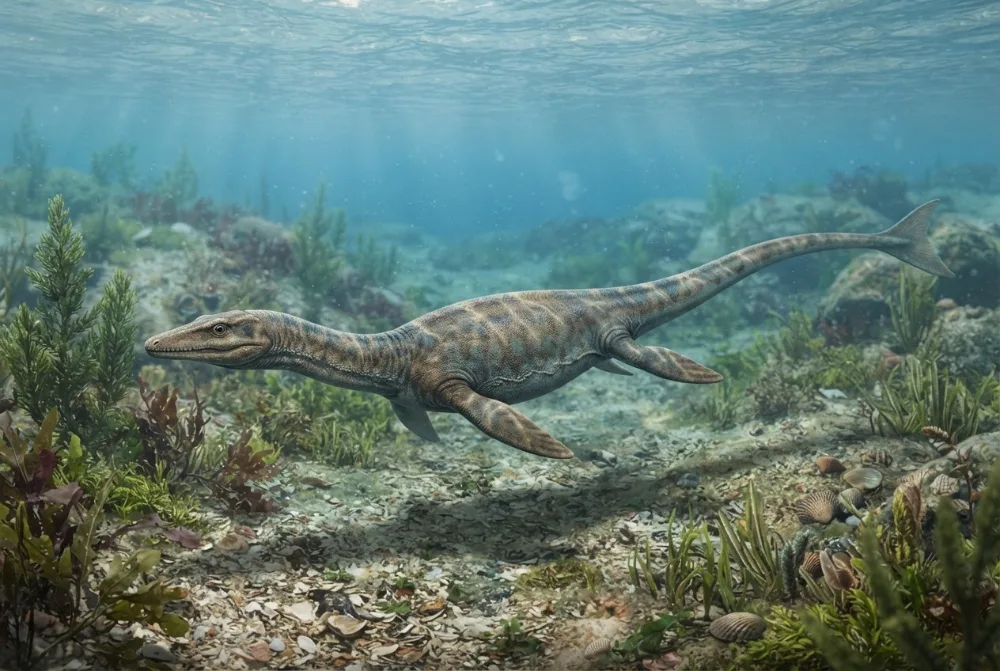
Ngir ñi xam dino lool
- Turu xam-xam
- Honghesaurus
- Ku ko tudde
- Xu et al. 20222
- Kurél
- Reptil yu géej
- Njaboot / klad
- Pachypleurosauridae2
- Klasifikasiyoŋ
- Sauropterygia2
- Màggaayu doj yi
- 244 ba 243 milyoŋ at ()2
- Formasiyoŋi doj
- Guanling2
- Réew yi
- Siin2
- Fosil yu ñu gis
- 1 ci The Paleobiology Database2
- Gisees
- The fossil was collected in 2021 during autumn fieldwork led by the first author, from the Guanling Formation in Luxi, Yunnan, China. It was named by Xu and colleagues in 2022.12
- Ñu ngi koy werante ba tey
- Scientists are still debating how Honghesaurus and other pachypleurosaurs are related to each other, and whether they all came from Europe or spread from the east.1
Fa xibaar yi jóge
- A long-tailed marine reptile from China provides new insights into the Middle Triassic pachypleurosaur radiation | Scientific Reports (nature.com)
- Honghesaurus in The Paleobiology Database (CC BY 4.0): at, béréb yi, formasiyoŋi doj, klasifikasiyoŋ.
Bépp xibaar ci xët wii am na lim bu wone fa mu jóge. Su nu juumee, baal nu, nun ñu bëgg dino lanu, du ab sërnaalu xam-xam. Wax nu ko ci [email protected] nu defar ko.
 Rex xiif na! Dino Wiki, mbiru ab baay la ngir doomam ju góor ju bëgg dinosoor, ci neen te amul kaamuñaate, amul tracker. Mag ñi mën nañu jox Rex tuuti ñam ngir dimbali ko mu des ci internet.Dundal Rex
 Nothosaurus
 Placodus
 Lariosaurus
 Cyamodus
 Cymatosaurus
 Proneusticosaurus
 Chonespondylus
 Cymbospondylus
 Phalarodon
 Mixosaurus
 Chaohusaurus
 Chensaurus