 Ban dino nga? Kiis
 Xeexu dino
 Rawante dino
 Fo yu ndaw yu dino
 Albomu sitikeer
 Limu TOP yu dino
 Bett ma!
Kañ la dundoon?

Naka la gaawoon?


Xibaar yu neex
Jiangxisaurus had a very long lower jaw compared to other oviraptorids, with a height-to-length ratio of about 20%.1
Its arm bones show that the radius (forearm bone) was only about 70% as long as the humerus (upper arm bone).1
The only known fossil of Jiangxisaurus is a partial skeleton that includes part of the skull, neck bones, and a nearly complete shoulder and arm.1
This dinosaur lived about 72 to 66 million years ago, during the very end of the Cretaceous Period.13
Jiangxisaurus shared its home with many other dinosaurs, including the tyrannosaur Qianzhousaurus and several other oviraptorids.1
Its skull was about 150 mm long, and the animal was probably a sub-adult when it died.1
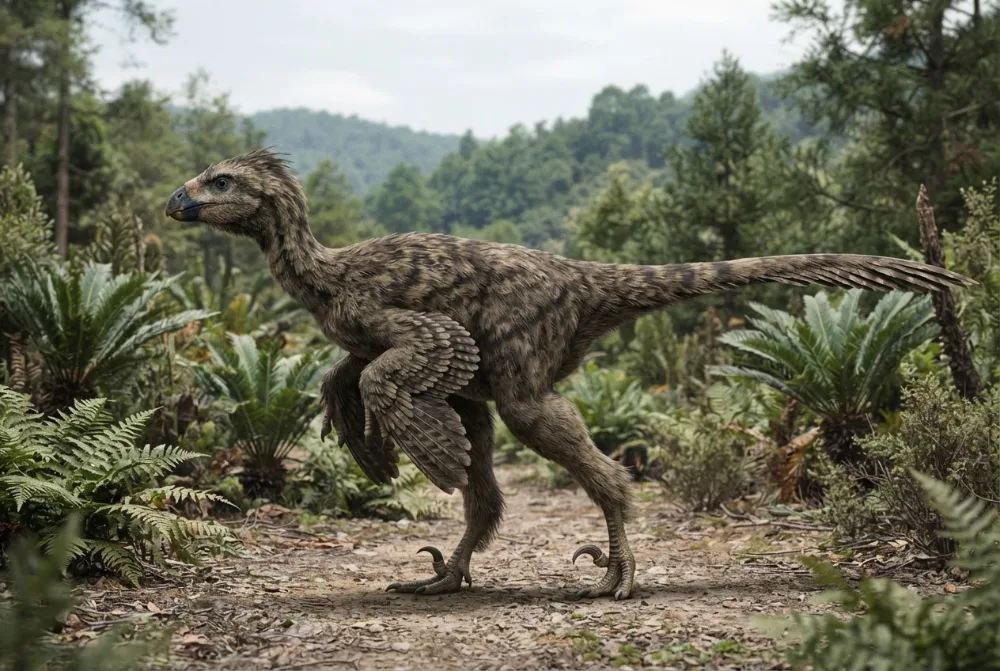
Laaj yi ñu gën a laaj ci Jiangxisaurus
?What did Jiangxisaurus eat?
Jiangxisaurus was most likely an omnivore, eating both plants and small animals. Its toothless beak and weak lower jaw suggest it may have eaten soft foods like leaves and seeds.12
?How big was Jiangxisaurus?
Jiangxisaurus was a medium-sized oviraptorid dinosaur. Its skull was about 150 mm long, and the only known fossil is from a sub-adult, so full size is not certain.1
?When did Jiangxisaurus live?
Jiangxisaurus lived during the Late Cretaceous Period, about 72 to 66 million years ago.1
Ngir ñi xam dino lool
- Turu xam-xam
- Jiangxisaurus
- Ku ko tudde
- Wei et al. 20133
- Kurél
- Dino yu am dun yu doy waar
- Njaboot / klad
- Oviraptoridae3
- Klasifikasiyoŋ
- Theropoda > Oviraptorosauria3
- Màggaayu doj yi
- 72 ba 66 milyoŋ at (Maastrichtian)3
- Réew yi
- Siin3
- Fosil yu ñu gis
- 1 ci The Paleobiology Database3
- Gisees
- Jiangxisaurus was named and described by Wei Xuefang, Pu Hanyong, Xu Li, Liu Di, and Lü Junchang in 2013. The only specimen was found in red sandstone in Ganzhou City, Jiangxi Province, China.1
- Ñu ngi koy werante ba tey
- Scientists are not sure exactly how Jiangxisaurus is related to other oviraptorids, though some studies place it in the group Heyuanninae.3
Fa xibaar yi jóge
- Jiangxisaurus (en.wikipedia.org)
- A New Oviraptorosaur (Dinosauria: Oviraptorosauria) from the Late Cretaceous of Southern China and Its Paleoecological Implications | PLOS One (journals.plos.org)
- Jiangxisaurus in The Paleobiology Database (CC BY 4.0): at, béréb yi, formasiyoŋi doj, klasifikasiyoŋ.
Bépp xibaar ci xët wii am na lim bu wone fa mu jóge. Su nu juumee, baal nu, nun ñu bëgg dino lanu, du ab sërnaalu xam-xam. Wax nu ko ci [email protected] nu defar ko.
 Rex xiif na! Dino Wiki, mbiru ab baay la ngir doomam ju góor ju bëgg dinosoor, ci neen te amul kaamuñaate, amul tracker. Mag ñi mën nañu jox Rex tuuti ñam ngir dimbali ko mu des ci internet.Dundal Rex
 Therizinosaurus
 Oviraptor
 Chirostenotes
 Citipes
 Leptorhynchos
 Avimimus
 Tyrannosaurus
 Triceratops
 Velociraptor
 Spinosaurus
 Ankylosaurus
 Parasaurolophus