 Ban dino nga? Kiis
 Xeexu dino
 Rawante dino
 Fo yu ndaw yu dino
 Albomu sitikeer
 Limu TOP yu dino
 Bett ma!
Kaikaifilu
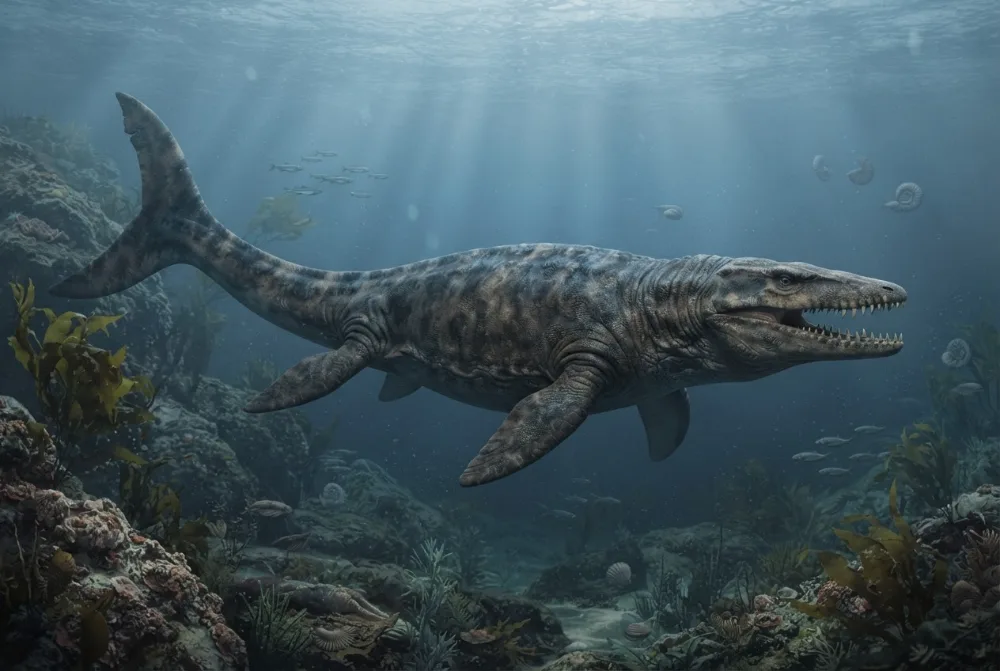
Kaikaifilu was a giant marine lizard that swam in the cold seas near Antarctica 66 million years ago. It was one of the biggest mosasaurs in the Southern Hemisphere, with a skull as long as a tall child!1
Kañ la dundoon?
Naka la réyoon?
Naka la guddoon?
 gudd ni 2 oto yu ñu taxawal ci benn rëdd🍌gudd ni 56 banaana yu ñu topp-toppale🏊mënoon na féey guddaayu pisin bu mag (50 m) ci 5,5 segond
Naka la Kaikaifilu réyoon, bu ñu ko méngalee ak YAW?
Ay kalkil rekk ci sa navigatëer. Dara du ñu denc, dara du ñu yónne fenn.
Naka la gaawoon?


Xibaar yu neex
Kaikaifilu had different types of teeth in its mouth, which is rare for mosasaurs. This is called heterodont dentition.1
Its skull was about 1.1 to 1.2 metres long, almost twice as long as the skull of another Antarctic mosasaur called Taniwhasaurus antarcticus.1
Kaikaifilu lived in waters that could be as cold as 6 °C, and sometimes the sea surface temperature dropped below freezing.1
It lived right at the end of the Age of Dinosaurs, during the Cretaceous-Paleogene extinction event, and was one of the last mosasaurs to exist.1
The only known fossil of Kaikaifilu is a partial skull and a humerus (upper arm bone), found in 2011 by a Chilean expedition.2
Scientists think Kaikaifilu might belong to the Tylosaurinae group, but some features make this uncertain.1
Laaj yi ñu gën a laaj ci Kaikaifilu
?How big was Kaikaifilu?
About 10 metres long, making it the largest mosasaur known from the Southern Hemisphere.13
?What did Kaikaifilu eat?
It was an apex predator that ate fish, plesiosaurs, other mosasaurs, and filter-feeding marine reptiles.13
?When did Kaikaifilu live?
It lived about 66 million years ago, right at the end of the Age of Dinosaurs, during the Cretaceous-Paleogene extinction event.13
?Where was Kaikaifilu found?
Its fossil was found on Seymour Island in Antarctica, by a Chilean expedition in 2011.1
?Why did Kaikaifilu have different teeth?
It had different types of teeth (heterodont dentition), which is rare for mosasaurs and helped it eat a variety of prey.1
Ngir ñi xam dino lool
- Turu xam-xam
- Kaikaifilu
- Ku ko tudde
- Otero et al. 20174
- Kurél
- Mosasoor yi
- Njaboot / klad
- Mosasauridae4
- Klasifikasiyoŋ
- Mosasauroidea4
- Màggaayu doj yi
- 72 ba 66 milyoŋ at (Maastrichtian)4
- Formasiyoŋi doj
- Lopez de Bertodano4
- Réew yi
- Antarktik4
- Fosil yu ñu gis
- 1 ci The Paleobiology Database4
- Gisees
- Kaikaifilu was named in 2017 by Rodrigo Otero and colleagues, based on a fossil found in January 2011 on Seymour Island, Antarctica, by a Chilean expedition.42
- Ñu ngi koy werante ba tey
- Scientists are not sure if Kaikaifilu truly belongs to the Tylosaurinae group, because some of its features are different from other tylosaurines.1
Fa xibaar yi jóge
- Kaikaifilu (en.wikipedia.org)
- Kaikaifilu hervei gen. et sp. nov., a new large mosasaur (Squamata, Mosasauridae) from the upper Maastrichtian of Antarctica (sciencedirect.com)
- A giant predatory lizard swam in Antarctic seas near the end of the dinosaur age | ScienceDaily (sciencedaily.com)
- Kaikaifilu in The Paleobiology Database (CC BY 4.0): at, béréb yi, formasiyoŋi doj, klasifikasiyoŋ.
Bépp xibaar ci xët wii am na lim bu wone fa mu jóge. Su nu juumee, baal nu, nun ñu bëgg dino lanu, du ab sërnaalu xam-xam. Wax nu ko ci [email protected] nu defar ko.
 Rex xiif na! Dino Wiki, mbiru ab baay la ngir doomam ju góor ju bëgg dinosoor, ci neen te amul kaamuñaate, amul tracker. Mag ñi mën nañu jox Rex tuuti ñam ngir dimbali ko mu des ci internet.Dundal Rex
 Mosasaurus
 Prognathodon
 Tylosaurus
 Platecarpus
 Clidastes
 Globidens
 Tyrannosaurus
 Triceratops
 Velociraptor
 Spinosaurus
 Ankylosaurus
 Parasaurolophus