 Ban dino nga? Kiis
 Xeexu dino
 Rawante dino
 Fo yu ndaw yu dino
 Albomu sitikeer
 Limu TOP yu dino
 Bett ma!
Keichousaurus
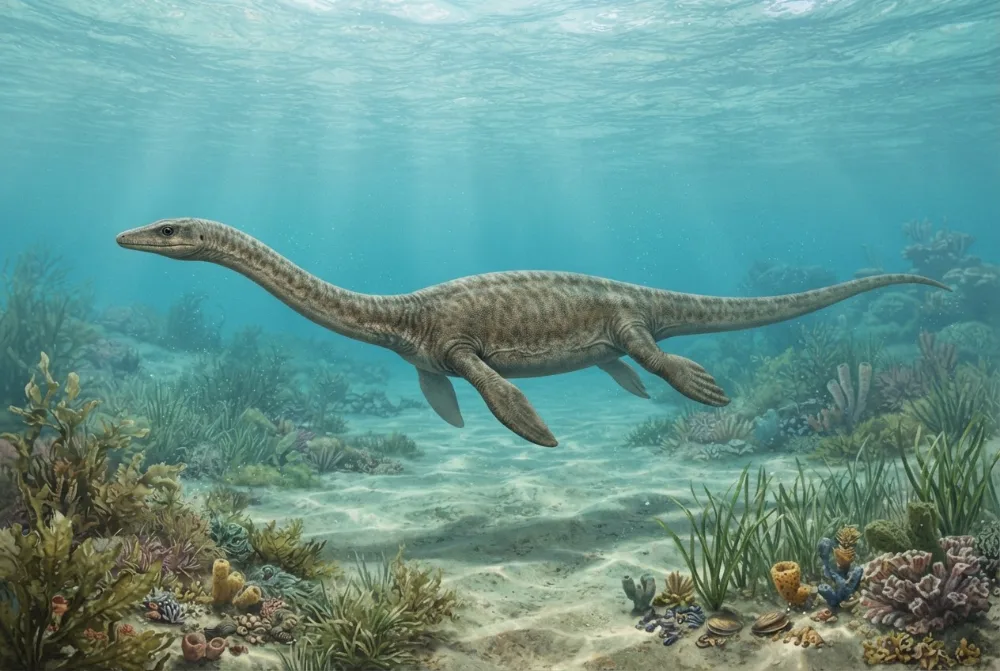
Keichousaurus was a small marine reptile that swam in warm seas during the Triassic Period. It had a long neck, a long tail, and paddle-like limbs to row through the water.1
Kañ la dundoon?
Naka la réyoon?
Naka la guddoon?
Naka la Keichousaurus réyoon, bu ñu ko méngalee ak YAW?
Ay kalkil rekk ci sa navigatëer. Dara du ñu denc, dara du ñu yónne fenn.
Naka la gaawoon?


Xibaar yu neex
Keichousaurus gave birth to live young instead of laying eggs. Baby fossils have been found inside adult females.1
This reptile had very broad ulna bones in its forelimbs, which helped make its paddles more effective for swimming.1
Males grew slightly larger than females. Mature males reached about 16 cm snout-vent length, while females reached about 15 cm.1
Keichousaurus is one of the most common sauropterygian fossils found in China. Many complete skeletons have been collected.1
It had a long, serpentine neck and a small head, similar to other pachypleurosaurs.1
Keichousaurus probably used a rowing motion with its paddle-like limbs to move through the water.1
Laaj yi ñu gën a laaj ci Keichousaurus
?Is Keichousaurus a dinosaur?
No, Keichousaurus is not a dinosaur. It is a marine reptile called a sauropterygian.1
?How big was Keichousaurus?
Keichousaurus was very small. Mature males reached about 16 cm snout-vent length, and females about 15 cm.1
?What did Keichousaurus eat?
It ate fish. It had pointed teeth and backward-curved teeth at the front of its mouth to catch and swallow prey whole.1
?Did Keichousaurus lay eggs?
No. Fossil evidence shows that Keichousaurus gave birth to live young, not eggs. Babies have been found inside adult females.143
?Could Keichousaurus swim?
Yes, it was a good swimmer. It used its paddle-like limbs to row through the water, similar to underwater flight.1
?When did Keichousaurus live?
Keichousaurus lived during the Triassic Period, from about 251 to 227 million years ago.1
Ngir ñi xam dino lool
- Turu xam-xam
- Keichousaurus
- Ku ko tudde
- Young 19585
- Kurél
- Reptil yu géej
- Njaboot / klad
- Keichousauridae5
- Klasifikasiyoŋ
- Sauropterygia5
- Màggaayu doj yi
- 251 ba 237 milyoŋ at ()5
- Formasiyoŋi doj
- Falang, Jialingjiang, Gejiu5
- Réew yi
- Siin5
- Fosil yu ñu gis
- 7 ci The Paleobiology Database5
- Gisees
- The first fossil of Keichousaurus was found in 1957 in Guizhou Province, China, by Hu Chengzhi. It was named by Chinese paleontologist Young Chung-chien in 1958.1
- Ñu ngi koy werante ba tey
- Scientists are not sure whether Keichousaurus was viviparous (giving birth to live young) or ovoviviparous (eggs hatching inside the mother).3
Fa xibaar yi jóge
- Keichousaurus (en.wikipedia.org)
- PBDB Taxon (paleobiodb.org)
- Morphology of Keichousaurus hui from the Middle Triassic of Xingyi, Guizhou Province with Comments on Its Reproduction Mode (xbna.pku.edu.cn)
- Triassic marine reptiles gave birth to live young | Nature (nature.com)
- Keichousaurus in The Paleobiology Database (CC BY 4.0): at, béréb yi, formasiyoŋi doj, klasifikasiyoŋ.
Bépp xibaar ci xët wii am na lim bu wone fa mu jóge. Su nu juumee, baal nu, nun ñu bëgg dino lanu, du ab sërnaalu xam-xam. Wax nu ko ci [email protected] nu defar ko.
 Rex xiif na! Dino Wiki, mbiru ab baay la ngir doomam ju góor ju bëgg dinosoor, ci neen te amul kaamuñaate, amul tracker. Mag ñi mën nañu jox Rex tuuti ñam ngir dimbali ko mu des ci internet.Dundal Rex
 Nothosaurus
 Placodus
 Lariosaurus
 Cyamodus
 Cymatosaurus
 Proneusticosaurus
 Chonespondylus
 Cymbospondylus
 Phalarodon
 Mixosaurus
 Chaohusaurus
 Chensaurus