 Ban dino nga? Kiis
 Xeexu dino
 Rawante dino
 Fo yu ndaw yu dino
 Albomu sitikeer
 Limu TOP yu dino
 Bett ma!
Kerberosaurus
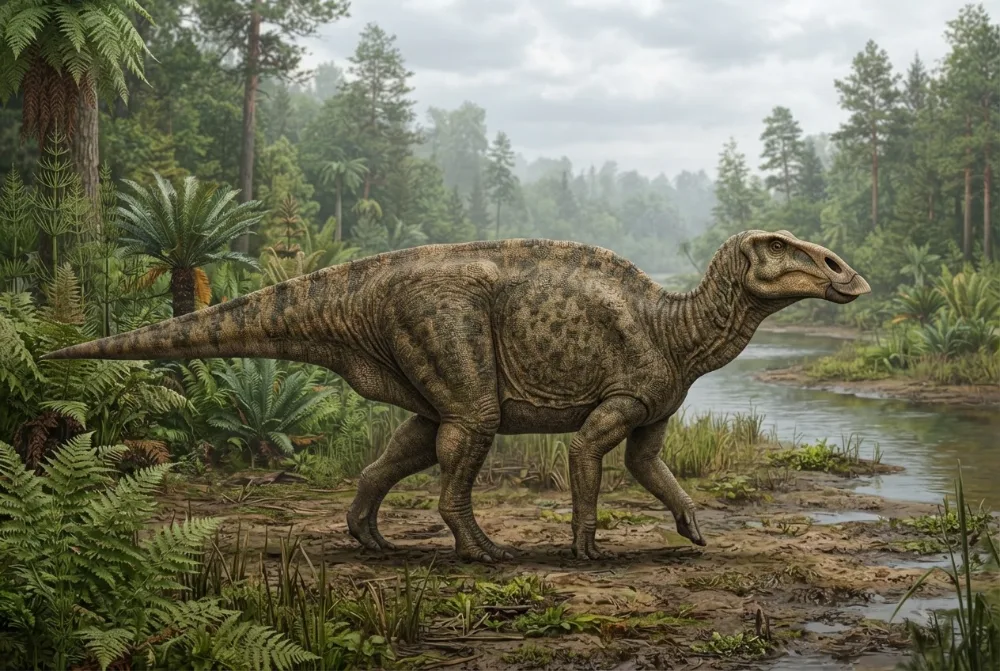
Kerberosaurus was a duck-billed dinosaur that lived in what is now Russia. It had a flat head and a wide, flattened crest around its nostrils. This plant-eater could walk on two legs or all fours.1
Kañ la dundoon?
Naka la réyoon?
Naka la guddoon?
Naka la kawewoon?
jortu
 gudd ni 8 xaj, bakkan ba geen🍌gudd ni 44 banaana yu ñu topp-toppale🏃mënoon na daw 100 meetar ci 14 segond (nit ki gën a gaaw dafay soxla 9,6)
Naka la Kerberosaurus réyoon, bu ñu ko méngalee ak YAW?
Ay kalkil rekk ci sa navigatëer. Dara du ñu denc, dara du ñu yónne fenn.
Naka la gaawoon?


Xibaar yu neex
Kerberosaurus is named after Kerberos, the three-headed dog that guarded the underworld in Greek myths.1
Its fossils were found in a bonebed with many other dinosaurs, including Amurosaurus, turtles, crocodiles, and even meat-eaters.1
Scientists think Kerberosaurus was closely related to Saurolophus and Prosaurolophus, which lived in North America.1
Kerberosaurus lived about 66 million years ago, right at the end of the Age of Dinosaurs.1
The first fossils of Kerberosaurus were discovered in 1984, but the dinosaur was not named until 2004.1
Kerberosaurus had a narrow frontal bone on its skull and a unique shape to its braincase.1
Laaj yi ñu gën a laaj ci Kerberosaurus
?How big was Kerberosaurus?
Kerberosaurus was about 8 metres (26 feet) long.1
?What did Kerberosaurus eat?
Kerberosaurus was a plant-eater. It ate plant matter using its complex teeth.1
?When did Kerberosaurus live?
Kerberosaurus lived about 66 million years ago, at the very end of the Age of Dinosaurs.1
?Where was Kerberosaurus found?
Kerberosaurus was found in Russia, in the Amur Region near Blagoveshchensk.1
Ku tas léeb yu dul dëgg
Léeb: Kerberosaurus might be the same dinosaur as Kundurosaurus.
Dëgg: Some scientists think Kundurosaurus is a younger name for the same animal, but others are not sure.2
Ngir ñi xam dino lool
- Turu xam-xam
- Kerberosaurus
- Ku ko tudde
- Bolotsky and Godefroit 20042
- Kurél
- Gémmiñu kanaar
- Njaboot / klad
- Hadrosauridae2
- Klasifikasiyoŋ
- Ornithischia > Ornithopoda > Iguanodontia > Hadrosauridae2
- Màggaayu doj yi
- 72 ba 66 milyoŋ at (Maastrichtian)2
- Formasiyoŋi doj
- Udurchukan2
- Réew yi
- Riisi2
- Fosil yu ñu gis
- 2 ci The Paleobiology Database2
- Ñu ngi koy wooye itam
- Kundurosaurus (tur yu njëkk yi, léegi ñu ngi leen jàppe ni benn rab rekk)2
- Gisees
- Yuri Bolotsky and the Amur Complex Integrated Research Institute found the first fossils in 1984 at a bonebed near Blagoveschensk, Russia. The dinosaur was named Kerberosaurus manakini by Bolotsky and Pascal Godefroit in 2004.1
- Ñu ngi koy werante ba tey
- Scientists debate whether Kerberosaurus is the same as Kundurosaurus, another duck-billed dinosaur from the same area.2
Fa xibaar yi jóge
- Kerberosaurus (en.wikipedia.org)
- Kerberosaurus in The Paleobiology Database (CC BY 4.0): at, béréb yi, formasiyoŋi doj, klasifikasiyoŋ.
Bépp xibaar ci xët wii am na lim bu wone fa mu jóge. Su nu juumee, baal nu, nun ñu bëgg dino lanu, du ab sërnaalu xam-xam. Wax nu ko ci [email protected] nu defar ko.
 Rex xiif na! Dino Wiki, mbiru ab baay la ngir doomam ju góor ju bëgg dinosoor, ci neen te amul kaamuñaate, amul tracker. Mag ñi mën nañu jox Rex tuuti ñam ngir dimbali ko mu des ci internet.Dundal Rex
 Parasaurolophus
 Edmontosaurus
 Saurolophus
 Hypacrosaurus
 Corythosaurus
 Kritosaurus
 Tyrannosaurus
 Triceratops
 Velociraptor
 Spinosaurus
 Ankylosaurus
 Pteranodon