 Ban dino nga? Kiis
 Xeexu dino
 Rawante dino
 Fo yu ndaw yu dino
 Albomu sitikeer
 Limu TOP yu dino
 Bett ma!
Kinnareemimus
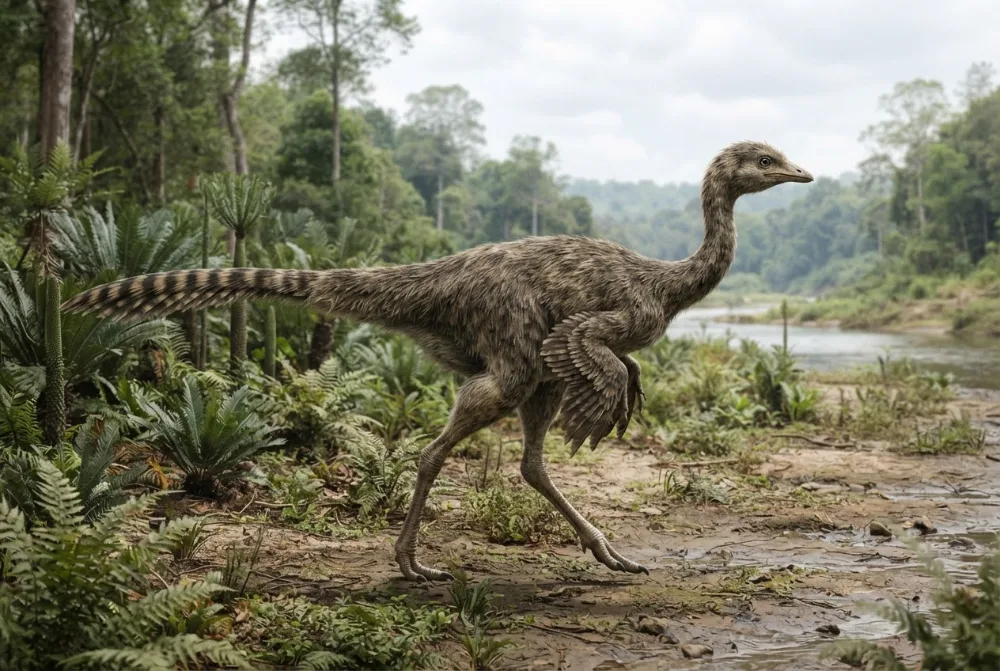
Kinnareemimus was a small, fast dinosaur that looked a bit like an ostrich. It lived in what is now Thailand during the Early Cretaceous period, about 125 million years ago. Scientists think it could run quickly on its long, bird-like legs.1
Kañ la dundoon?
Naka la réyoon?
Naka la guddoon?
Naka la kawewoon?
jortu
Naka la diisoon?
 gudd ni 4 muusu kër, bakkan ba geen🍌gudd ni 10 banaana yu ñu topp-toppale🍌diis ni 110 banaana🏃mënoon na daw 100 meetar ci 7,1 segond (nit ki gën a gaaw dafay soxla 9,6)
Naka la Kinnareemimus réyoon, bu ñu ko méngalee ak YAW?
Ay kalkil rekk ci sa navigatëer. Dara du ñu denc, dara du ñu yónne fenn.
Naka la gaawoon?


Xibaar yu neex
The name Kinnareemimus comes from a Kinnaree, a magical creature from Thai stories that has a woman's head and a bird's legs.1
Only a single foot bone, a metatarsal, was chosen as the main specimen. Other bones from the same site were also assigned to this dinosaur.1
Its foot had a special shape called semi-arctometatarsalian, where the middle toe bone gets narrow in the middle and then widens at the bottom.1
Kinnareemimus lived alongside many other dinosaurs, including the huge sauropod Phuwiangosaurus and the meat-eating Siamotyrannus.1
The fossils were found in red clay and sandstone that were once a river floodplain with lakes.1
Scientists think Kinnareemimus might have been a good runner, but not as fast as later ostrich dinosaurs like Gallimimus.1
Laaj yi ñu gën a laaj ci Kinnareemimus
?How big was Kinnareemimus?
About 1.8 metres (5.9 ft) long and possibly weighed around 13 kilograms (29 lb). Scientists are not sure because only a few foot bones have been found.1
?What did Kinnareemimus eat?
It was an ornithomimosaur, so it likely ate plants and small animals, like other ostrich dinosaurs. No direct evidence of its diet has been found.1
?Could Kinnareemimus run fast?
Probably yes, but not as fast as later ostrich dinosaurs like Gallimimus. Its leg bones suggest it was a good runner, though scientists are not certain.1
?Where was Kinnareemimus found?
In northeastern Thailand, in the Early Cretaceous Sao Khua Formation. The fossils were discovered at a site called Phu Wiang 5.1
Ngir ñi xam dino lool
- Turu xam-xam
- Kinnareemimus
- Ku ko tudde
- Buffetaut et al. 20093
- Kurél
- Dino yu niru otris
- Njaboot / klad
- Ornithomimosauria3
- Klasifikasiyoŋ
- Theropoda > Ornithomimosauria3
- Màggaayu doj yi
- 126 ba 121 milyoŋ at (Barremian)3
- Formasiyoŋi doj
- Sao Khua3
- Réew yi
- Taylaand3
- Fosil yu ñu gis
- 1 ci The Paleobiology Database3
- Gisees
- The first fossils were reported in 1997, but the dinosaur was officially named Kinnareemimus khonkaenensis in 2009 by Eric Buffetaut, Varavudh Suteethorn, and Haiyan Tong.1
- Ñu ngi koy werante ba tey
- Because only a few bones are known, scientists are not sure exactly how big Kinnareemimus was or what its whole body looked like.1
Fa xibaar yi jóge
- Kinnareemimus (en.wikipedia.org)
- PBDB Taxon (paleobiodb.org)
- Kinnareemimus in The Paleobiology Database (CC BY 4.0): at, béréb yi, formasiyoŋi doj, klasifikasiyoŋ.
Bépp xibaar ci xët wii am na lim bu wone fa mu jóge. Su nu juumee, baal nu, nun ñu bëgg dino lanu, du ab sërnaalu xam-xam. Wax nu ko ci [email protected] nu defar ko.
 Rex xiif na! Dino Wiki, mbiru ab baay la ngir doomam ju góor ju bëgg dinosoor, ci neen te amul kaamuñaate, amul tracker. Mag ñi mën nañu jox Rex tuuti ñam ngir dimbali ko mu des ci internet.Dundal Rex
 Gallimimus
 Ornithomimus
 Struthiomimus
 Deinocheirus
 Dromiceiomimus
 Archaeornithomimus
 Stegosaurus
 Iguanodon
 Archaeopteryx
 Giganotosaurus
 Microraptor
 Deinonychus