 Ban dino nga? Kiis
 Xeexu dino
 Rawante dino
 Fo yu ndaw yu dino
 Albomu sitikeer
 Limu TOP yu dino
 Bett ma!
Leiodon
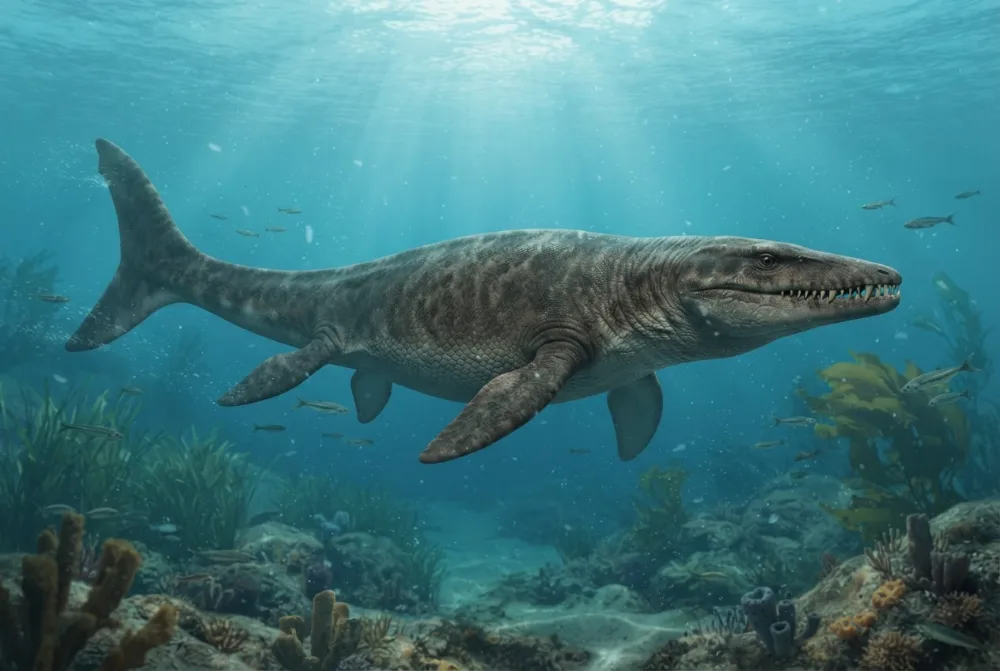
Leiodon was a giant marine lizard that swam in the warm seas of the Late Cretaceous. It had smooth, curved teeth perfect for grabbing slippery fish and other sea creatures.1
Kañ la dundoon?
Naka la gaawoon?


Xibaar yu neex
Leiodon was first named by the famous scientist Richard Owen in 1841, based on just two tooth fragments and a bit of jawbone.1
The name Leiodon means 'smooth tooth' because the fossil teeth had a smooth and polished surface.1
Leiodon lived between about 100 and 66 million years ago, during the Late Cretaceous period.3
Leiodon fossils have been found all over the world, including in Antarctica, Europe, Africa, and South America.3
Some scientists think Leiodon might not be a valid genus because its main fossil teeth are now lost, making it a 'nomen dubium' or doubtful name.1
Leiodon was one of the original genera used to define the family Mosasauridae in 1853.1
Ku tas léeb yu dul dëgg
Léeb: Leiodon was a dinosaur.
Dëgg: Leiodon was not a dinosaur. It was a mosasaur, a type of giant marine lizard that lived in the ocean.1
Ngir ñi xam dino lool
- Turu xam-xam
- Leiodon
- Ku ko tudde
- Owen 18423
- Kurél
- Mosasoor yi
- Njaboot / klad
- Mosasauridae3
- Klasifikasiyoŋ
- Mosasauroidea3
- Màggaayu doj yi
- 100 ba 66 milyoŋ at (Cenomanian / Maastrichtian)3
- Formasiyoŋi doj
- López de Bertodano, Gramame, Opoka3
- Réew yi
- Siri, Antarktik, Beresil, Suwed, Poloñ, Almaañ3
- Fosil yu ñu gis
- 18 ci The Paleobiology Database3
- Gisees
- Richard Owen named Leiodon in 1841 from two tooth fragments and a small jaw piece found in Essex, England.1
- Ñu ngi koy werante ba tey
- Scientists are not sure if Leiodon is a valid genus because the original tooth fossils are missing, so it might be a 'nomen dubium' (doubtful name).1
Fa xibaar yi jóge
- Liodon (en.wikipedia.org)
- PBDB Taxon (paleobiodb.org)
- Leiodon in The Paleobiology Database (CC BY 4.0): at, béréb yi, formasiyoŋi doj, klasifikasiyoŋ.
Bépp xibaar ci xët wii am na lim bu wone fa mu jóge. Su nu juumee, baal nu, nun ñu bëgg dino lanu, du ab sërnaalu xam-xam. Wax nu ko ci [email protected] nu defar ko.
 Rex xiif na! Dino Wiki, mbiru ab baay la ngir doomam ju góor ju bëgg dinosoor, ci neen te amul kaamuñaate, amul tracker. Mag ñi mën nañu jox Rex tuuti ñam ngir dimbali ko mu des ci internet.Dundal Rex
 Mosasaurus
 Prognathodon
 Tylosaurus
 Platecarpus
 Clidastes
 Globidens
 Tyrannosaurus
 Triceratops
 Velociraptor
 Spinosaurus
 Ankylosaurus
 Parasaurolophus