 Ban dino nga? Kiis
 Xeexu dino
 Rawante dino
 Fo yu ndaw yu dino
 Albomu sitikeer
 Limu TOP yu dino
 Bett ma!
Lessemsaurus
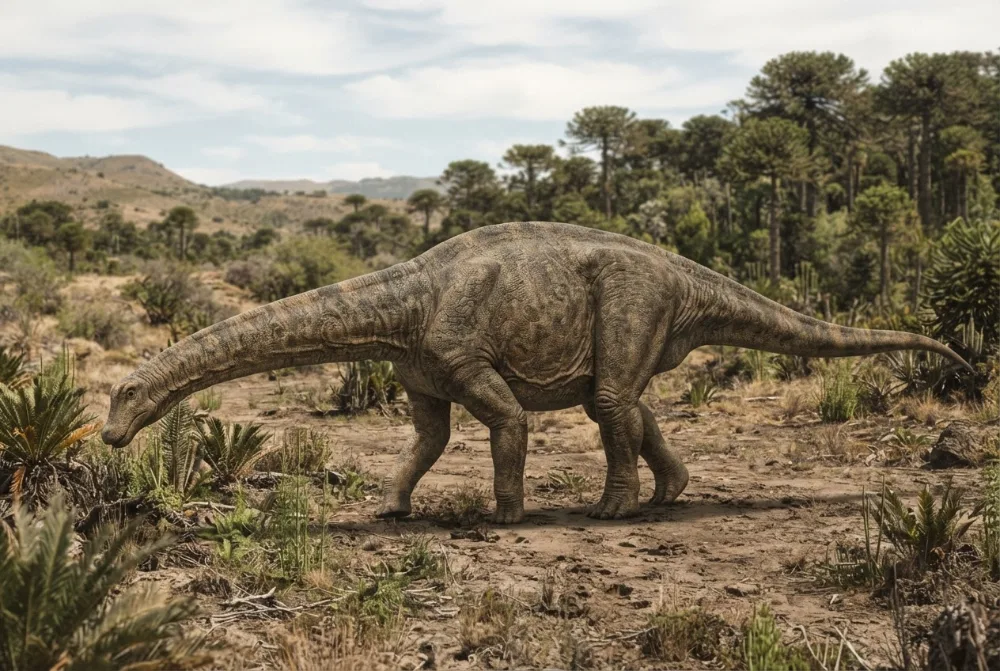
Lessemsaurus was a giant plant-eater that stomped through what is now Argentina about 213 million years ago. It was one of the biggest animals of its time, with a long neck and a huge body. Scientists think it was an early relative of the famous long-necked sauropods like Brachiosaurus.13
Kañ la dundoon?
Naka la réyoon?
Naka la guddoon?
Naka la kawewoon?
jortu
Naka la diisoon?
 gudd ni 2,5 oto yu ñu taxawal ci benn rëdd🍌gudd ni 67 banaana yu ñu topp-toppale
 diis ni 1,5 ñey🍉diis ni 2000 xaal🎒diis ni 12 klaas yu mat yu xale yu lekkool🐻❄️diis ni 22 uurs yu weex🏃mënoon na daw 100 meetar ci 22 segond (nit ki gën a gaaw dafay soxla 9,6)
Naka la Lessemsaurus réyoon, bu ñu ko méngalee ak YAW?
Ay kalkil rekk ci sa navigatëer. Dara du ñu denc, dara du ñu yónne fenn.
Naka la gaawoon?


Xibaar yu neex
Lessemsaurus had very tall neural arches on its backbones, which made its spine look like a sail and helped support its heavy body.2
It was named after Don Lessem, a science writer who founded The Dinosaur Society, not after a place or a feature.12
Scientists think Lessemsaurus lived in groups, because the fossils of three individuals were found together.32
Its neck bones had a special shape with deep pits and ridges, which may have made its neck stronger and more flexible.2
Lessemsaurus was about as long as a school bus and weighed as much as two elephants.1
Laaj yi ñu gën a laaj ci Lessemsaurus
?How big was Lessemsaurus?
It was about 10 to 12 metres long and weighed over 7 metric tons, possibly up to 8 to 10 metric tons. That is about as long as a school bus and as heavy as two elephants.1
?What did Lessemsaurus eat?
Lessemsaurus was a plant-eater, just like other sauropodomorph dinosaurs. It ate leaves and other plants.1
?When did Lessemsaurus live?
It lived about 213 million years ago, during the Norian age of the Late Triassic.1
?Where was Lessemsaurus found?
Its fossils were found in the Los Colorados Formation in La Rioja Province, Argentina.1
?Is Lessemsaurus a dinosaur?
Yes, Lessemsaurus is a dinosaur. It is a sauropodiform dinosaur, an early relative of the long-necked sauropods.1
?How fast could Lessemsaurus run?
Scientists do not know exactly how fast it could run, but because it was a large, heavy quadruped, it probably moved slowly, like other big sauropodomorphs.1
Ku tas léeb yu dul dëgg
Léeb: Some people think Lessemsaurus was a true sauropod like Brachiosaurus.
Dëgg: Scientists are not sure. Some studies put it as a very early sauropod, while others say it was a close relative but not a true sauropod.3
Ngir ñi xam dino lool
- Turu xam-xam
- Lessemsaurus
- Ku ko tudde
- Bonaparte 19994
- Kurél
- Baat yu gudd
- Njaboot / klad
- Lessemsauridae4
- Klasifikasiyoŋ
- Sauropodomorpha > Sauropoda4
- Màggaayu doj yi
- 227 ba 206 milyoŋ at (Norian)4
- Formasiyoŋi doj
- Los Colorados4
- Réew yi
- Arsantin4
- Fosil yu ñu gis
- 1 ci The Paleobiology Database4
- Gisees
- Lessemsaurus was named by the famous paleontologist José Bonaparte in 1999. He found the fossils in Argentina and named the species L. sauropoides, which means 'like a sauropod'.12
- Ñu ngi koy werante ba tey
- Scientists still debate whether Lessemsaurus was a true sauropod or a more primitive sauropodomorph, because its bones show a mix of features.3
Fa xibaar yi jóge
- Lessemsaurus (en.wikipedia.org)
- Abstract. EVOLUTION OF THE PRESACRAL VERTEBRAE OF THE SAUROPODOMORPHA. The presacral vertebrae of the pre-dinosaur Marasuchus and the prosauropods Riojasaurus and Plateosaurus are redescribed and discussed. A new genus and species, Lessemsaurus sauropoides, diagnosed by tall neural arches and infrapostzygapophyseal constriction in the posterior cervicals, is described; the vertebral morphology of the cetiosaurid sauropods Volkheimeria, Lapparentosaurus and Patagosaurus is discussed and compared; as well as that of Diplodocus, Apatosaurus, Brachiosaurus brancai, Camarasaurus, Dicraeosaurus, Haplocanthosaurus, the Titanosauridae s. str., Saltasaurus, and a Titanosaurinae indet. from Brazil. Other incompletely known Titanosauria and Opisthocoelicaudia are discussed more briefly. This study demonstrates that the presacral vertebrae represent a rich source of information for understanding the evolution and systematics of sauropodomorphs. In the basal dinosauromorph Marasuchus, three morphological types of vertebrae are recognized, a condition further developed by sauropodomorphs. Within Prosauropoda, the melanorosaurid Riojasaurus shows the most primitive condition in the number and organization of the cervical vertebrae: it has 9 cervicals, the first 5 of which exhibit the cervical morphological type, whereas the last 4 correspond to the dorsal morphological type. Plateosaurus is more derived than Riojasaurus in characters of the neck. The primitive sauropod-type vertebrae is more advanced than the typical prosauropod-type vertebrae, but it shows more primitive characters than the cetiosaurid type. It is considered that the cetiosaurid-type presacrals correspond to an evolutionary stage that might have made gigantism possible, triggering the adaptive radiation recorded in the Upper Jurassic of North America, Africa and Asia. In diplodocids the presacrals show clear relationships to the cetiosaurid type, but there are a high number of cervicals, and opisthocoely of centr (naturalhistory.si.edu)
- PBDB Taxon (paleobiodb.org)
- Lessemsaurus in The Paleobiology Database (CC BY 4.0): at, béréb yi, formasiyoŋi doj, klasifikasiyoŋ.
Bépp xibaar ci xët wii am na lim bu wone fa mu jóge. Su nu juumee, baal nu, nun ñu bëgg dino lanu, du ab sërnaalu xam-xam. Wax nu ko ci [email protected] nu defar ko.
 Rex xiif na! Dino Wiki, mbiru ab baay la ngir doomam ju góor ju bëgg dinosoor, ci neen te amul kaamuñaate, amul tracker. Mag ñi mën nañu jox Rex tuuti ñam ngir dimbali ko mu des ci internet.Dundal Rex
 Brachiosaurus
 Diplodocus
 Brontosaurus
 Argentinosaurus
 Camarasaurus
 Morosaurus
 Nothosaurus
 Coelophysis
 Podokesaurus
 Simosaurus
 Eudimorphodon
 Herrerasaurus