 Ban dino nga? Kiis
 Xeexu dino
 Rawante dino
 Fo yu ndaw yu dino
 Albomu sitikeer
 Limu TOP yu dino
 Bett ma!
Libonectes
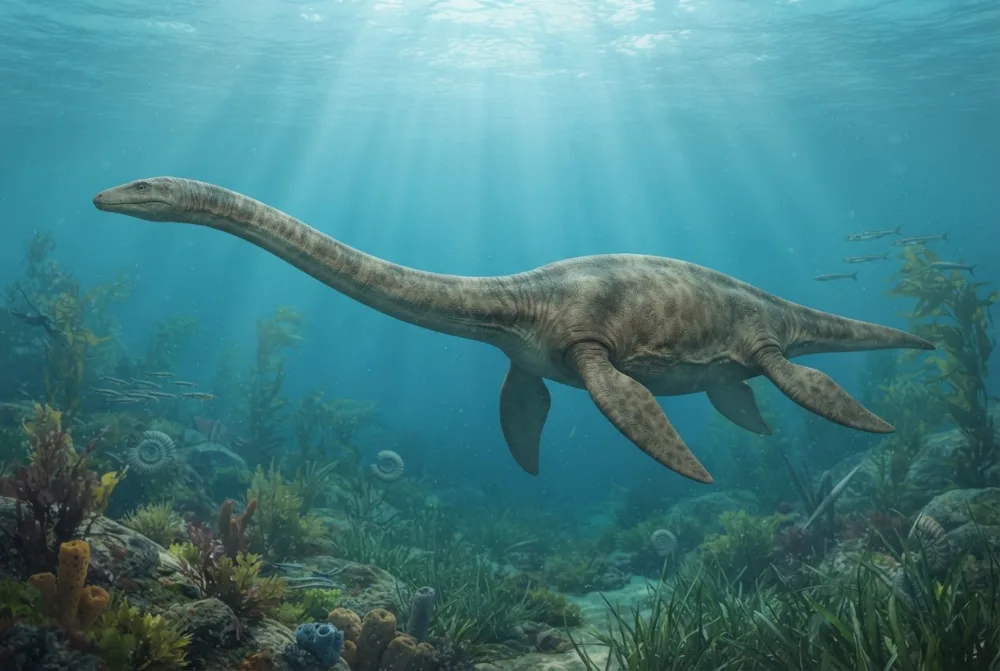
Libonectes was a long-necked marine reptile that swam in warm seas during the time of the dinosaurs. It used its strong flippers to paddle through the water and may have swallowed fish and ammonites whole. Fossils show it had a skull that is one of the best preserved of any elasmosaurid plesiosaur.1
Kañ la dundoon?
Naka la réyoon?
Naka la guddoon?
 gudd ni 7 xaj, bakkan ba geen🍌gudd ni 40 banaana yu ñu topp-toppale🏊mënoon na féey guddaayu pisin bu mag (50 m) ci 7,2 segond
Naka la Libonectes réyoon, bu ñu ko méngalee ak YAW?
Ay kalkil rekk ci sa navigatëer. Dara du ñu denc, dara du ñu yónne fenn.
Naka la gaawoon?


Xibaar yu neex
Libonectes had a neck that was 5.06 metres (16.6 feet) long, more than two-thirds of its total body length.1
The first fossils were found by a farmer named T.W. Tidwell in the late 1930s in Texas.1
Its skull is the best preserved skull of any elasmosaurid plesiosaur ever found.1
Libonectes lived about 93 million years ago, during the Late Cretaceous period.3
It was originally named Elasmosaurus morgani in 1949, but was given its own genus, Libonectes, in 1997.1
Gastroliths (stomach stones) have been found inside Libonectes fossils, which may have helped it digest food or control its buoyancy in the water.1
Libonectes probably swam slowly and used its large size to trap prey.1
Laaj yi ñu gën a laaj ci Libonectes
?How big was Libonectes?
Libonectes was a medium-sized plesiosaur, about 7.2 metres (24 feet) long. Its neck alone was 5.06 metres (16.6 feet) long.1
?What did Libonectes eat?
Libonectes probably ate small fish and ammonites. It may have swallowed prey whole and used stomach stones to help digest food.1
Ku tas léeb yu dul dëgg
Léeb: Some people think plesiosaurs like Libonectes could lift their heads and necks high out of the water like a swan.
Dëgg: Scientists now believe their necks were not flexible enough to lift high above the water. They probably held their necks more horizontally while swimming.1
Ngir ñi xam dino lool
- Turu xam-xam
- Libonectes
- Ku ko tudde
- Carpenter 19973
- Kurél
- Plesiyosoor yi
- Njaboot / klad
- Elasmosauridae3
- Klasifikasiyoŋ
- Plesiosauria > Elasmosauridae > Sauropterygia3
- Màggaayu doj yi
- 100 ba 90 milyoŋ at (Cenomanian / Turonian)3
- Formasiyoŋi doj
- Britton, Akrabou3
- Réew yi
- Amerig, Marog3
- Fosil yu ñu gis
- 2 ci The Paleobiology Database3
- Gisees
- The first Libonectes fossils were found by tenant farmer T.W. Tidwell in the late 1930s in Texas. Charles Gill Morgan prepared the fossils, and the species was named Elasmosaurus morgani by Welles in 1949. It was reclassified as its own genus Libonectes by Carpenter in 1997.1
- Ñu ngi koy werante ba tey
- Scientists are not sure whether Libonectes was a pure carnivore or an omnivore, because gastroliths could indicate plant eating or just buoyancy control.1
Fa xibaar yi jóge
- Libonectes (en.wikipedia.org)
- Libonectes morgani, an elasmosaur with transatlantic dispersal (sachspal.de)
- Libonectes in The Paleobiology Database (CC BY 4.0): at, béréb yi, formasiyoŋi doj, klasifikasiyoŋ.
Bépp xibaar ci xët wii am na lim bu wone fa mu jóge. Su nu juumee, baal nu, nun ñu bëgg dino lanu, du ab sërnaalu xam-xam. Wax nu ko ci [email protected] nu defar ko.
 Rex xiif na! Dino Wiki, mbiru ab baay la ngir doomam ju góor ju bëgg dinosoor, ci neen te amul kaamuñaate, amul tracker. Mag ñi mën nañu jox Rex tuuti ñam ngir dimbali ko mu des ci internet.Dundal Rex
 Elasmosaurus
 Pliosaurus
 Plesiosaurus
 Cimoliasaurus
 Colymbosaurus
 Trinacromerum
 Tyrannosaurus
 Triceratops
 Velociraptor
 Spinosaurus
 Ankylosaurus
 Parasaurolophus