 Ban dino nga? Kiis
 Xeexu dino
 Rawante dino
 Fo yu ndaw yu dino
 Albomu sitikeer
 Limu TOP yu dino
 Bett ma!
Livyatan
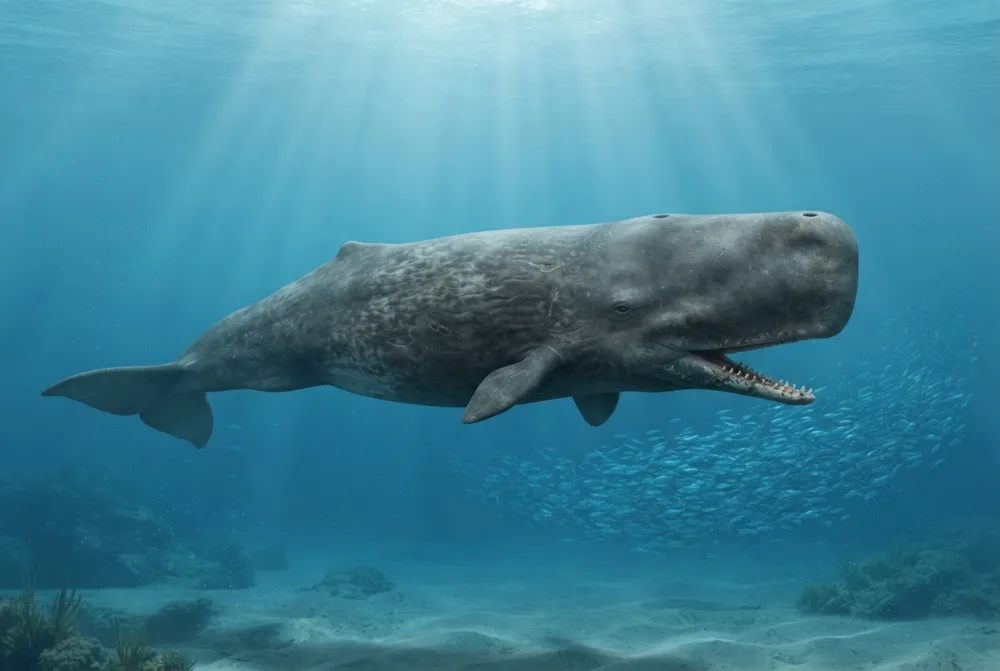
Livyatan was a giant sperm whale that lived in the ocean millions of years ago. It had huge teeth and was one of the biggest hunters in the sea. It was not a dinosaur, but a mammal like whales today.1
Kañ la dundoon?
Naka la réyoon?
Naka la guddoon?
Naka la diisoon?

 gudd ni 4 oto yu ñu taxawal ci benn rëdd🍌gudd ni 97 banaana yu ñu topp-toppale🍉diis ni 11000 xaal🎒diis ni 71 klaas yu mat yu xale yu lekkool🐻❄️diis ni 130 uurs yu weex🏊mënoon na féey guddaayu pisin bu mag (50 m) ci 5,1 segond
Naka la Livyatan réyoon, bu ñu ko méngalee ak YAW?
Ay kalkil rekk ci sa navigatëer. Dara du ñu denc, dara du ñu yónne fenn.
Naka la gaawoon?


Xibaar yu neex
Livyatan had teeth up to 36 centimeters (over 14 inches) long, bigger than any other sperm whale.1
Its skull was about 3 meters (10 feet) long, making it the largest fossil sperm whale skull known.1
Livyatan lived at the same time as the giant shark Carcharocles megalodon, and both were top predators.1
Scientists think Livyatan could bite harder than any other four-legged animal ever found.1
Unlike modern sperm whales that suck in food, Livyatan used its teeth to hunt and tear large prey.1
The name Livyatan comes from a Hebrew word for a sea monster, and the species name melvillei honors the author of Moby-Dick.1
Laaj yi ñu gën a laaj ci Livyatan
?How big was Livyatan?
About 13.5 to 17.5 meters (44 to 57 feet) long, similar to a modern sperm whale.2
?What did Livyatan eat?
It hunted large prey like medium-sized baleen whales, using its huge teeth to bite and tear flesh.12
?Did Livyatan live at the same time as megalodon?
Yes, Livyatan and the giant shark megalodon lived in the same oceans and may have competed for food.23
?Why did Livyatan go extinct?
It probably died out because of a cooling event at the end of the Miocene that reduced its food supply.2
?Is Livyatan a dinosaur?
No, Livyatan was a mammal, a giant sperm whale, not a dinosaur.2
?How long were Livyatan's teeth?
Its teeth were up to 36.2 centimeters (14.3 inches) long, the largest biting teeth of any known animal.21
?Where was Livyatan discovered?
Its fossil skull was found in the Pisco Formation of Peru, in a coastal desert near Ica.21
Ku tas léeb yu dul dëgg
Léeb: Some people think Livyatan was a dinosaur.
Dëgg: Livyatan was a whale, a mammal, not a dinosaur.1
Ngir ñi xam dino lool
- Turu xam-xam
- Livyatan
- Ku ko tudde
- Lambert et al. 20104
- Kurél
- Rab yu siiw lool yu jamono ju yàgg
- Njaboot / klad
- Physeteroidea4
- Klasifikasiyoŋ
- Mammalia > Cetacea > Physeteroidea4
- Màggaayu doj yi
- 23 ba 3,6 milyoŋ at (Aquitanian / Zanclean)4
- Formasiyoŋi doj
- Pisco4
- Réew yi
- Afrig di Sid, Peru, Arsantin, Sili, Amerig4
- Fosil yu ñu gis
- 6 ci The Paleobiology Database4
- Gisees
- Scientists found a skull with teeth in the Pisco desert of Peru, and they named it Livyatan melvillei in 2010.1
- Ñu ngi koy werante ba tey
- Scientists are still debating what the big basin on its head was for, like echolocation or display.1
Fa xibaar yi jóge
- The giant bite of a new raptorial sperm whale from the Miocene epoch of Peru (nature.com)
- Livyatan (en.wikipedia.org)
- Behold Livyatan: the sperm whale that killed other whales | National Geographic (nationalgeographic.com)
- Livyatan in The Paleobiology Database (CC BY 4.0): at, béréb yi, formasiyoŋi doj, klasifikasiyoŋ.
Bépp xibaar ci xët wii am na lim bu wone fa mu jóge. Su nu juumee, baal nu, nun ñu bëgg dino lanu, du ab sërnaalu xam-xam. Wax nu ko ci [email protected] nu defar ko.
 Rex xiif na! Dino Wiki, mbiru ab baay la ngir doomam ju góor ju bëgg dinosoor, ci neen te amul kaamuñaate, amul tracker. Mag ñi mën nañu jox Rex tuuti ñam ngir dimbali ko mu des ci internet.Dundal Rex
 Megalodon
 Sabre-toothed cat
 Dimetrodon
 Woolly mammoth
 Arthropleura
 Helicoprion