 Ban dino nga? Kiis
 Xeexu dino
 Rawante dino
 Fo yu ndaw yu dino
 Albomu sitikeer
 Limu TOP yu dino
 Bett ma!
Kañ la dundoon?

Naka la réyoon?
Naka la guddoon?
Naka la kawewoon?
jortu
Naka la diisoon?

 gudd ni 5 oto yu ñu taxawal ci benn rëdd🍌gudd ni 120 banaana yu ñu topp-toppale🍉diis ni 6000 xaal🎒diis ni 38 klaas yu mat yu xale yu lekkool🐻❄️diis ni 67 uurs yu weex🏢kawe ba mën a xool ci palanteer bu nekk ci eta 2🏃mënoon na daw 100 meetar ci 33 segond (nit ki gën a gaaw dafay soxla 9,6)
Naka la Lusotitan réyoon, bu ñu ko méngalee ak YAW?
Ay kalkil rekk ci sa navigatëer. Dara du ñu denc, dara du ñu yónne fenn.
Naka la gaawoon?


Xibaar yu neex
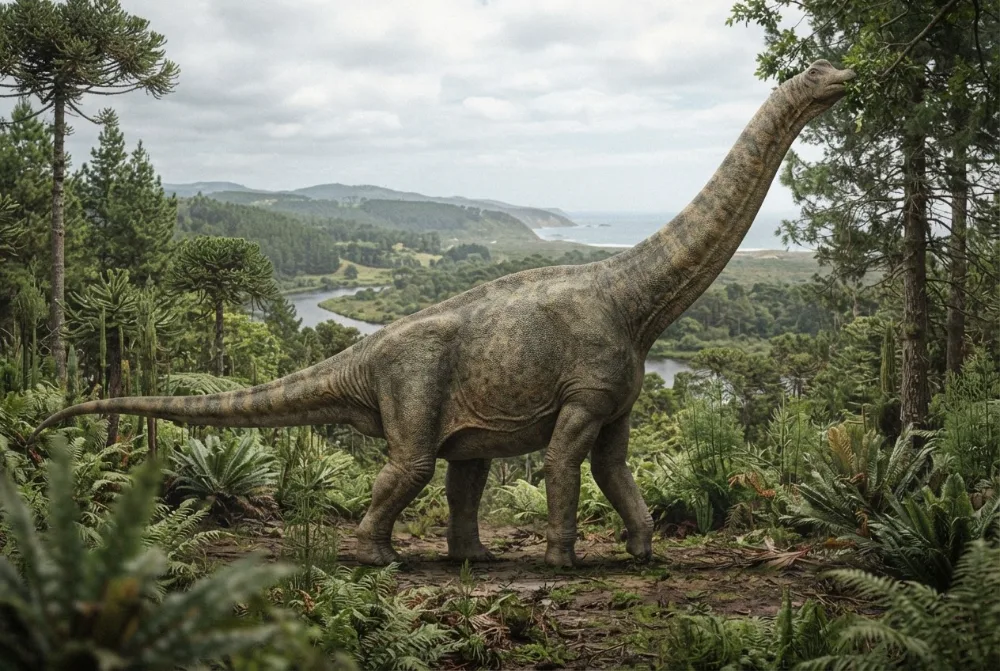
Lusotitan was once thought to be a species of Brachiosaurus, but in 2003 scientists gave it its own name.1
It belongs to a group called brachiosaurids, which had very long front legs and a body that slanted upward, like a giraffe.1
Lusotitan lived during the Late Jurassic period, about 150 to 143 million years ago.1
Only a few bones of Lusotitan have been found, including vertebrae and parts of the legs and hips.2
Scientists can tell Lusotitan apart from other dinosaurs by special features in its tail bones, like long projections that stick out far behind the bone.2
Like all sauropods, Lusotitan had air sacs inside its body that helped it breathe and kept it from being too heavy.1
Laaj yi ñu gën a laaj ci Lusotitan
?How big was Lusotitan?
Lusotitan was about 21 metres (69 feet) long and weighed around 25 to 30 tonnes (28 to 33 short tons). That is only an estimate because the full skeleton has never been found.31
?What did Lusotitan eat?
Lusotitan was a herbivore, meaning it ate plants. It used its long front legs and tall body to reach leaves high up in trees.1
?When did Lusotitan live?
Lusotitan lived during the Late Jurassic period, about 150 to 143 million years ago.1
?Where was Lusotitan found?
Lusotitan was found in Portugal, in the Lourinhã Formation. It is the largest dinosaur discovered in that area.3
?Was Lusotitan bigger than Brachiosaurus?
Nobody knows for sure. Lusotitan might not have been quite as large as Brachiosaurus, which was about 25 metres long, but its remains are too scarce to compare exactly.1
?Did Lusotitan have air sacs?
Yes, like all sauropods, Lusotitan had internal air sacs that helped it breathe and kept it from being too heavy. It is unknown if it had external air sacs on its head, as its skull has never been found.1
Ku tas léeb yu dul dëgg
Léeb: Lusotitan was exactly the same size as Brachiosaurus.
Dëgg: Lusotitan might have been slightly smaller than Brachiosaurus, but because its skeleton is incomplete, scientists cannot be sure.1
Ngir ñi xam dino lool
- Turu xam-xam
- Lusotitan
- Ku ko tudde
- Antunes and Mateus 20034
- Kurél
- Baat yu gudd
- Njaboot / klad
- Brachiosauridae4
- Klasifikasiyoŋ
- Sauropodomorpha > Sauropoda > Macronaria4
- Màggaayu doj yi
- 152 ba 145 milyoŋ at (Kimmeridgian / Tithonian)4
- Formasiyoŋi doj
- Lourinhã4
- Réew yi
- Portigaal4
- Fosil yu ñu gis
- 1 ci The Paleobiology Database4
- Gisees
- Lusotitan was named in 2003 by paleontologists Miguel Telles Antunes and Octávio Mateus. The fossils were found in the Lourinhã Formation in Portugal.41
- Ñu ngi koy werante ba tey
- Scientists are not sure exactly how tall Lusotitan was, because much of its neck is missing from the fossil record.1
Fa xibaar yi jóge
- Lusotitan | Natural History Museum (nhm.ac.uk)
- Osteology of the Late Jurassic Portuguese sauropod dinosaur Lusotitan atalaiensis (Macronaria) and the evolutionary history of basal titanosauriforms | Zoological Journal of the Linnean Society | Oxford Academic (academic.oup.com)
- Lusotitan (Wikipedia) (Wikipedia)
- Lusotitan in The Paleobiology Database (CC BY 4.0): at, béréb yi, formasiyoŋi doj, klasifikasiyoŋ.
Bépp xibaar ci xët wii am na lim bu wone fa mu jóge. Su nu juumee, baal nu, nun ñu bëgg dino lanu, du ab sërnaalu xam-xam. Wax nu ko ci [email protected] nu defar ko.
 Rex xiif na! Dino Wiki, mbiru ab baay la ngir doomam ju góor ju bëgg dinosoor, ci neen te amul kaamuñaate, amul tracker. Mag ñi mën nañu jox Rex tuuti ñam ngir dimbali ko mu des ci internet.Dundal Rex
 Brachiosaurus
 Diplodocus
 Brontosaurus
 Argentinosaurus
 Camarasaurus
 Morosaurus
 Allosaurus
 Compsognathus
 Camptosaurus
 Nanosaurus
 Rhamphorhynchus
 Ceratosaurus