 Ban dino nga? Kiis
 Xeexu dino
 Rawante dino
 Fo yu ndaw yu dino
 Albomu sitikeer
 Limu TOP yu dino
 Bett ma!
Majungasaurus
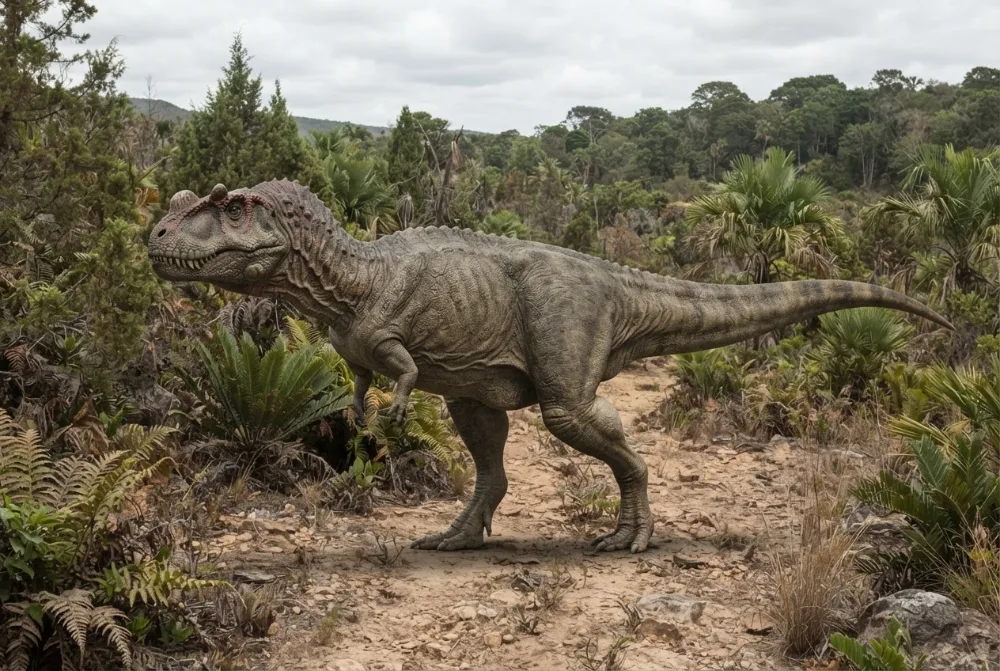
Majungasaurus was a meat-eating dinosaur that lived on the island of Madagascar near the end of the Age of Dinosaurs. It was the top predator in its home, and scientists have even found evidence that it sometimes ate other Majungasaurus!12
Kañ la dundoon?
Naka la réyoon?
Naka la guddoon?
Naka la kawewoon?
jortu
Naka la diisoon?
 gudd ni 7 xaj, bakkan ba geen🍌gudd ni 39 banaana yu ñu topp-toppale🍉diis ni 220 xaal🧸diis ni 58 xale yu maternel🎒diis ni 34 xale yu lekkool🐻❄️diis ni 2,5 uurs yu weex🏃mënoon na daw 100 meetar ci 9,7 segond (nit ki gën a gaaw dafay soxla 9,6)
Naka la Majungasaurus réyoon, bu ñu ko méngalee ak YAW?
Ay kalkil rekk ci sa navigatëer. Dara du ñu denc, dara du ñu yónne fenn.
Naka la gaawoon?


Xibaar yu neex
Majungasaurus lived about 70 to 66 million years ago, during the very end of the Cretaceous Period. It was one of the last non-avian dinosaurs before the big extinction.1
This dinosaur had a thick, bumpy skull with a single rounded horn on top of its head. The horn was made of bone and was probably used for head-butting or showing off.12
Majungasaurus was about 6 to 7 metres long, which is as long as a big school bus. It was a medium-sized theropod, not as huge as T. rex but still a fierce hunter.2
Fossils show that Majungasaurus sometimes ate other Majungasaurus. Tooth marks on its bones match its own teeth, making it one of the few dinosaurs known to have been cannibalistic.2
It shared its home with many other animals, including the long-necked sauropod Rapetosaurus, the small meat-eater Masiakasaurus, and giant crocodile-like creatures.1
The first Majungasaurus fossils were found in 1895 by French explorers. At first, scientists thought it was a kind of Megalosaurus, and later it was even called Majungatholus.12
Majungasaurus is one of the best-known meat-eating dinosaurs from the southern continents. Many complete skulls and skeletons have been found, so scientists know a lot about it.2
Laaj yi ñu gën a laaj ci Majungasaurus
?How big was Majungasaurus?
Majungasaurus was about 6 to 7 metres long (20 to 23 feet) and weighed around 750 to 1,100 kilograms (1,650 to 2,430 pounds). Some larger individuals may have reached over 8 metres (26 feet).1
?Did Majungasaurus eat other dinosaurs?
Yes, it mainly hunted sauropods like Rapetosaurus. It also ate other Majungasaurus, making it one of the few dinosaurs known to be cannibalistic.14
?When did Majungasaurus live?
Majungasaurus lived about 70 to 66 million years ago, at the very end of the Cretaceous Period. It was one of the last non-avian dinosaurs before the big extinction.1
?Did Majungasaurus have a horn?
Yes, it had a single rounded horn on top of its skull, made of bone. Scientists think it might have been used for head-butting or showing off.1
?Was Majungasaurus bigger than T. rex?
No, Majungasaurus was much smaller. T. rex was about 12 metres long and weighed over 8 tonnes, while Majungasaurus was only about 6 to 7 metres long and weighed around 1 tonne.1
?Where was Majungasaurus found?
All Majungasaurus fossils have been found in northwestern Madagascar, in the Maevarano Formation. The first remains were discovered along the Betsiboka River in 1896.1
?Did Majungasaurus have feathers?
No one knows for sure. No feather impressions have been found with Majungasaurus fossils, and it belonged to a group of dinosaurs (abelisaurids) that are not known to have had feathers.1
?Is Majungasaurus a dinosaur?
Yes, Majungasaurus is a dinosaur. It is a theropod dinosaur, which means it was a meat-eating, two-legged dinosaur.1
Ku tas léeb yu dul dëgg
Léeb: Some people think Majungasaurus was a type of tyrannosaur like T. rex.
Dëgg: Majungasaurus was actually an abelisaurid, a different group of meat-eating dinosaurs that lived mainly in the southern continents. It had a shorter, deeper skull and tiny arms, but it was not closely related to T. rex.12
Ngir ñi xam dino lool
- Turu xam-xam
- Majungasaurus
- Ku ko tudde
- Lavocat 19555
- Kurél
- Dino yuy lekk yàpp
- Njaboot / klad
- Abelisauridae5
- Klasifikasiyoŋ
- Theropoda > Ceratosauria > Abelisauridae5
- Màggaayu doj yi
- 72 ba 66 milyoŋ at (Maastrichtian)5
- Formasiyoŋi doj
- Maevarano5
- Réew yi
- Madagaskaar5
- Fosil yu ñu gis
- 25 ci The Paleobiology Database5
- Ñu ngi koy wooye itam
- Majungatholus (tur yu njëkk yi, léegi ñu ngi leen jàppe ni benn rab rekk)5
- Gisees
- The first fossils of Majungasaurus were discovered in 1895 in Madagascar by French explorers. It was named Majungasaurus by French paleontologist René Lavocat in 1955, after the Mahajanga region where it was found.15
- Ñu ngi koy werante ba tey
- Scientists are not sure exactly how the single horn on Majungasaurus's head was used. It might have been for fighting rivals, attracting mates, or both.1
Fa xibaar yi jóge
- Majungasaurus (en.wikipedia.org)
- OVERVIEW OF THE HISTORY OF DISCOVERY, TAXONOMY, PHYLOGENY, AND BIOGEOGRAPHY OF MAJUNGASAURUS CRENATISSIMUS (THEROPODA: ABELISAURIDAE) FROM THE LATE CRETACEOUS OF MADAGASCAR (sites.ohio.edu)
- Majungasaurus (en.wikipedia.org)
- Cannibalism in the Madagascan dinosaur Majungatholus atopus | Nature (nature.com)
- Majungasaurus in The Paleobiology Database (CC BY 4.0): at, béréb yi, formasiyoŋi doj, klasifikasiyoŋ.
Bépp xibaar ci xët wii am na lim bu wone fa mu jóge. Su nu juumee, baal nu, nun ñu bëgg dino lanu, du ab sërnaalu xam-xam. Wax nu ko ci [email protected] nu defar ko.
 Rex xiif na! Dino Wiki, mbiru ab baay la ngir doomam ju góor ju bëgg dinosoor, ci neen te amul kaamuñaate, amul tracker. Mag ñi mën nañu jox Rex tuuti ñam ngir dimbali ko mu des ci internet.Dundal Rex
 Allosaurus
 Carnotaurus
 Dilophosaurus
 Giganotosaurus
 Compsognathus
 Paronychodon
 Tyrannosaurus
 Triceratops
 Velociraptor
 Spinosaurus
 Ankylosaurus
 Parasaurolophus