 Ban dino nga? Kiis
 Xeexu dino
 Rawante dino
 Fo yu ndaw yu dino
 Albomu sitikeer
 Limu TOP yu dino
 Bett ma!
Megacephalosaurus
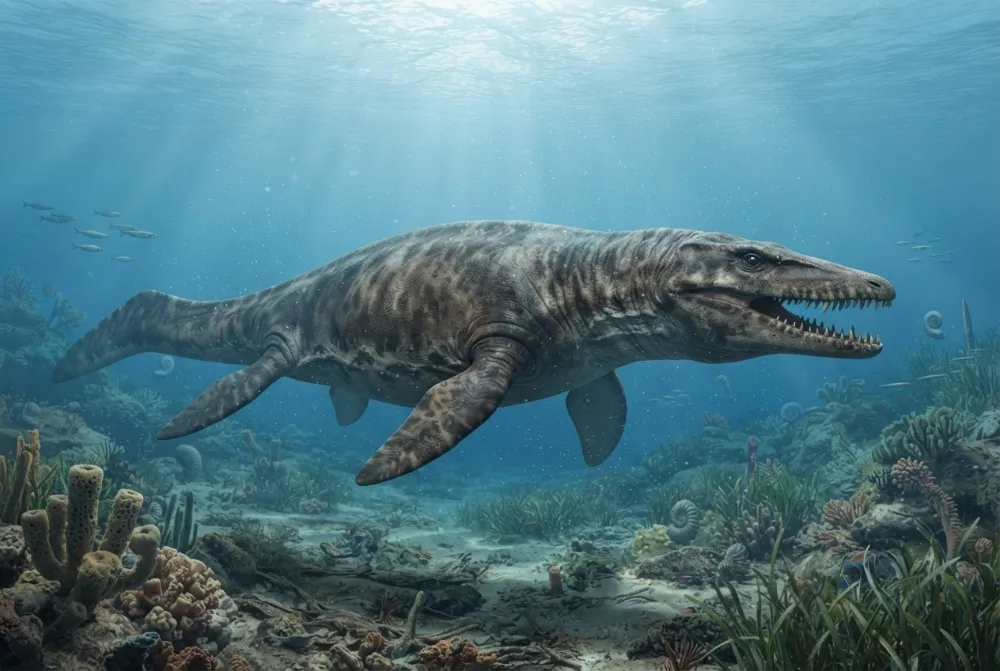
Megacephalosaurus was a huge, short-necked plesiosaur that swam in the ancient sea that split North America in two. It had a massive head, the biggest of any plesiosaur found on the continent, and used its long snout to catch smaller prey.1
Kañ la dundoon?
Naka la réyoon?
Naka la guddoon?
 gudd ni 2 oto yu ñu taxawal ci benn rëdd🍌gudd ni 50 banaana yu ñu topp-toppale🏊mënoon na féey guddaayu pisin bu mag (50 m) ci 7,8 segond
Naka la Megacephalosaurus réyoon, bu ñu ko méngalee ak YAW?
Ay kalkil rekk ci sa navigatëer. Dara du ñu denc, dara du ñu yónne fenn.
Naka la gaawoon?


Xibaar yu neex
Megacephalosaurus was one of the last pliosaurs, living about 94 to 93 million years ago during the Turonian stage of the Late Cretaceous.1
Its skull was up to 1.75 meters (5.7 feet) long, making it the largest skull of any plesiosaur known from North America.1
The teeth had long, thin ridges called apicobasal ridges that helped grip and puncture slippery prey.1
It shared its ocean home with sharks like Cretoxyrhina and Squalicorax, as well as other marine reptiles like mosasaurs and sea turtles.1
The first fossils were found in 1950 and were originally thought to belong to a different pliosaur called Brachauchenius lucasi.1
It was not until 2013 that scientists realized the fossils were from a new, distinct animal and named it Megacephalosaurus.1
Laaj yi ñu gën a laaj ci Megacephalosaurus
?How big was Megacephalosaurus?
It was one of the largest marine reptiles of its time, estimated to be 6 to 9 meters (20 to 30 ft) long. Its skull alone could reach 1.75 meters (5.7 ft) in length.1
?What did Megacephalosaurus eat?
It likely ate smaller prey, because it had a long snout and teeth that were all about the same size. Its teeth had ridges that helped grip and puncture slippery animals.12
?When did Megacephalosaurus live?
It lived about 94 to 93 million years ago, during the Turonian stage of the Late Cretaceous. It was among the last of the pliosaurs.1
?Is Megacephalosaurus a dinosaur?
No, it is not a dinosaur. It is a plesiosaur, a type of marine reptile that lived in the ocean at the same time as dinosaurs.1
Ngir ñi xam dino lool
- Turu xam-xam
- Megacephalosaurus
- Ku ko tudde
- Schumacher et al. 20133
- Kurél
- Plesiyosoor yi
- Njaboot / klad
- Pliosauridae3
- Klasifikasiyoŋ
- Plesiosauria > Pliosauridae > Sauropterygia3
- Màggaayu doj yi
- 94 ba 90 milyoŋ at (Turonian)3
- Formasiyoŋi doj
- Carlile Shale, Greenhorn Limestone3
- Réew yi
- Amerig3
- Fosil yu ñu gis
- 2 ci The Paleobiology Database3
- Gisees
- The first fossils were discovered in 1950 by George F. Sternberg in Kansas. They were later studied by Bruce Schumacher, Kenneth Carpenter, and Mike Everhart, who named the new species Megacephalosaurus eulerti in 2013.1
- Ñu ngi koy werante ba tey
- Scientists are still debating how the last brachauchenine pliosaurs, including Megacephalosaurus, are related to each other and what their teeth tell us about their evolution.2
Fa xibaar yi jóge
- Megacephalosaurus (en.wikipedia.org)
- Morphological and phylogenetic aspects of the dentition of Megacephalosaurus eulerti , a pliosaurid from the Turonian of Kansas, USA, with remarks on the cranial anatomy of the taxon (cambridge.org)
- Megacephalosaurus in The Paleobiology Database (CC BY 4.0): at, béréb yi, formasiyoŋi doj, klasifikasiyoŋ.
Bépp xibaar ci xët wii am na lim bu wone fa mu jóge. Su nu juumee, baal nu, nun ñu bëgg dino lanu, du ab sërnaalu xam-xam. Wax nu ko ci [email protected] nu defar ko.
 Rex xiif na! Dino Wiki, mbiru ab baay la ngir doomam ju góor ju bëgg dinosoor, ci neen te amul kaamuñaate, amul tracker. Mag ñi mën nañu jox Rex tuuti ñam ngir dimbali ko mu des ci internet.Dundal Rex
 Elasmosaurus
 Pliosaurus
 Plesiosaurus
 Cimoliasaurus
 Colymbosaurus
 Trinacromerum
 Tyrannosaurus
 Triceratops
 Velociraptor
 Spinosaurus
 Ankylosaurus
 Parasaurolophus