 Ban dino nga? Kiis
 Xeexu dino
 Rawante dino
 Fo yu ndaw yu dino
 Albomu sitikeer
 Limu TOP yu dino
 Bett ma!
Meganeura
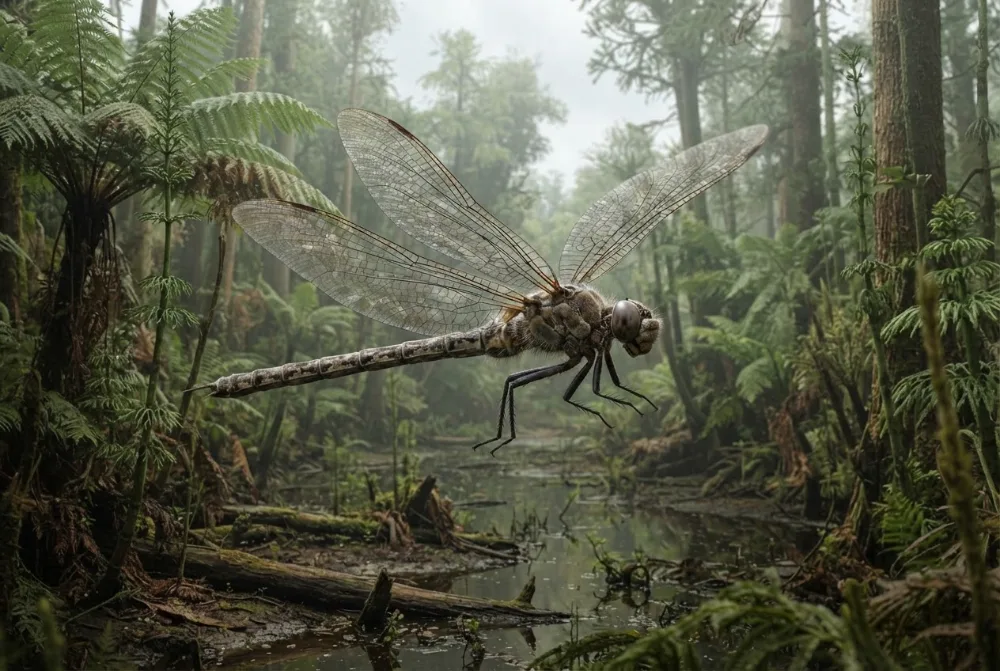
Meganeura was a giant dragonfly-like insect that lived about 300 million years ago. It had a wingspan as wide as a small bird and was one of the biggest flying insects ever. It hunted other insects in open forests and near lakes.12
Kañ la dundoon?
Naka la réyoon?
Naka la guddoon?
Naka la diisoon?
Naka la Meganeura réyoon, bu ñu ko méngalee ak YAW?
Ay kalkil rekk ci sa navigatëer. Dara du ñu denc, dara du ñu yónne fenn.
Naka la gaawoon?


Xibaar yu neex
Meganeura's wingspan was about 65 to 75 centimetres (2.1 to 2.5 feet), bigger than any dragonfly alive today.1
Its huge compound eyes met along the top of its head, giving it excellent vision to spot prey against the sky.12
Meganeura was a 'hawker' that patrolled open areas and above the treetops, not a fast zigzag flyer through dense forests.2
Its legs had large spines that formed a 'flying trap' to grab insects in mid-air.1
Scientists think Meganeura spent a lot of time perching because its large body made breathing difficult during flight.1
The first Meganeura fossil was found in a coal mine in Commentry, France, in 1880.1
Only one species of Meganeura is considered valid today: Meganeura monyi.1
Laaj yi ñu gën a laaj ci Meganeura
?How big was Meganeura?
Meganeura had a wingspan of about 65 to 75 centimetres (2.1 to 2.5 feet) and a body length up to 43 centimetres (1.4 feet). It was one of the largest flying insects ever.14
?Could Meganeura fly fast?
No, it could not make sudden direction changes like modern dragonflies. It was a 'hawker' that patrolled open areas and above treetops, flying steadily rather than zigzagging.12
?What did Meganeura eat?
Meganeura was a predator that ate other insects. It used large spines on its legs to trap prey in mid-air, like a flying trap.14
?Is Meganeura a dinosaur?
No, Meganeura is not a dinosaur. It was a giant dragonfly-like insect that lived about 300 million years ago, long before dinosaurs evolved.1
?When did Meganeura live?
Meganeura lived during the Late Carboniferous period, about 300 million years ago.1
?Why was Meganeura so big?
Scientists think the high oxygen levels in the Carboniferous air may have helped it grow so large, but they are not sure. Another idea is that there were no big flying predators back then.1
?Did Meganeura have good eyesight?
Yes, it had huge compound eyes that met along the top of its head, giving it excellent vision to spot prey against the sky.12
?Where was Meganeura found?
The first Meganeura fossil was found in a coal mine in Commentry, France, in 1880.1
?How much did Meganeura weigh?
Estimates vary a lot, from about 18 grams (0.04 pounds) up to 100 to 150 grams (0.22 to 0.33 pounds). Scientists are not sure of the exact weight.1
Ngir ñi xam dino lool
- Turu xam-xam
- Meganeura
- Ku ko tudde
- Brongniart 18855
- Kurél
- Rab yu siiw lool yu jamono ju yàgg
- Njaboot / klad
- Meganeuridae5
- Klasifikasiyoŋ
- Insecta > Meganisoptera > Meganeuridae5
- Màggaayu doj yi
- 304 ba 299 milyoŋ at (Gzhelian)5
- Formasiyoŋi doj
- Commentry Shales5
- Réew yi
- Faraas5
- Fosil yu ñu gis
- 7 ci The Paleobiology Database5
- Gisees
- French paleontologist Charles Brongniart named Meganeura in 1885 after studying fossils from Commentry, France. The first fossil was found in 1880.13
- Ñu ngi koy werante ba tey
- Scientists are still unsure exactly how heavy Meganeura was, with estimates ranging from 18 grams to 150 grams.1
Fa xibaar yi jóge
- Meganeura (en.wikipedia.org)
- Palaeozoic giant dragonflies were hawker predators | Scientific Reports (nature.com)
- PBDB Taxon (paleobiodb.org)
- Griffinflies: The earliest flying insects (nhm.ac.uk)
- Meganeura in The Paleobiology Database (CC BY 4.0): at, béréb yi, formasiyoŋi doj, klasifikasiyoŋ.
Bépp xibaar ci xët wii am na lim bu wone fa mu jóge. Su nu juumee, baal nu, nun ñu bëgg dino lanu, du ab sërnaalu xam-xam. Wax nu ko ci [email protected] nu defar ko.
 Rex xiif na! Dino Wiki, mbiru ab baay la ngir doomam ju góor ju bëgg dinosoor, ci neen te amul kaamuñaate, amul tracker. Mag ñi mën nañu jox Rex tuuti ñam ngir dimbali ko mu des ci internet.Dundal Rex
 Megalodon
 Sabre-toothed cat
 Dimetrodon
 Woolly mammoth
 Arthropleura
 Helicoprion