 Ban dino nga? Kiis
 Xeexu dino
 Rawante dino
 Fo yu ndaw yu dino
 Albomu sitikeer
 Limu TOP yu dino
 Bett ma!
Mikadocephalus
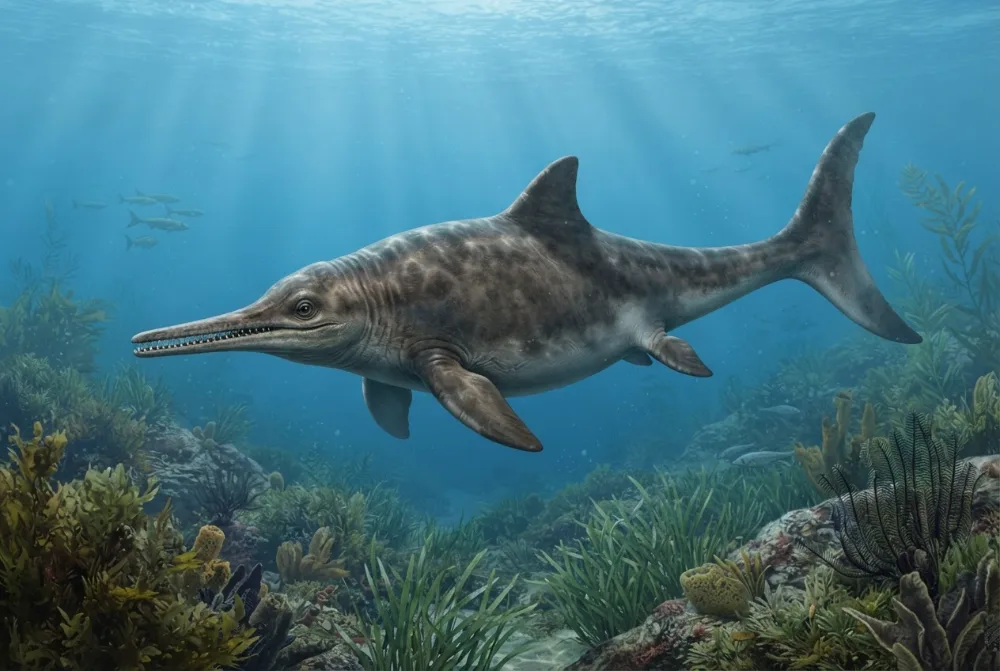
Mikadocephalus was a big, fish-shaped marine reptile that swam in warm seas during the Triassic Period. It was not a dinosaur, but a kind of ichthyosaur, with a long snout full of teeth for catching fish and squid.14
Kañ la dundoon?
Naka la réyoon?
Naka la guddoon?
 gudd ni 8 xaj, bakkan ba geen🍌gudd ni 44 banaana yu ñu topp-toppale🏊mënoon na féey guddaayu pisin bu mag (50 m) ci 4,6 segond
Naka la Mikadocephalus réyoon, bu ñu ko méngalee ak YAW?
Ay kalkil rekk ci sa navigatëer. Dara du ñu denc, dara du ñu yónne fenn.
Naka la gaawoon?


Xibaar yu neex
Mikadocephalus is known from a skull that was so crushed and jumbled that it looked like a game of pick-up sticks, which is how it got its name.1
It lived about 247 to 237 million years ago, during the Middle Triassic, making it one of the earliest big ichthyosaurs.4
Its fossils were found in the Besano Formation, which was once a warm, shallow lagoon with poor oxygen at the bottom.1
Scientists think Mikadocephalus might actually be the same animal as another ichthyosaur called Besanosaurus, because they look very similar.1
The species name gracilirostris means 'slender snout', because its jaws were long and thin.1
Laaj yi ñu gën a laaj ci Mikadocephalus
?How big was Mikadocephalus?
About 8 metres (26 feet) long, based on the largest known specimen of Besanosaurus, which scientists think is the same animal.2
?What did Mikadocephalus eat?
It ate small fish and squid, catching them with its long, slender snout and tiny pointed teeth.2
?Is Mikadocephalus a dinosaur?
No, it is not a dinosaur. It is a kind of ichthyosaur, a fish-shaped marine reptile that lived in the sea.1
?Why is it called Mikadocephalus?
Its name means 'Mikado head,' because its skull was so crushed and jumbled that it looked like a game of pick-up sticks.1
Ku tas léeb yu dul dëgg
Léeb: Some people think Mikadocephalus was a dinosaur because it lived long ago and had a long snout.
Dëgg: Mikadocephalus was an ichthyosaur, a marine reptile that lived in the sea. Ichthyosaurs are not dinosaurs.1
Ngir ñi xam dino lool
- Turu xam-xam
- Mikadocephalus
- Ku ko tudde
- Maisch and Matzke 19974
- Kurél
- Iktiyosoor yi
- Njaboot / klad
- Guanlingsauridae4
- Klasifikasiyoŋ
- Ichthyosauria > Ichthyosauromorpha4
- Màggaayu doj yi
- 247 ba 237 milyoŋ at ()4
- Formasiyoŋi doj
- Monte San Giorgio bituminous shales, Tschermakfjellet4
- Réew yi
- Suwis, Swalbaar4
- Fosil yu ñu gis
- 2 ci The Paleobiology Database4
- Gisees
- The skull was found in Switzerland, in the Besano Formation, and was named by Michael Maisch and Andreas Matzke in 1997.1
- Ñu ngi koy werante ba tey
- Scientists still debate whether Mikadocephalus is its own species or the same as Besanosaurus, since the skull is so crushed.1
Fa xibaar yi jóge
- Besanosaurus (en.wikipedia.org)
- Besanosaurus (Wikipedia) (Wikipedia)
- Cranial anatomy of Besanosaurus leptorhynchus Dal Sasso & Pinna, 1996 (Reptilia: Ichthyosauria) from the Middle Triassic Besano Formation of Monte San Giorgio, Italy/Switzerland: taxonomic and palaeobiological implications [PeerJ] (peerj.com)
- Mikadocephalus in The Paleobiology Database (CC BY 4.0): at, béréb yi, formasiyoŋi doj, klasifikasiyoŋ.
Bépp xibaar ci xët wii am na lim bu wone fa mu jóge. Su nu juumee, baal nu, nun ñu bëgg dino lanu, du ab sërnaalu xam-xam. Wax nu ko ci [email protected] nu defar ko.
 Rex xiif na! Dino Wiki, mbiru ab baay la ngir doomam ju góor ju bëgg dinosoor, ci neen te amul kaamuñaate, amul tracker. Mag ñi mën nañu jox Rex tuuti ñam ngir dimbali ko mu des ci internet.Dundal Rex
 Ichthyosaurus
 Platypterygius
 Stenopterygius
 Khudiakovia
 Ophthalmosaurus
 Chonespondylus
 Placodus
 Lariosaurus
 Cyamodus
 Cymatosaurus
 Proneusticosaurus
 Neusticosaurus