 Ban dino nga? Kiis
 Xeexu dino
 Rawante dino
 Fo yu ndaw yu dino
 Albomu sitikeer
 Limu TOP yu dino
 Bett ma!
Kañ la dundoon?

Naka la réyoon?
Naka la guddoon?
Naka la kawewoon?
jortu
Naka la diisoon?
 gudd ni 3 xaj, bakkan ba geen🍌gudd ni 17 banaana yu ñu topp-toppale🍉diis ni 70 xaal🧸diis ni 18 xale yu maternel🎒diis ni 11 xale yu lekkool🏃mënoon na daw 100 meetar ci 13 segond (nit ki gën a gaaw dafay soxla 9,6)
Naka la Neimongosaurus réyoon, bu ñu ko méngalee ak YAW?
Ay kalkil rekk ci sa navigatëer. Dara du ñu denc, dara du ñu yónne fenn.
Naka la gaawoon?


Xibaar yu neex
Neimongosaurus had one of the longest necks of any non-bird theropod, with about 14 neck vertebrae. That is more than most other meat-eating dinosaurs had.1
Its tail was fairly short, with only 22 tail vertebrae, which is unusual for a theropod.1
The front of its lower jaw was toothless, like a beak, and it had only a few teeth further back. This helped it eat plants.1
Its arm bones show a large bump for the biceps muscle, which may have given it strong arms for pulling branches.1
The vertebrae in its spine were hollow and filled with air spaces, a feature also seen in some advanced bird-like dinosaurs.2
Scientists think Neimongosaurus was closely related to oviraptorosaurs because of its long neck and short tail.2
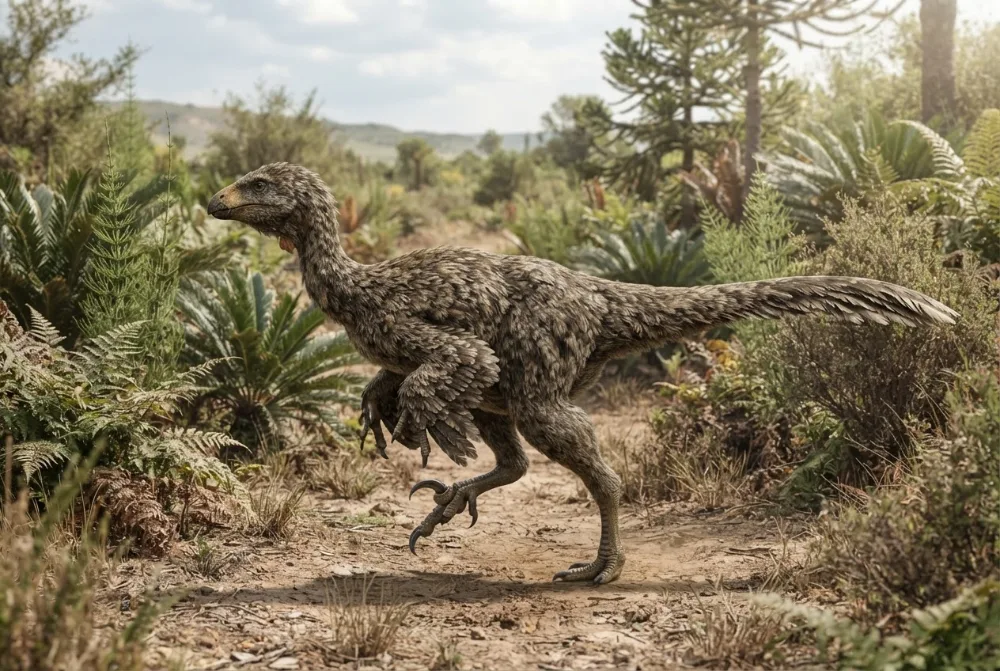
Laaj yi ñu gën a laaj ci Neimongosaurus
?How big was Neimongosaurus?
About 2 to 3 metres long. It weighed around 350 kg, which is about the weight of a small horse.1
?What did Neimongosaurus eat?
It ate plants. Its lower jaw had a toothless, beak-like front and only a few teeth with serrated edges in the back.1
?Did Neimongosaurus have feathers?
Scientists think it likely had feathers, because its relatives (therizinosaurs) are often shown with feathers, but no direct feather fossils have been found for this species.1
Ngir ñi xam dino lool
- Turu xam-xam
- Neimongosaurus
- Ku ko tudde
- Zhang et al. 20014
- Kurél
- Dino yu am dun yu doy waar
- Njaboot / klad
- Therizinosauridae4
- Klasifikasiyoŋ
- Theropoda > Therizinosauria4
- Màggaayu doj yi
- 86 ba 72 milyoŋ at (Santonian / Campanian)4
- Formasiyoŋi doj
- Iren Dabasu, Bostobe4
- Réew yi
- Siin, Kasakstaan4
- Fosil yu ñu gis
- 2 ci The Paleobiology Database4
- Gisees
- In 1999, a team from the Ministry of Land and Resources in Inner Mongolia found two skeletons at Sanhangobi, about 20 km southwest of Erenhot. In 2001, scientists named the new species Neimongosaurus yangi, honoring Chinese paleontologist Yang Zhongjian.1
- Ñu ngi koy werante ba tey
- Scientists are not sure exactly where Neimongosaurus sits on the family tree. Some studies place it outside the therizinosaurid group, while others put it inside, close to Therizinosaurus.1
Fa xibaar yi jóge
- Neimongosaurus (en.wikipedia.org)
- A LONG-NECKED THERIZINOSAUROID DINOSAUR FROM THE UPPER CRETACEOUS IREN DABASU FORMATION OF NEI MONGOL, PEOPL E’S REPUBLIC OF CHINA (vertpala.ac.cn)
- Neimongosaurus (en.wikipedia.org)
- Neimongosaurus in The Paleobiology Database (CC BY 4.0): at, béréb yi, formasiyoŋi doj, klasifikasiyoŋ.
Bépp xibaar ci xët wii am na lim bu wone fa mu jóge. Su nu juumee, baal nu, nun ñu bëgg dino lanu, du ab sërnaalu xam-xam. Wax nu ko ci [email protected] nu defar ko.
 Rex xiif na! Dino Wiki, mbiru ab baay la ngir doomam ju góor ju bëgg dinosoor, ci neen te amul kaamuñaate, amul tracker. Mag ñi mën nañu jox Rex tuuti ñam ngir dimbali ko mu des ci internet.Dundal Rex
 Therizinosaurus
 Oviraptor
 Chirostenotes
 Citipes
 Leptorhynchos
 Avimimus
 Tyrannosaurus
 Triceratops
 Velociraptor
 Spinosaurus
 Ankylosaurus
 Parasaurolophus