 Ban dino nga? Kiis
 Xeexu dino
 Rawante dino
 Fo yu ndaw yu dino
 Albomu sitikeer
 Limu TOP yu dino
 Bett ma!
Kañ la dundoon?

Naka la réyoon?
Naka la guddoon?
Naka la kawewoon?
Naka la diisoon?

 gudd ni 8 xaj, bakkan ba geen🍌gudd ni 44 banaana yu ñu topp-toppalediis ni 170 xaj🍉diis ni 680 xaal🎒diis ni 4 klaas yu mat yu xale yu lekkool🐻❄️diis ni 8 uurs yu weex🏃mënoon na daw 100 meetar ci 15 segond (nit ki gën a gaaw dafay soxla 9,6)
Naka la Olorotitan réyoon, bu ñu ko méngalee ak YAW?
Ay kalkil rekk ci sa navigatëer. Dara du ñu denc, dara du ñu yónne fenn.
Naka la gaawoon?


Xibaar yu neex
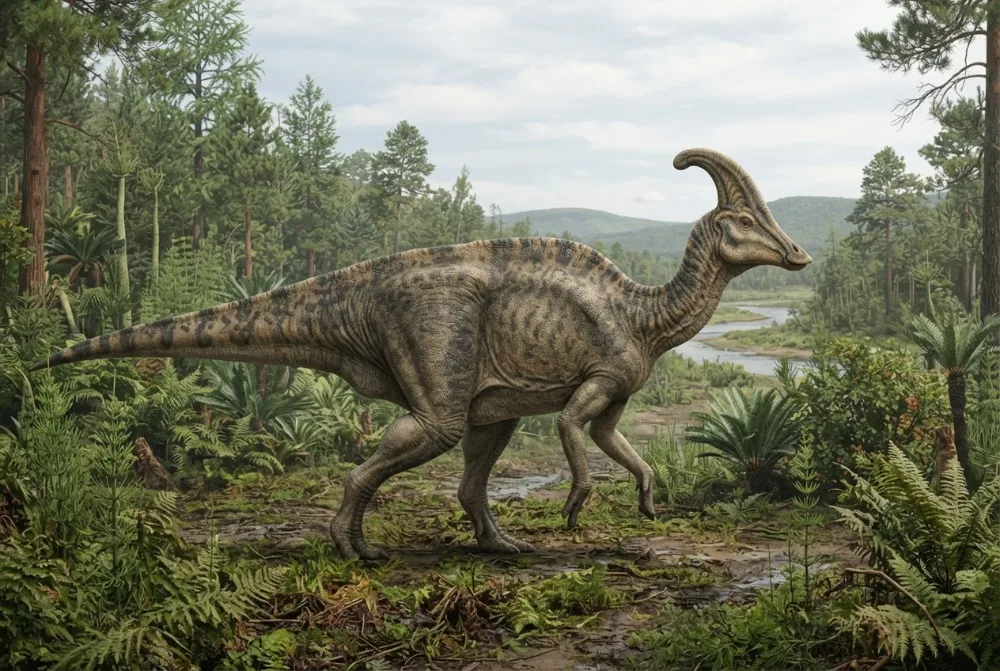
Olorotitan had a very long neck for a duck-billed dinosaur, with 18 neck bones. That is why its name means 'titanic swan'.12
Its hollow head crest was tall and helmet-shaped, made from expanded skull bones that held the nasal passages.12
The skeleton of Olorotitan is the most complete lambeosaurine (a type of duck-billed dinosaur) ever found outside North America.12
Olorotitan lived about 72 to 66 million years ago, during the Maastrichtian age of the Late Cretaceous.3
It was one of the last non-bird dinosaurs to go extinct, dying out in the great extinction event 66 million years ago.1
The tail of Olorotitan had extra connections between the bones in its upper part, which may have made that section stiff.2
Olorotitan is closely related to the North American dinosaurs Corythosaurus and Hypacrosaurus.2
Laaj yi ñu gën a laaj ci Olorotitan
?How big was Olorotitan?
Olorotitan grew up to 8 metres (26 feet) long, up to 3.5 metres (11 feet) tall, and weighed between 2.6 and 3.4 metric tons.1
?What did Olorotitan eat?
Olorotitan was a plant-eater. It used its strong beak and hundreds of constantly replaced teeth to grind tough plants.1
?When did Olorotitan live?
Olorotitan lived about 72 to 66 million years ago, during the Maastrichtian age of the Late Cretaceous. It was one of the last non-bird dinosaurs to go extinct.1
?Where was Olorotitan found?
Olorotitan fossils were found in the Amur region of eastern Russia, near the Amur River. The first nearly complete skeleton was discovered between 1999 and 2001.1
?Why did Olorotitan have a crest?
The tall, hollow crest on its head was made from skull bones that held the nasal passages. It probably helped Olorotitan identify others of its kind by sight and sound.1
?Is Olorotitan a dinosaur?
Yes, Olorotitan is a dinosaur. It is a type of duck-billed dinosaur called a lambeosaurine hadrosaurid.1
Ngir ñi xam dino lool
- Turu xam-xam
- Olorotitan
- Ku ko tudde
- Godefroit et al. 20033
- Kurél
- Gémmiñu kanaar
- Njaboot / klad
- Hadrosauridae3
- Klasifikasiyoŋ
- Ornithischia > Ornithopoda > Iguanodontia > Hadrosauridae3
- Màggaayu doj yi
- 72 ba 66 milyoŋ at (Maastrichtian)3
- Formasiyoŋi doj
- Udurchukan3
- Réew yi
- Riisi3
- Fosil yu ñu gis
- 1 ci The Paleobiology Database3
- Gisees
- Olorotitan was named by Pascal Godefroit and colleagues in 2003. The nearly complete skeleton was dug up between 1999 and 2001 in the Udurchukan Formation at Kundur, Russia.12
- Ñu ngi koy werante ba tey
- Scientists are not sure if the extra connections between the tail bones were a normal feature or a sign of disease.2
Fa xibaar yi jóge
- Olorotitan (en.wikipedia.org)
- doi:10.1016/S1631-0683(03)00017-4 (sciencepress.mnhn.fr)
- Olorotitan in The Paleobiology Database (CC BY 4.0): at, béréb yi, formasiyoŋi doj, klasifikasiyoŋ.
Bépp xibaar ci xët wii am na lim bu wone fa mu jóge. Su nu juumee, baal nu, nun ñu bëgg dino lanu, du ab sërnaalu xam-xam. Wax nu ko ci [email protected] nu defar ko.
 Rex xiif na! Dino Wiki, mbiru ab baay la ngir doomam ju góor ju bëgg dinosoor, ci neen te amul kaamuñaate, amul tracker. Mag ñi mën nañu jox Rex tuuti ñam ngir dimbali ko mu des ci internet.Dundal Rex
 Parasaurolophus
 Edmontosaurus
 Saurolophus
 Hypacrosaurus
 Corythosaurus
 Kritosaurus
 Tyrannosaurus
 Triceratops
 Velociraptor
 Spinosaurus
 Ankylosaurus
 Pteranodon