 Ban dino nga? Kiis
 Xeexu dino
 Rawante dino
 Fo yu ndaw yu dino
 Albomu sitikeer
 Limu TOP yu dino
 Bett ma!
Paralitherizinosaurus
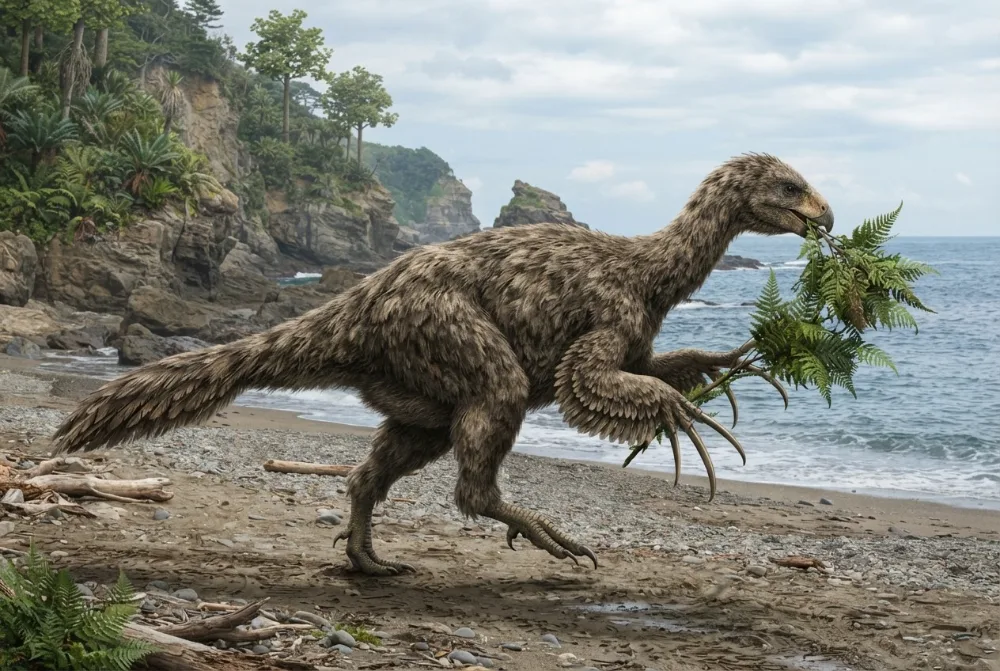
Paralitherizinosaurus was a strange, plant-eating dinosaur with long, curved claws on its hands. It lived near the coast of ancient Japan and used its claws to pull leaves and branches toward its mouth. This dinosaur was covered in feathers and looked a bit like a giant, slow-moving bird.14
Kañ la dundoon?
Naka la réyoon?
Naka la guddoon?
Naka la kawewoon?
jortu
Naka la diisoon?
 gudd ni 4 xaj, bakkan ba geen🍌gudd ni 20 banaana yu ñu topp-toppale🍉diis ni 56 xaal🧸diis ni 15 xale yu maternel🎒diis ni 9 xale yu lekkool🏃mënoon na daw 100 meetar ci 13 segond (nit ki gën a gaaw dafay soxla 9,6)
Naka la Paralitherizinosaurus réyoon, bu ñu ko méngalee ak YAW?
Ay kalkil rekk ci sa navigatëer. Dara du ñu denc, dara du ñu yónne fenn.
Naka la gaawoon?


Xibaar yu neex
Paralitherizinosaurus is the youngest therizinosaur ever found in Japan, living about 83 to 72 million years ago.1
Its fossils were discovered in a marine rock layer, meaning it lived near the coast and its body washed out to sea after death.1
Only a partial hand and a single vertebra have been found, but those bones show it had very slender, curved claws like its relative Therizinosaurus.1
The first bone of its thumb (metacarpal I) was flattened from top to bottom, a unique feature that helps scientists tell it apart from other dinosaurs.1
Its claws had weak flexor tubercles (the bump where a muscle attaches), which means it used a hook-and-pull motion to bring branches to its mouth, not to slash or stab.1
Paralitherizinosaurus is one of the few therizinosaurs found in marine sediments anywhere in the world, along with Nothronychus from North America.1
Laaj yi ñu gën a laaj ci Paralitherizinosaurus
?What did Paralitherizinosaurus eat?
It was a plant-eater. It used its long, curved claws to hook and pull leaves and branches toward its mouth.1
?How big was Paralitherizinosaurus?
Nobody knows for sure because only a partial hand and a neck bone have been found. It was probably medium-sized, but its exact size is unknown.3
?Did Paralitherizinosaurus have feathers?
Yes, it was a feathered theropod dinosaur, related to other feathered dinosaurs like Therizinosaurus. It probably looked like a big, slow-moving bird.3
Ngir ñi xam dino lool
- Turu xam-xam
- Paralitherizinosaurus
- Ku ko tudde
- Kobayashi et al. 20224
- Kurél
- Dino yu am dun yu doy waar
- Njaboot / klad
- Therizinosauridae4
- Klasifikasiyoŋ
- Theropoda > Therizinosauria4
- Màggaayu doj yi
- 84 ba 72 milyoŋ at (Campanian)4
- Formasiyoŋi doj
- Osoushinai4
- Réew yi
- Sapoŋ4
- Fosil yu ñu gis
- 1 ci The Paleobiology Database4
- Gisees
- The first fossils of Paralitherizinosaurus were found in a concretion (a hard rock nodule) near a river in Hokkaido, Japan. Scientists Murakami and colleagues first described the bones in 2008, but it was not until 2022 that Kobayashi and his team named it as a new species.1
- Ñu ngi koy werante ba tey
- Scientists are not sure exactly where Paralitherizinosaurus fits on the therizinosaur family tree. It might be closely related to Therizinosaurus, Suzhousaurus, and another unnamed form from the Bissekty Formation, but the relationships are still debated.1
Fa xibaar yi jóge
- New therizinosaurid dinosaur from the marine Osoushinai Formation (Upper Cretaceous, Japan) provides insight for function and evolution of therizinosaur claws (pmc.ncbi.nlm.nih.gov)
- Paralitherizinosaurus japonicus | Dinosaur Database by DinoAnimals.com (dinoanimals.com)
- Paralitherizinosaurus (en.wikipedia.org)
- Paralitherizinosaurus in The Paleobiology Database (CC BY 4.0): at, béréb yi, formasiyoŋi doj, klasifikasiyoŋ.
Bépp xibaar ci xët wii am na lim bu wone fa mu jóge. Su nu juumee, baal nu, nun ñu bëgg dino lanu, du ab sërnaalu xam-xam. Wax nu ko ci [email protected] nu defar ko.
 Rex xiif na! Dino Wiki, mbiru ab baay la ngir doomam ju góor ju bëgg dinosoor, ci neen te amul kaamuñaate, amul tracker. Mag ñi mën nañu jox Rex tuuti ñam ngir dimbali ko mu des ci internet.Dundal Rex
 Therizinosaurus
 Oviraptor
 Chirostenotes
 Citipes
 Leptorhynchos
 Avimimus
 Tyrannosaurus
 Triceratops
 Velociraptor
 Spinosaurus
 Ankylosaurus
 Parasaurolophus