 Ban dino nga? Kiis
 Xeexu dino
 Rawante dino
 Fo yu ndaw yu dino
 Albomu sitikeer
 Limu TOP yu dino
 Bett ma!
Pararcus
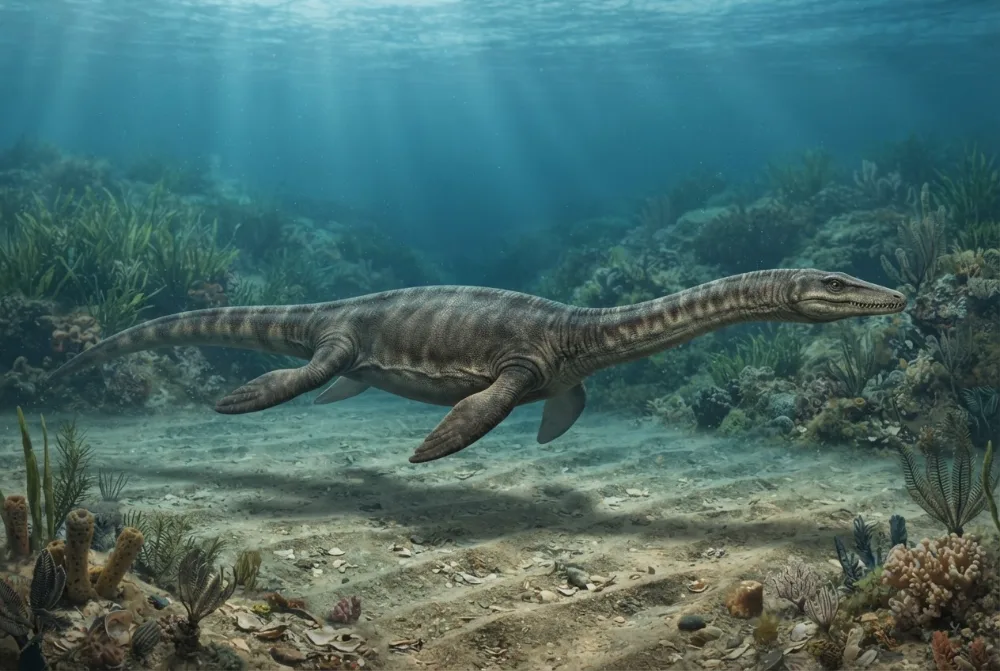
Pararcus was a marine reptile that lived in the shallow seas of the Netherlands about 245 million years ago. It had a flat body and strong, paddle-like limbs for swimming. Unlike many other placodonts, it did not have a heavy shell on its back.12
Kañ la dundoon?
Naka la réyoon?
Naka la guddoon?
 gudd ni 2,5 muusu kër, bakkan ba geen🍌gudd ni 8 banaana yu ñu topp-toppale🏊mënoon na féey guddaayu pisin bu mag (50 m) ci 16 segond
Naka la Pararcus réyoon, bu ñu ko méngalee ak YAW?
Ay kalkil rekk ci sa navigatëer. Dara du ñu denc, dara du ñu yónne fenn.
Naka la gaawoon?


Xibaar yu neex
Pararcus had a special backbone where the neural arches (the parts that protect the spinal cord) were not fused together, even in adults. This is called paedomorphosis and is common in animals that live in the sea.1
Its hip bones (pubis and ischium) were flat and plate-like, which helped it swim efficiently.1
The only known fossil of Pararcus was found by a fossil collector named Gerben Diepenbroek, and the species is named after him.1
Pararcus lived during the Middle Triassic period, about 247 to 241 million years ago, when the Netherlands was covered by a shallow sea.2
Unlike some other placodonts that had heavy armour plates, Pararcus only had a few small, unfused armour plates scattered in its skin.1
The vertebrae of Pararcus were deeply hollowed out on both ends (amphicoelous) and still had a notochord, a flexible rod that runs through the spine.1
Ngir ñi xam dino lool
- Turu xam-xam
- Pararcus
- Ku ko tudde
- Klein and Scheyer 20142
- Kurél
- Reptil yu géej
- Njaboot / klad
- Placodontia2
- Klasifikasiyoŋ
- Placodontia > Sauropterygia2
- Màggaayu doj yi
- 247 ba 241 milyoŋ at ()2
- Formasiyoŋi doj
- Vossenveld2
- Réew yi
- Olaand2
- Fosil yu ñu gis
- 1 ci The Paleobiology Database2
- Gisees
- Pararcus was named in 2014 by Nicole Klein and Torsten Scheyer. The only fossil was found by Gerben Diepenbroek in a quarry near Winterswijk, the Netherlands.21
- Ñu ngi koy werante ba tey
- Scientists are not sure exactly how Pararcus swam. Its flexible backbone and flat hip bones suggest it might have moved differently from other placodonts.1
Fa xibaar yi jóge
- Klein_20120147.indd (zora.uzh.ch)
- Pararcus in The Paleobiology Database (CC BY 4.0): at, béréb yi, formasiyoŋi doj, klasifikasiyoŋ.
Bépp xibaar ci xët wii am na lim bu wone fa mu jóge. Su nu juumee, baal nu, nun ñu bëgg dino lanu, du ab sërnaalu xam-xam. Wax nu ko ci [email protected] nu defar ko.
 Rex xiif na! Dino Wiki, mbiru ab baay la ngir doomam ju góor ju bëgg dinosoor, ci neen te amul kaamuñaate, amul tracker. Mag ñi mën nañu jox Rex tuuti ñam ngir dimbali ko mu des ci internet.Dundal Rex
 Nothosaurus
 Placodus
 Lariosaurus
 Cyamodus
 Cymatosaurus
 Proneusticosaurus
 Chonespondylus
 Cymbospondylus
 Phalarodon
 Mixosaurus
 Chaohusaurus
 Chensaurus