 Ban dino nga? Kiis
 Xeexu dino
 Rawante dino
 Fo yu ndaw yu dino
 Albomu sitikeer
 Limu TOP yu dino
 Bett ma!
Kañ la dundoon?

Naka la réyoon?
Naka la guddoon?
Naka la kawewoon?
jortu
Naka la diisoon?

 gudd ni 2,5 xaj, bakkan ba geen🍌gudd ni 14 banaana yu ñu topp-toppale🍉diis ni 6 xaal🏃mënoon na daw 100 meetar ci 6,2 segond (nit ki gën a gaaw dafay soxla 9,6)
Naka la Pelecanimimus réyoon, bu ñu ko méngalee ak YAW?
Ay kalkil rekk ci sa navigatëer. Dara du ñu denc, dara du ñu yónne fenn.
Naka la gaawoon?


Xibaar yu neex
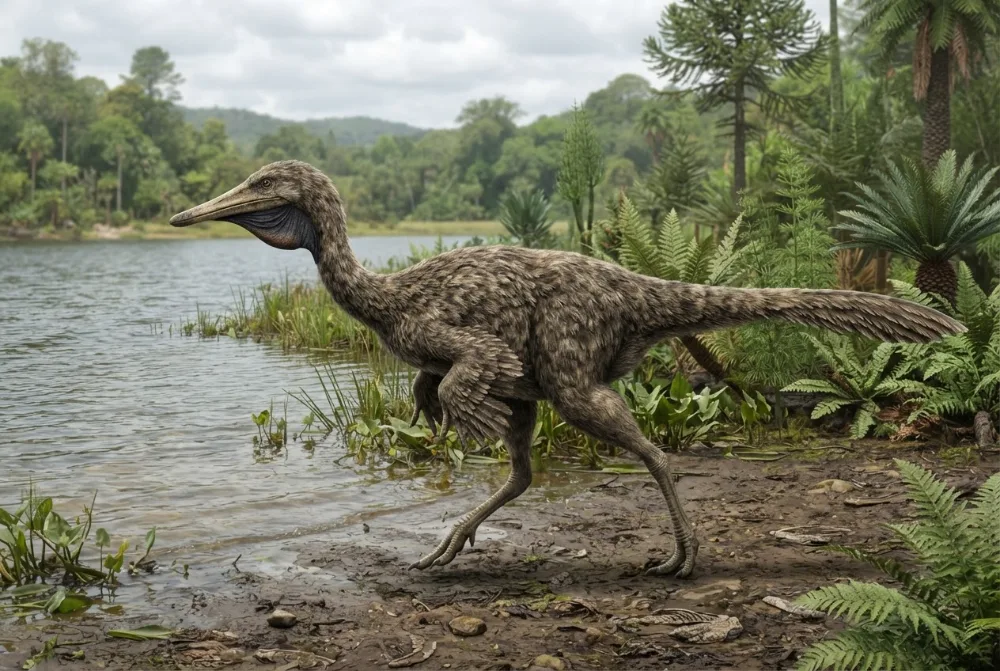
Pelecanimimus had about 220 tiny teeth in its mouth, more than any other meat-eating dinosaur.1
Its teeth were different shapes: front teeth were broad and D-shaped, while back teeth were blade-like.1
It also had a small crest on the back of its head, made of skin or keratin.1
Pelecanimimus lived about 125 million years ago during the Early Cretaceous in what is now Spain.13
Only the front half of one skeleton has been found, but it includes amazing details like skin impressions and throat bones.1
Laaj yi ñu gën a laaj ci Pelecanimimus
?How big was Pelecanimimus?
About 1.9 to 2.5 metres long and weighed 17 to 30 kilograms. That is about as long as a large bicycle.12
?What did Pelecanimimus eat?
It was carnivorous, meaning it ate meat. It probably waded in lakes or ponds to catch fish with its claws and many teeth, storing them in its throat pouch.12
?Did Pelecanimimus have feathers?
No, the preserved skin impressions show wrinkled skin that lacked scales or feathers. Some filament-like structures were once thought to be feathers, but they are now seen as muscle fibers.1
?When did Pelecanimimus live?
It lived during the Early Cretaceous period, about 127 to 121 million years ago.2
Ku tas léeb yu dul dëgg
Léeb: Some people think Pelecanimimus could fly because of its large chest bones.
Dëgg: Scientists are not sure, but most think it was a ground dinosaur, not a flier.1
Ngir ñi xam dino lool
- Turu xam-xam
- Pelecanimimus
- Ku ko tudde
- Pérez-Moreno et al. 19943
- Kurél
- Dino yu niru otris
- Njaboot / klad
- Ornithomimosauria3
- Klasifikasiyoŋ
- Theropoda > Ornithomimosauria3
- Màggaayu doj yi
- 126 ba 121 milyoŋ at (Barremian)3
- Formasiyoŋi doj
- La Huérguina3
- Réew yi
- Españ3
- Fosil yu ñu gis
- 1 ci The Paleobiology Database3
- Gisees
- Armando Díaz Romeral found the first skeleton in 1993 in Spain. Scientists named it Pelecanimimus polyodon in 1994.12
- Ñu ngi koy werante ba tey
- Scientists still debate whether Pelecanimimus could fly or if its large chest muscles were for something else.1
Fa xibaar yi jóge
- Pelecanimimus (en.wikipedia.org)
- Pelecanimimus | Natural History Museum (nhm.ac.uk)
- Pelecanimimus in The Paleobiology Database (CC BY 4.0): at, béréb yi, formasiyoŋi doj, klasifikasiyoŋ.
Bépp xibaar ci xët wii am na lim bu wone fa mu jóge. Su nu juumee, baal nu, nun ñu bëgg dino lanu, du ab sërnaalu xam-xam. Wax nu ko ci [email protected] nu defar ko.
 Rex xiif na! Dino Wiki, mbiru ab baay la ngir doomam ju góor ju bëgg dinosoor, ci neen te amul kaamuñaate, amul tracker. Mag ñi mën nañu jox Rex tuuti ñam ngir dimbali ko mu des ci internet.Dundal Rex
 Gallimimus
 Ornithomimus
 Struthiomimus
 Deinocheirus
 Dromiceiomimus
 Archaeornithomimus
 Stegosaurus
 Iguanodon
 Archaeopteryx
 Giganotosaurus
 Microraptor
 Deinonychus