 Ban dino nga? Kiis
 Xeexu dino
 Rawante dino
 Fo yu ndaw yu dino
 Albomu sitikeer
 Limu TOP yu dino
 Bett ma!
Portunatasaurus
Portunatasaurus was a small marine lizard that swam in warm seas during the time of the dinosaurs. It was only about 1 meter long, as long as a big skateboard, and had a long body and special flipper-like arms.12
Kañ la dundoon?
Naka la réyoon?
Naka la guddoon?
 gudd ni 2 muusu kër, bakkan ba geen🍌gudd ni 6 banaana yu ñu topp-toppale🏊mënoon na féey guddaayu pisin bu mag (50 m) ci 15 segond
Naka la Portunatasaurus réyoon, bu ñu ko méngalee ak YAW?
Ay kalkil rekk ci sa navigatëer. Dara du ñu denc, dara du ñu yónne fenn.
Naka la gaawoon?


Xibaar yu neex
Portunatasaurus had 10 small bones in its wrist, like land lizards, but also a flattened first finger bone like later sea lizards.2
Its arm was a mix between a walking leg and a swimming paddle, showing how lizards slowly turned into sea swimmers.2
The only skeleton found was almost complete from the neck to the hips, with a perfectly preserved right arm.2
It lived about 100 to 90 million years ago, during the Cenomanian and Turonian ages of the Late Cretaceous.3
Portunatasaurus is the third and youngest aigialosaur (a type of early marine lizard) found in Croatia.2
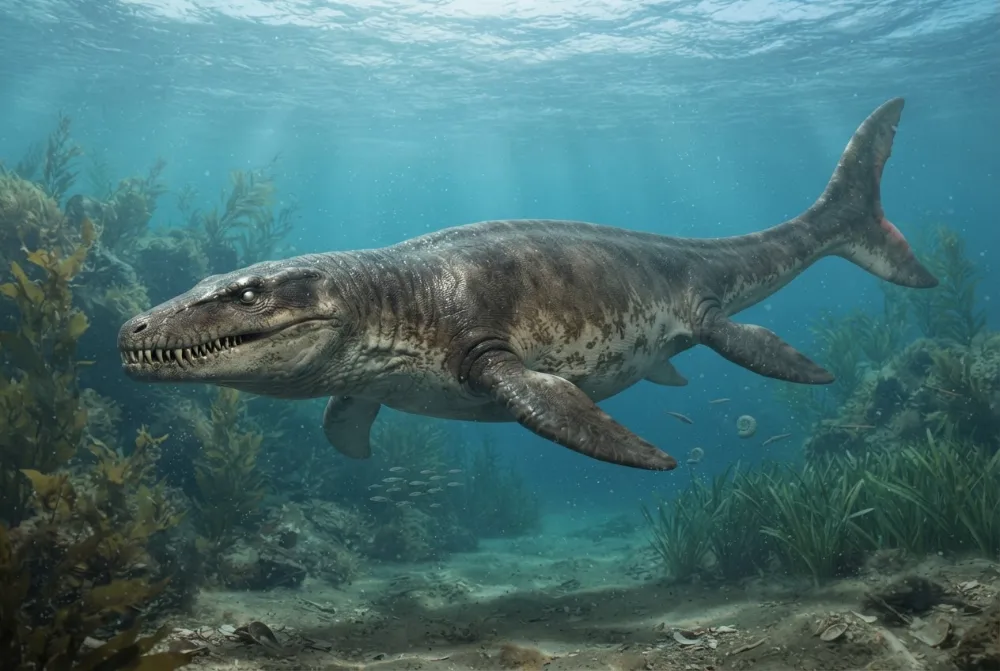
Laaj yi ñu gën a laaj ci Portunatasaurus
Ngir ñi xam dino lool
- Turu xam-xam
- Portunatasaurus
- Ku ko tudde
- Campbell Mekarski et al. 20194
- Kurél
- Mosasoor yi
- Njaboot / klad
- Mosasauroidea4
- Klasifikasiyoŋ
- Mosasauroidea4
- Màggaayu doj yi
- 100 ba 90 milyoŋ at (Cenomanian / Turonian)4
- Réew yi
- Kroasi4
- Fosil yu ñu gis
- 1 ci The Paleobiology Database4
- Gisees
- The skeleton was found in 2008 on the island of Dugi Otok in Croatia. Scientists Michelle Mekarski, Dražen Japundžić, Katarina Krizmanić and Michael Caldwell named it Portunatasaurus krambergeri in 2019.12
- Ñu ngi koy werante ba tey
- Scientists are still debating whether its paddle-like arm evolved earlier in mosasaur history or evolved more than once.2
Fa xibaar yi jóge
- Portunatasaurus (en.wikipedia.org)
- Description of a new basal mosasauroid from the Late Cretaceous of Croatia, with comments on the evolution of the mosasauroid forelimb (exa.ai)
- PBDB Taxon (paleobiodb.org)
- Portunatasaurus in The Paleobiology Database (CC BY 4.0): at, béréb yi, formasiyoŋi doj, klasifikasiyoŋ.
Bépp xibaar ci xët wii am na lim bu wone fa mu jóge. Su nu juumee, baal nu, nun ñu bëgg dino lanu, du ab sërnaalu xam-xam. Wax nu ko ci [email protected] nu defar ko.
 Rex xiif na! Dino Wiki, mbiru ab baay la ngir doomam ju góor ju bëgg dinosoor, ci neen te amul kaamuñaate, amul tracker. Mag ñi mën nañu jox Rex tuuti ñam ngir dimbali ko mu des ci internet.Dundal Rex
 Mosasaurus
 Prognathodon
 Tylosaurus
 Platecarpus
 Clidastes
 Globidens
 Tyrannosaurus
 Triceratops
 Velociraptor
 Spinosaurus
 Ankylosaurus
 Parasaurolophus