 Ban dino nga? Kiis
 Xeexu dino
 Rawante dino
 Fo yu ndaw yu dino
 Albomu sitikeer
 Limu TOP yu dino
 Bett ma!
Prosaurolophus
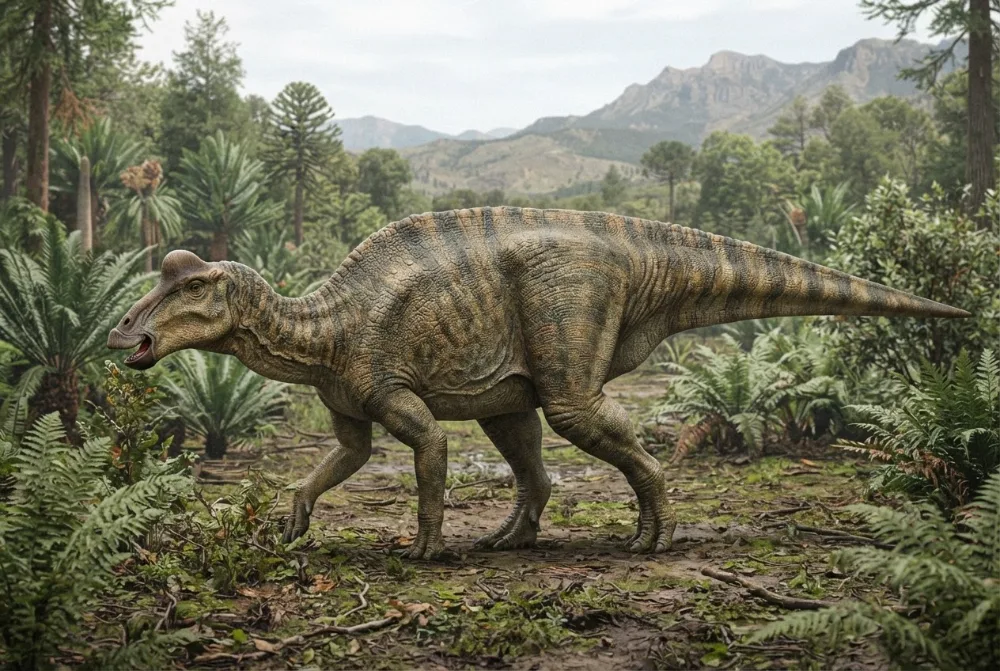
Prosaurolophus was a duck-billed dinosaur that lived in North America about 75 million years ago. It had a small, solid bump on its nose that looked like a little hat. This gentle giant munched on plants and could walk on two legs or all fours.1
Kañ la dundoon?
Naka la réyoon?
Naka la guddoon?
Naka la kawewoon?
jortu
Naka la diisoon?

 gudd ni 8 xaj, bakkan ba geen🍌gudd ni 47 banaana yu ñu topp-toppalediis ni 150 xaj🍉diis ni 600 xaal🎒diis ni 4 klaas yu mat yu xale yu lekkool🐻❄️diis ni 7 uurs yu weex🏃mënoon na daw 100 meetar ci 15 segond (nit ki gën a gaaw dafay soxla 9,6)
Naka la Prosaurolophus réyoon, bu ñu ko méngalee ak YAW?
Ay kalkil rekk ci sa navigatëer. Dara du ñu denc, dara du ñu yónne fenn.
Naka la gaawoon?


Xibaar yu neex
Prosaurolophus had a small, triangular crest on its head made of bone, but scientists think it might have had inflatable nose sacs for display.1
Fossils of at least 25 individuals have been found, including some in a bonebed that suggests they lived together in groups near water.1
Its teeth were packed into dental batteries with hundreds of teeth, and they were replaced throughout its life.1
Prosaurolophus could probably walk on two legs or all fours, and it could reach plants up to 4 metres (13 feet) high.1
It lived in a warm, swampy environment with rivers and floodplains, alongside horned dinosaurs like Centrosaurus and the tyrannosaur Gorgosaurus.1
Laaj yi ñu gën a laaj ci Prosaurolophus
?How big was Prosaurolophus?
About 8.5 metres (28 feet) long and weighed around 3 tonnes (3.3 tons). Its skull was about 0.9 metres (3 feet) long.1
?What did Prosaurolophus eat?
It was a herbivore that ate plants like conifer trees and tree bark, using its broad beak to crop food and hundreds of teeth to grind it.1
?Did Prosaurolophus have a crest?
Yes, it had a small, triangular crest on its forehead made of bone. Scientists think it might also have had inflatable nose sacs for display.13
?When did Prosaurolophus live?
It lived during the Late Cretaceous period, about 75.7 to 74.1 million years ago.1
?Where was Prosaurolophus found?
Fossils have been found in Alberta, Canada, and Montana, USA, in the Dinosaur Park Formation and Two Medicine Formation.12
?Did Prosaurolophus live in groups?
Yes, a bonebed of several individuals suggests they lived together in groups, possibly gathering near water during droughts.1
Ngir ñi xam dino lool
- Turu xam-xam
- Prosaurolophus
- Ku ko tudde
- Brown 19164
- Kurél
- Gémmiñu kanaar
- Njaboot / klad
- Hadrosauridae4
- Klasifikasiyoŋ
- Ornithischia > Ornithopoda > Iguanodontia > Hadrosauridae4
- Màggaayu doj yi
- 84 ba 66 milyoŋ at (Campanian / Maastrichtian)4
- Formasiyoŋi doj
- Dinosaur Park, Two Medicine, Bearpaw Shale4
- Réew yi
- Kanadaa, Amerig4
- Fosil yu ñu gis
- 15 ci The Paleobiology Database4
- Gisees
- American paleontologist Barnum Brown found a skull in Alberta, Canada in 1915 and named Prosaurolophus maximus in 1916.1
- Ñu ngi koy werante ba tey
- Scientists are not sure if the small crest was used for display or if it supported soft tissue like inflatable nose sacs.1
Fa xibaar yi jóge
- Prosaurolophus (en.wikipedia.org)
- Prosaurolophus | Natural History Museum (nhm.ac.uk)
- Local juvenile duck-billed dinosaur fossil discovery reveals new details about its appearance | News | University of Calgary (news.ucalgary.ca)
- Prosaurolophus in The Paleobiology Database (CC BY 4.0): at, béréb yi, formasiyoŋi doj, klasifikasiyoŋ.
Bépp xibaar ci xët wii am na lim bu wone fa mu jóge. Su nu juumee, baal nu, nun ñu bëgg dino lanu, du ab sërnaalu xam-xam. Wax nu ko ci [email protected] nu defar ko.
 Rex xiif na! Dino Wiki, mbiru ab baay la ngir doomam ju góor ju bëgg dinosoor, ci neen te amul kaamuñaate, amul tracker. Mag ñi mën nañu jox Rex tuuti ñam ngir dimbali ko mu des ci internet.Dundal Rex
 Parasaurolophus
 Edmontosaurus
 Saurolophus
 Hypacrosaurus
 Corythosaurus
 Kritosaurus
 Tyrannosaurus
 Triceratops
 Velociraptor
 Spinosaurus
 Ankylosaurus
 Pteranodon